It depends on the job. On independent tests, Anthropic's Claude Fable 5.2 scores higher than OpenAI's GPT-6.2 Astra, 65 against 62, at the same list price of $8 and $40 per million tokens, and costs 6.6 times more per task. Claude Opus 5.5 beats GPT-6.2 Sol on strategy, finance and code that has to merge, and Sol wins on automation and CAD at about a tenth of the cost. OpenAI released Astra and Sol on 17 November 2026, eight days after Fable 5.2. Below: what OpenAI announced, how the two pairs compare on cost and on real work, why the two products keep converging, and how a company can choose without switching at every launch. Prices and scores as of 18 November 2026.
The short version
- GPT-6.2 Astra and Sol run in ChatGPT Work and Codex on Plus, Pro, Business, Enterprise and Edu plans, and in the API. Neither is in regular ChatGPT chat.
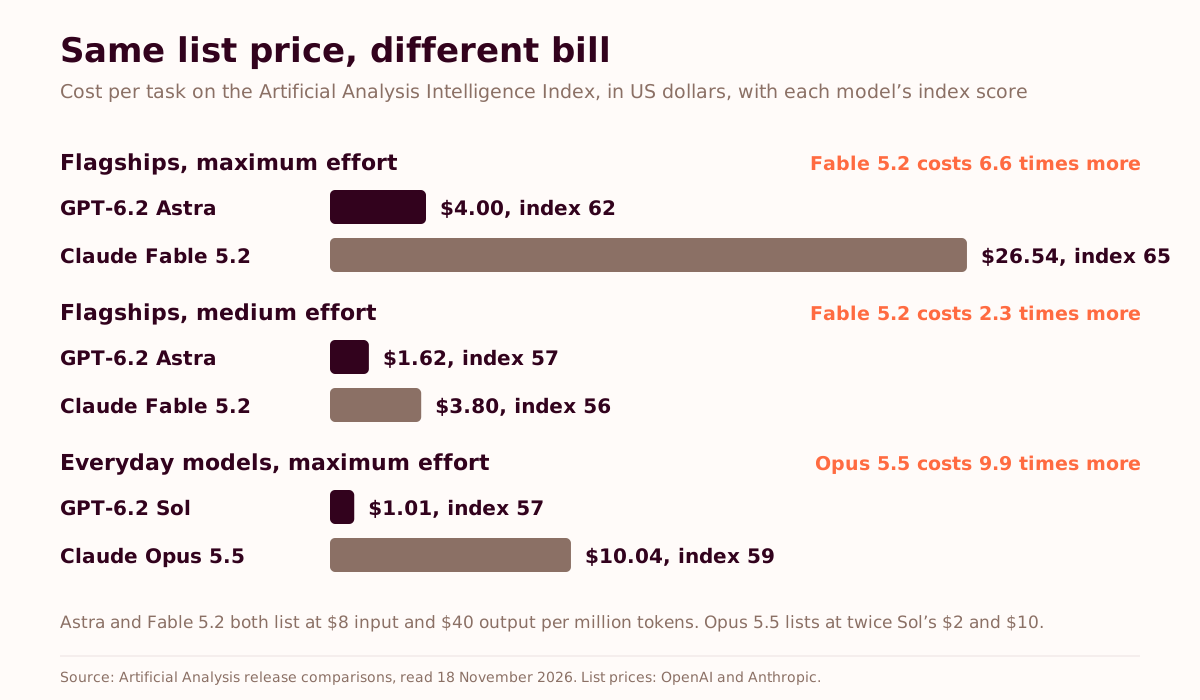
- Astra and Claude Fable 5.2 list at the same $8 and $40 per million tokens. On Artificial Analysis's runs, Fable scores 65 against Astra's 62 and costs 6.6 times more per task at maximum effort.
- GPT-6.2 Sol against Claude Opus 5.5: Opus leads on strategy, finance, office deliverables and code that has to merge. Sol leads on automation and CAD, at about a tenth of the cost per task.
- Early testers called Astra uneven and hard to steer, and praised its 3D work. Independent coding scores didn't move.
- Team seats cost the same on both sides: $25 a month, or $20 on annual billing.
- The features keep converging, down to Claude renaming Customize to Plugins. Choose on your work mix and your data rules, then test on your own tasks.
"Are we on the right tool?"
If you run AI adoption in a company, the message probably came in this week. A link to OpenAI's launch post, forwarded by someone senior, with one line on top: are we on the right tool?
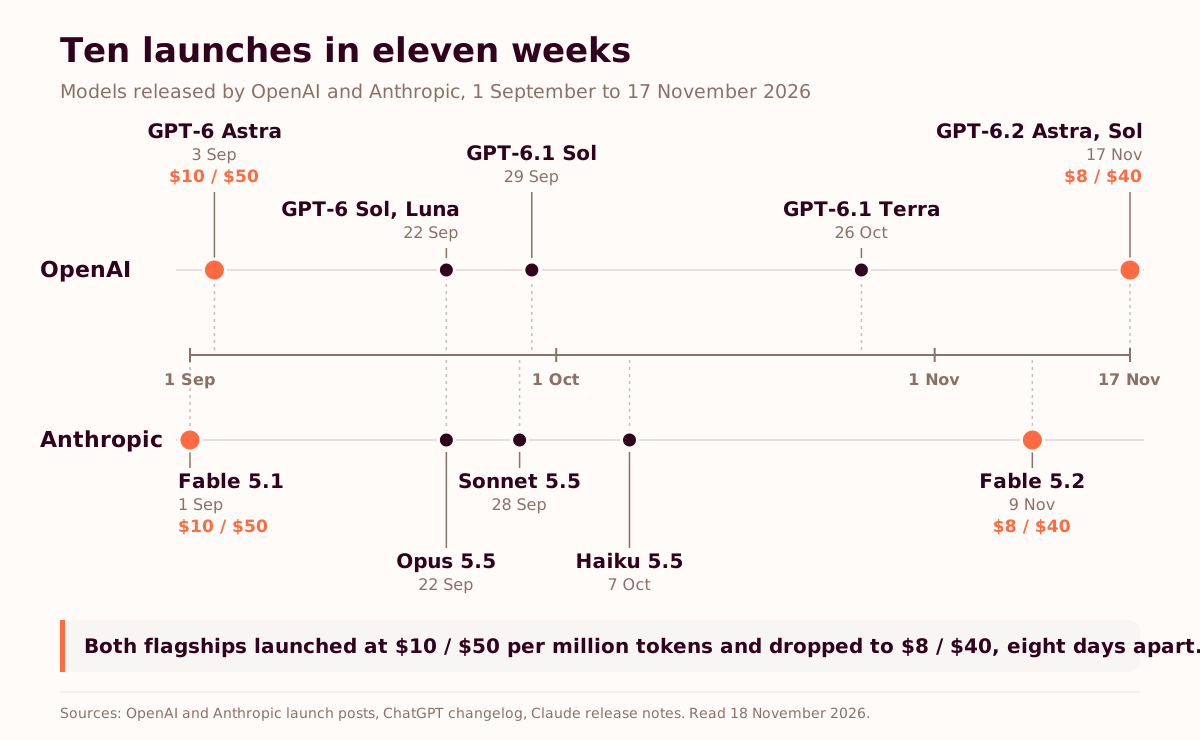
It's a fair question, and it keeps coming back. OpenAI and Anthropic released ten models between 1 September and 17 November 2026, and most launch posts came with a chart where the new model sits on top.
This launch is worth reading closely for one reason. For the first time, the two flagships list at exactly the same price. That makes the comparison clean, and it shows how little a price list tells you.
What did OpenAI announce on 17 November 2026?
OpenAI announced two models on 17 November 2026: GPT-6.2 Astra, "our new frontier model for your hardest projects", and GPT-6.2 Sol, "our efficient, versatile model for everyday work" (OpenAI). Both run in ChatGPT Work and Codex, and in the API as gpt-6.2-astra and gpt-6.2-sol.
- Who gets them: Plus, Pro, Business, Enterprise and Edu plans. Enterprise and Edu admins have to switch the models on first (ChatGPT Learn).
- Where they don't run: regular ChatGPT chat. "To use GPT-6.2 Astra or Sol in ChatGPT, open Work," says OpenAI's own guide.
- The default: new Work chats open on Sol, at Light reasoning effort on consumer plans and Medium on Enterprise.
- The price: Astra drops 20% to $8 per million input tokens and $40 per million output. Sol keeps GPT-6.1 Sol's $2 and $10 (OpenAI).
- Speed: an Ultrafast mode on both models in the API. In ChatGPT, Pro 500 subscribers get it on both models and Pro 200 subscribers on Sol.
The timing is the story. Claude Fable 5.2 came out on 9 November at the same $8 and $40, and Google opened Gemini 4 Carbon to the public on 10 November (VentureBeat). For the previous OpenAI flagship, our guide to GPT-6 Astra at work covers how non-technical teams get useful output from it.
What is supposed to be better in GPT-6.2 Astra and Sol?
OpenAI's pitch is efficiency: better results on demanding work with fewer output tokens, so the same plan or budget goes further. Astra is sold on professional deliverables, coding, 3D and computer use. Sol is sold as the model that finishes more tasks on the same subscription.
| What OpenAI claims | OpenAI's evidence |
|---|---|
| Same work, fewer tokens | GDPval v2, long assignments from real projects in consulting, finance and design: Astra up 6.2 points on GPT-6 Astra with 22% fewer output tokens |
| Decks, workbooks and documents that follow your template | Slides rebuilt from a screenshot "down to the exact font size". Harvey's legal benchmark: 15.0% strict pass rate, against 8.6% for GPT-6 Astra |
| Better websites, 3D and CAD | AA-3D, a blind human vote: Astra 1,318 Elo, Claude Fable 5.2 1,271, Sol 1,259. BenchCAD 2.1: 82.5% against 62.6% for GPT-6 Astra |
| More precise computer use | Demos in CAD and simulation tools, including a car's suspension modelled in Python and animated in Blender |
| Sol finishes more per plan | "Lets you complete more tasks on the same paid plan." Within 0.5 points of Astra on FrontierCode 2.0 at about a fifth of the cost |
| Cheaper than Claude per task | Agents' Last Exam: Astra "5.5 points ahead of Claude Fable 5.2 at just 5% of the cost" |
Claims and figures from OpenAI's launch post, 17 November 2026. All of them are OpenAI's own runs, except AA-3D, which Artificial Analysis runs with human judges. Harvey pass rates via VentureBeat.
What the independent numbers say
Artificial Analysis, which runs the same tests on every model and publishes its method, puts GPT-6.2 Astra second on its Intelligence Index at 62, behind Claude Fable 5.2 at 65. GPT-6.2 Sol scores 57 (Artificial Analysis).
Coding didn't move. On the Artificial Analysis Coding Agent Index, Astra is flat against GPT-6 Astra and Sol loses 3 points against GPT-6.1 Sol, mostly because it more often leaves important facts out when it answers questions about a codebase.
Astra leads on interactive 3D and on a robotics preview, and OpenAI's models now hold most of the cost-per-task frontier. Astra also guesses. When it doesn't know a factual answer, it makes one up 59% of the time at maximum effort, and Sol 55% of the time, on the AA-Omniscience test (Artificial Analysis).
What the early testers say
The reception was rough. Matt Shumer, former CEO of HyperWrite, called the models "essentially unusable" for delegated work. Developer Theo Browne called Astra "the worst model OpenAI has ever released". Ethan Mollick found it "very uneven & weird" and harder to steer than rival models (VentureBeat, Mollick on X).
Shumer gave Astra work as a sub-agent under Claude models, and the Claude models redid it. At Every, Dan Shipper's team tested both models for weeks: Astra matched its predecessor on most of their coding tests, often stopped early on end-to-end builds, and wrote too briefly to follow. "Across everyone on our team who tried it, no one loved it," Shipper said (Every).
The same testers praised the 3D work, game prototypes, motion graphics and computer use. Browne credited Astra with catching code-review issues other models missed, and still preferred Claude Opus 5.5 for his own development work. Launch-day reviews come from particular testers on particular tasks, and these ones disagree with each other.
OpenAI's own system card adds a finding worth knowing before you hand Astra an agent job. Both models more often fail to mention an obstacle that blocked the work, such as a missing file. Without the instructions OpenAI ships in Codex, Astra left the obstacle out 22.28% of the time, twice the 11.09% of GPT-6 Astra (GPT-6.2 system card).
GPT-6.2 Astra vs Claude Fable 5.2: how do they compare?
GPT-6.2 Astra and Claude Fable 5.2 list at the same token price. Fable scores higher on independent tests and costs several times more per task. On the Artificial Analysis Intelligence Index, Fable 5.2 scores 65 and Astra 62 at maximum effort, for $26.54 and $4.00 per task (Artificial Analysis).
Price and access
| GPT-6.2 Astra | Claude Fable 5.2 | |
|---|---|---|
| Maker, release | OpenAI, 17 November 2026 | Anthropic, 9 November 2026 |
| What the maker says it's for | "Your hardest projects" | "The most ambitious, open-ended technical work". Anthropic tells users to start with Opus 5.5 |
| API price, per million tokens | $8 input, $40 output | $8 input, $40 output |
| Cached input, per million | $0.40 | $0.20 |
| Prompts over 272,000 tokens | The whole request at $16 and $60 | Standard rate across the 1M window |
| Faster modes | Fast at 2x the price. Ultrafast at 3x until 28 February 2027, then 6x | Fast mode at $16 and $80, up to 2.5 times faster |
| Batch | 50% off | 50% off |
| Context window, longest reply | 1.05M tokens, 128K | 1M tokens, 128K |
| Cheapest way in | ChatGPT Plus, $20 a month, in Work and Codex only | Claude Pro, $20 a month, on usage credits. Included from Max, $100 a month, up to half the weekly limit |
| Team seat that includes it | ChatGPT Business, $25 a month or $20 on annual billing | Claude Team premium seat, $125 a month or $100 annual, up to half the weekly limit |
| Enterprise | Quote only. The admin switches GPT-6.2 on | $20 a seat a month plus usage at API rates, 20 seats minimum |
| Data | US and EU data residency on Standard, Fast and Batch. Ultrafast in the US only | 30-day retention for safety monitoring, unless the customer qualifies for zero data retention |
Prices from OpenAI's launch post, ChatGPT Learn, Anthropic's launch post and claude.com/pricing. Long-prompt and cache rules from VentureBeat and AlphaCorp AI's reading of both pricing pages. Seat prices from OpenAI's Help Center. Read on 18 November 2026.
Results on work tasks
| Test | GPT-6.2 Astra | Claude Fable 5.2 |
|---|---|---|
| Run by Artificial Analysis, maximum effort unless stated | ||
| Intelligence Index (nine tests) | 62 | 65 |
| Cost per index task, maximum effort | $4.00 | $26.54 |
| Cost per index task, medium effort | $1.62 | $3.80 |
| Time per index task, maximum effort | 10.4 minutes | 40.8 minutes |
| Finance and accounting score | 61 | 65 |
| Strategy and operations score | 63 | 67 |
| Legal score | 59 | 63 |
| Office deliverables (AA-Briefcase, Elo) | 1,643 | 1,785 |
| Factual knowledge (AA-Omniscience) | 50 | 67 |
| Business automation (AutomationBench) | 77.2% | 76.4% |
| Code maintainers would merge (FrontierCode 2.0) | 45.4% | 48.8% |
| Coding in a terminal (Terminal-Bench 4.0) | 64.1% | 59.6% |
| Research work in a terminal (Terminal-Bench-Science) | 78.1% | 73.3% |
| Interactive 3D, blind human vote (AA-3D, Elo) | 1,318 | 1,271 |
| Run by OpenAI | ||
| Long professional workflows (Agents' Last Exam) | 78.3% at $2.89 a task | 72.8% at $60.05 a task, maximum effort only, nine tasks excluded |
| Legal deliverables, strict pass (Harvey LAB-AA) | 15.0% | 7.2% |
| Professional assignments (GDPval v2) | 50.4%, 35,812 output tokens a task | 44.8%, 222,344 output tokens a task |
Independent rows from Artificial Analysis's comparison page and launch analysis. OpenAI-run rows from OpenAI's launch charts, with the Claude figures as read off those charts by AlphaCorp AI. OpenAI plotted Fable 5.2 on Agents' Last Exam at maximum effort only.
Three things the tables don't say on their own
Same list price, different bill. Astra and Fable 5.2 both charge $8 and $40. On the same nine tests, Fable used enough extra tokens to cost 6.6 times more per task at maximum effort, and 2.3 times more at medium effort, the default in Claude's apps. On OpenAI's GDPval v2 run, Fable wrote 222,344 output tokens per task against Astra's 35,812. Maximum effort isn't always the best setting either: on OpenAI's FrontierCode chart, Fable 5.2 scores 49.1% at Xhigh and 45.6% at Max, which costs about three times as much (AlphaCorp AI).
Check who ran the test. OpenAI's launch charts are OpenAI's runs of Claude. Anthropic's 9 November table compares Fable 5.2 with GPT-6 Astra, the older model (Anthropic). The independent rows come from Artificial Analysis. Where a figure appears on both labs' pages, it agrees: Fable 5.2 at 49.1% on FrontierCode 2.0, and Opus 5.5 at 65.3% on BenchCAD.
Long prompts change the maths. Above 272,000 input tokens, OpenAI reprices the whole Astra request at $16 and $60 per million. Anthropic keeps Fable 5.2 at its standard rate across the 1M window (AlphaCorp AI). For a team that sends whole contract sets or codebases in one prompt, that rule can outweigh every other row.
For Fable 5.2 inside Claude, Cowork and Claude Code, including what each plan gets, see our Claude Fable 5.2 guide for companies.
What do GPT-6.2 and Claude cost a company?
On seats, nothing separates them. ChatGPT Business and Claude Team both charge $25 a seat a month, or $20 on annual billing, and $125 or $100 for a premium seat (OpenAI, Anthropic). The difference shows up in which models each seat reaches, and how fast it runs out.
| Plan | ChatGPT | Claude |
|---|---|---|
| One person | Plus, $20 a month | Pro, $20 a month, or $17 on annual billing |
| One heavy user | Pro, $100, $200 or $500 a month | Max, $100 a month, or Ultra, $200 |
| Team seat | Business Standard, $25 a month or $20 annual, 2 to 200 seats | Team Standard, $25 a month or $20 annual, 2 to 150 seats |
| Premium team seat | Business Premium, $125 a month or $100 annual | Team Premium, $125 a month or $100 annual |
| Enterprise | Quote only | $20 a seat plus usage at API rates, 20 seats minimum |
| The new top model | Astra and Sol in Work and Codex from Plus | Fable 5.2 on Max, Ultra and Team premium seats, up to half the weekly limit. Usage credits on Pro |
Prices from chatgpt.com/pricing, OpenAI's Pro tiers page, OpenAI's Business billing page and claude.com/pricing, read on 18 November 2026. US prices, before tax. For a plan-by-plan buyer's guide, see ChatGPT vs Claude plans for companies.
Per task, the gap is wide. Sol costs $1.01 per Artificial Analysis index task at maximum effort and Opus 5.5 costs $10.04. Astra costs $4.00 and Fable 5.2 costs $26.54. On a subscription, that shows up as how quickly people hit their limits. On the API, it shows up on the invoice.
Neither figure includes the part that costs most: the person who checks the output and sends it back. VentureBeat put it plainly in its launch review: what matters is the cost of an output the business can use, including the runs that fail and the time an analyst spends fixing the file (VentureBeat). A cheap task that comes back twice is an expensive task.
The number
Put your own numbers on it.
Seats, hours saved, hourly cost. The AI ROI calculator gives you the figure your CFO will ask for before the renewal, with the assumptions written down.
Run the AI ROI calculator →GPT-6.2 Sol vs Claude Opus 5.5: which is best for which work?
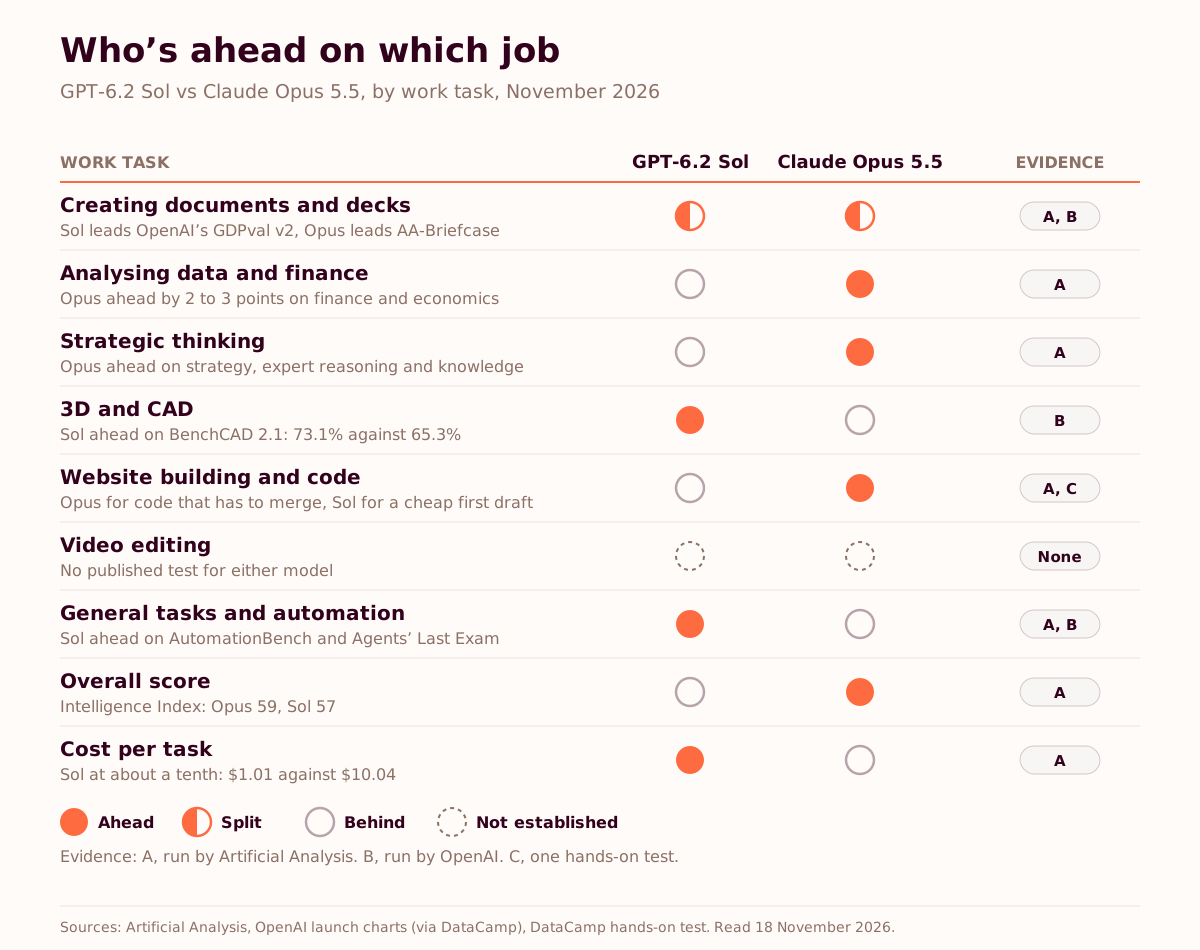
Claude Opus 5.5 leads GPT-6.2 Sol on strategy, finance, office deliverables and code that has to merge. Sol leads on business automation and CAD, and costs about a tenth as much per task. On the Artificial Analysis Intelligence Index, Opus 5.5 scores 59 and Sol 57 (Artificial Analysis).
These are the two models most staff will actually meet. Sol is the default in ChatGPT Work. Anthropic calls Opus 5.5 its "strongest daily driver" and tells users to start there (Anthropic). And no, there's no Claude Opus 5.2: the 5.2 belongs to Fable.
| Work task | GPT-6.2 Sol | Claude Opus 5.5 | Ahead, and how sure |
|---|---|---|---|
| Creating documents, decks and workbooks | GDPval v2: 46.9%. AA-Briefcase: 1,612 Elo | GDPval v2: 43.5%. AA-Briefcase: 1,800 Elo | Split. Sol on OpenAI's test, Opus on the independent one (A, B) |
| Analysing data and finance | Finance and accounting: 57. Economics: 57 | Finance and accounting: 59. Economics: 60 | Opus, by 2 to 3 points (A) |
| Strategic thinking | Strategy and operations: 59. Expert reasoning (HLE-Diamond): 64.0%. Factual knowledge: 40 | Strategy and operations: 61. Expert reasoning: 67.9%. Factual knowledge: 48 | Opus (A) |
| 3D and CAD | BenchCAD 2.1: 73.1%. AA-3D: 1,259 Elo | BenchCAD 2.1: 65.3% | Sol on CAD (B). Both labs print the same 65.3% for Opus |
| Website building and code | FrontierCode 2.0: 44.4%. Coding Agent Index: 50, in Codex | FrontierCode 2.0: 46.4%. Coding Agent Index: 58, in Claude Code | Opus for code that has to be right (A). One shader test: Sol scored 4.8 out of 5 for $0.21, Opus 4.5 for $1.20 (C) |
| Video editing | No published test | No published test | Not established. Testers praised Astra for motion graphics, and nobody has tested Sol on it (C) |
| General tasks and automation | AutomationBench: 71.3%. Agents' Last Exam: 73.0% at $1.32 a task | AutomationBench: 69.5%. Agents' Last Exam: 71.6% at $17.57 a task | Sol (A, B) |
| Overall | Intelligence Index: 57 | Intelligence Index: 59 | Opus, by 2 points (A) |
| Cost per index task, maximum effort | $1.01 | $10.04 | Sol, at about a tenth (A) |
| Time per index task, maximum effort | 7.9 minutes | 24.5 minutes | Sol (A) |
| API price, per million tokens | $2 input, $10 output | $4 input, $20 output | Sol, at half (A) |
A: run by Artificial Analysis. B: run by OpenAI, from its launch charts as reported by DataCamp. C: one hands-on test (DataCamp) or tester reports (VentureBeat). Coding Agent Index figures are each model's best setting. Read on 18 November 2026.
Read the table by job and two patterns come out. Opus 5.5 leads where Artificial Analysis grades reasoning, knowledge and finished office work, by 2 to 8 points. Sol leads where the work is a long chain of steps across business apps, and on price, by a factor of ten.
The coding row is the one with a real gap. Opus 5.5 in Claude Code scores 58 on the Coding Agent Index and Sol in Codex scores 50 (DataCamp). In DataCamp's single shader test, Sol built the more realistic scene for a sixth of the price. A first draft of a website and a change someone has to merge are different jobs.
Video editing is the honest gap. No benchmark tests either model on it. The praise from early testers is about Astra's motion graphics and agent-driven video editing (VentureBeat), and Claude's own video tool, Claude Motion, is in beta on Team and Enterprise (Anthropic). For teams on Claude, our Claude training for teams starts from the work each team already does.
Why do ChatGPT and Claude look more alike every month?
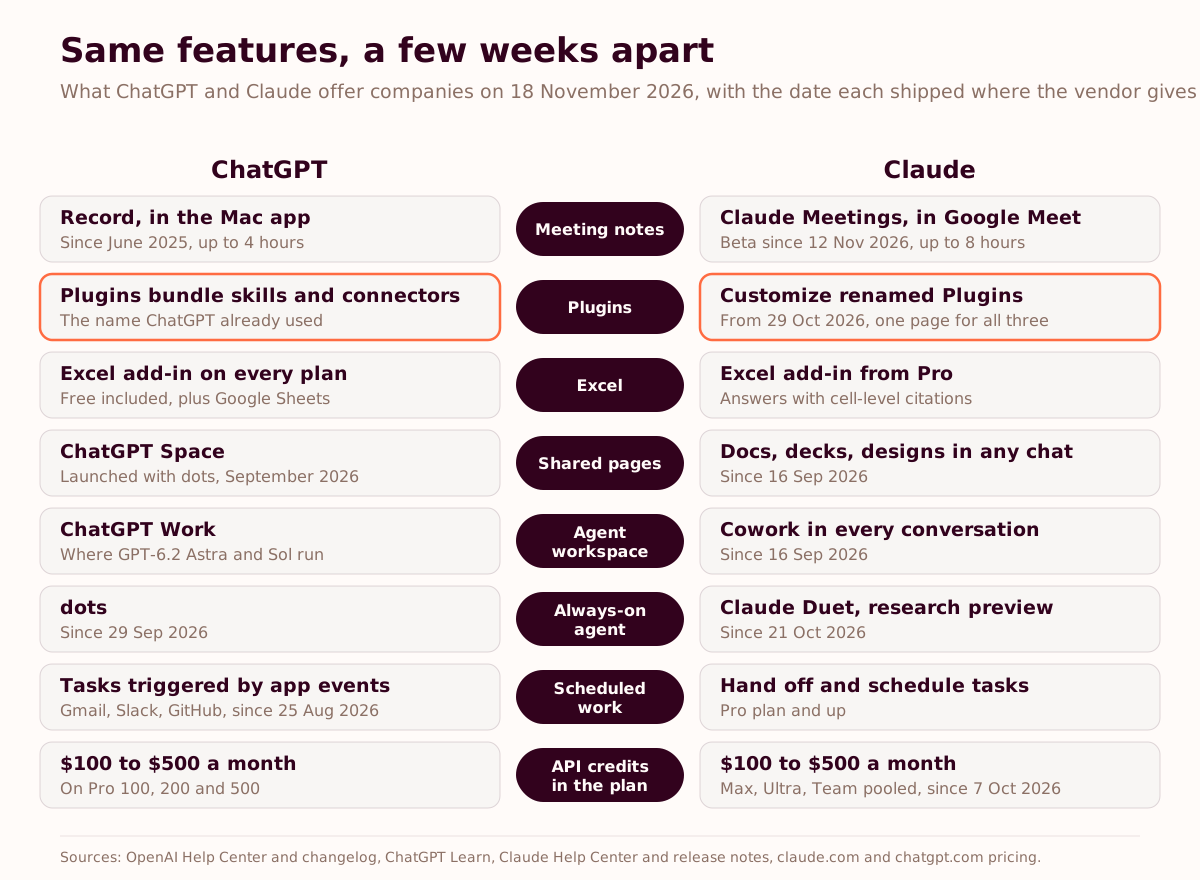
Because each one ships what the other has, a few weeks or months later. On 18 November 2026, the two products overlap on meeting notes, plugins, Excel add-ins, shared pages, agent workspaces, always-on agents, scheduled tasks and API credits in the plan. A feature list stopped being a reason to choose.
| What | ChatGPT | Claude |
|---|---|---|
| Meeting notes | Record transcribes and summarises meetings in the Mac app, since June 2025. It joins Google Meet calls from your calendar, for up to 4 hours | Claude Meetings, in beta on Team and Enterprise since 12 November 2026. It joins Google Meet as a visible participant, for up to 8 hours |
| Plugins | A plugin bundles skills and connectors (MCP servers) | Customize renamed Plugins from 29 October 2026: one page for skills, connectors and plugins |
| Excel | Add-in on every plan, Free included, plus a Google Sheets version | Add-in from Pro, with answers that cite cells |
| Shared pages | ChatGPT Space, launched with dots in September 2026, replaces Library | Designs, decks and docs in any conversation since 16 September 2026. Sheets and Whiteboards in beta |
| Agent workspace | ChatGPT Work | Cowork in every conversation since 16 September 2026 |
| Always-on agent | dots, since 29 September 2026 | Claude Duet, research preview since 21 October 2026 |
| Scheduled work | Tasks triggered by Gmail, Slack and GitHub events, since 25 August 2026 | Hand off and schedule tasks, on Pro and up |
| API credits in the subscription | $100 to $500 a month on the Pro tiers | $100 on Max, $200 on Ultra, up to $500 pooled on Team, since 7 October 2026 |
Sources: OpenAI Help Center and OpenAI on X for Record, ChatGPT Learn for plugins, Claude Help Center for the Plugins page, Claude release notes, ChatGPT changelog, Chris Alarcon for the Excel add-ins, ChatGPT Space and eesel AI for its launch, OpenAI for dots, chatgpt.com and claude.com pricing. Read on 18 November 2026.
The plugin rename says it best. Since 29 October 2026, the menu Claude used to call Customize reads Plugins in the sidebar, the chat menu and settings, and one page replaces the separate Skills, Connectors and Plugins tabs (Claude Help Center). Plugins is the word ChatGPT already used. In OpenAI's docs, a plugin is "an installable bundle that can include skills and Model Context Protocol (MCP) servers" (ChatGPT Learn). Same word, same bundle, same menu.
One detail for admins: the new page becomes the default on Enterprise on 30 November, and from that date a Team or Enterprise organisation with Skills switched off also blocks plugins in Claude Desktop.
Meetings went the other way. ChatGPT's Record mode reached the Mac app in June 2025 (OpenAI on X). Anthropic announced Claude Meetings on 10 November 2026 as a participant that does the work while the meeting is still going, and the beta started rolling out on 12 November (Reuters, Claude release notes).
Even the testers overlap. Jump Trading, IMC and Harvey are quoted praising the new model on Anthropic's launch page on 9 November and on OpenAI's on 17 November. Two of the quotes come from the same people: Marquis Wong of IMC and Niko Grupen of Harvey (Anthropic, OpenAI). And Anthropic's own launch post steers most daily work away from its top model: "start with Claude Opus 5.5".
So a feature comparison has a shelf life of about a month. Ours included. For the agents on each side, see our comparison of dots, Claude Duet and the other personal agents, and for the ChatGPT side, what ChatGPT Enterprise does beyond writing emails.
Free, 8 minutes
Before you switch models, look at what your teams do with the one they have.
The AI Maturity Audit places your company on the WCS AI Maturity Model in 21 questions.
You get your stage, the barrier in the way (people, leadership, process or foundations) and the workflow to fix first. Free personalised report, no credit card.
Run the free AI Maturity Audit →How should a company choose between ChatGPT and Claude?
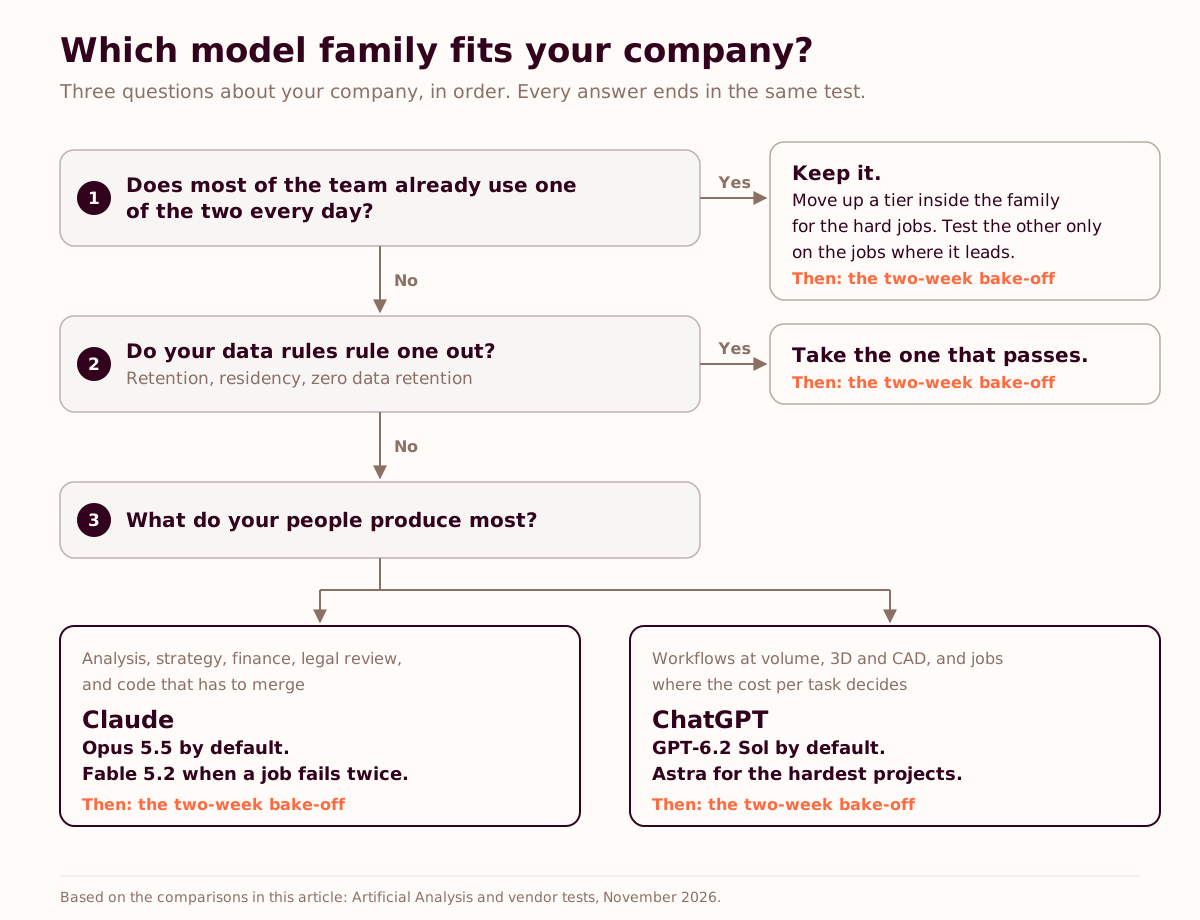
Choose on what your company does, then test on your own work. The model will change again before your next renewal. Your work mix, your data rules and the tool your people already open every morning will still be there.
Here are the seven questions we start from. None of them needs a benchmark.
| # | Criterion | The question | Where the answer is |
|---|---|---|---|
| 1 | The work mix | What do people produce all week: decks and memos, analysis, code, 3D? | The work-task table above, then your own task list |
| 2 | Where the work lives | Microsoft 365, Google Workspace, Slack? Which add-ins does IT already allow? | The feature table, then your IT policy |
| 3 | Cost of a finished task | What does one usable output cost, review time included? | Cost per task above, then your own log |
| 4 | Data rules | Retention, residency, zero data retention, health data? | The data row in the first table, then your DPO |
| 5 | Admin and control | SSO, SCIM, audit logs, and who approves a plugin? | Each vendor's Team and Enterprise pages |
| 6 | The redo rate | How often does someone send the output back? | Your own log. Launch-week testers disagree |
| 7 | What teams do today | How many licences get used weekly, and for what? | Your admin dashboard, or the audit below |
The first two decide most cases. A team that builds decks all day and a team that ships code can land on different answers inside the same company, and a mixed estate is a legitimate result. For the data question, our comparison of zero data retention across OpenAI, Claude, Gemini and Copilot covers what each vendor offers.
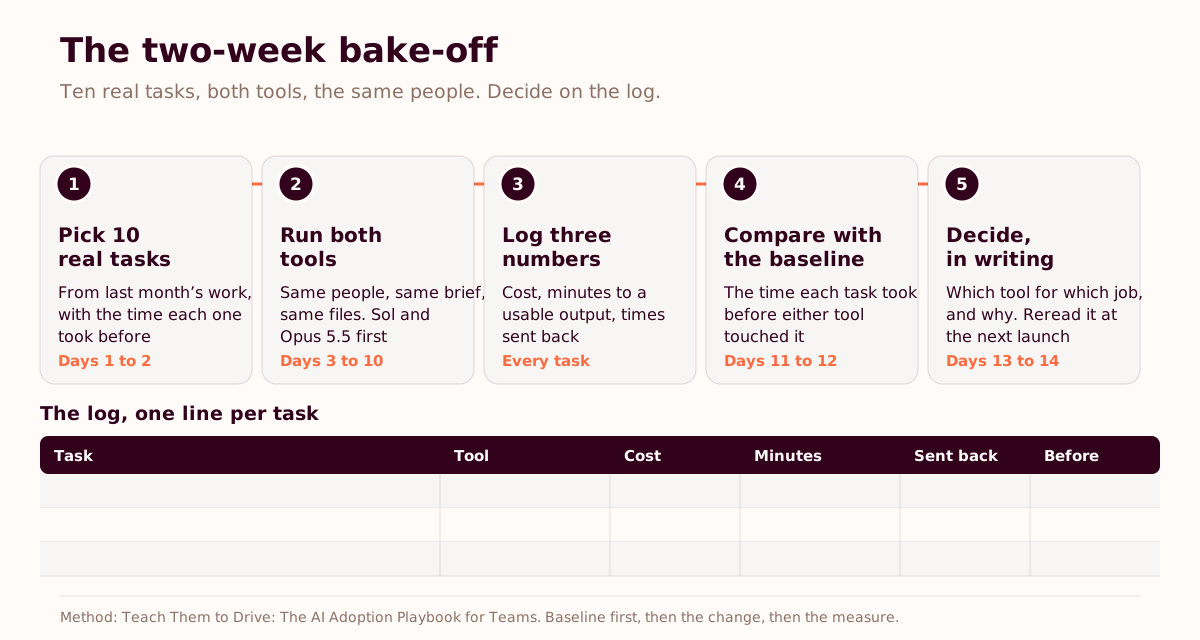
The two-week bake-off
This is the test we'd run before signing either contract. It takes two weeks and the people who do the work.
- Pick 10 real tasks. From last month's work, with the time each one took. A board deck, a contract summary, a forecast update, a supplier comparison.
- Run both tools on the same tasks. Same people, same brief, same files. Sol and Opus 5.5 first. Astra and Fable 5.2 only for the jobs that fail.
- Log three numbers per task. The cost, the minutes to a usable output, and how many times someone sent it back.
- Compare with the baseline. The time each task took before either tool touched it.
- Decide, and write down why. Which tool, for which job. The note is what you reread when the next model ships.
The model will change again before your renewal
A new model shipped this week. Another will ship next month, with a chart that puts it on top. The decision that holds is the one made on your own tasks, with a baseline taken before anything changed.
We wrote about the same pattern in September, when four labs shipped in one week: AI model fatigue in the enterprise. Two months and eight launches later, nothing about it has changed except the version numbers. And if you're weighing a full switch, how to move from Claude to ChatGPT covers the work involved.
"The tool was never the problem. Nobody taught them to drive."
Toni Dos Santos, Teach Them to Drive: The AI Adoption Playbook for Teams
The playbook
The tool was never the problem. Nobody taught them to drive.
Teach Them to Drive: The AI Adoption Playbook for Teams is the method behind the bake-off above: one painful workflow, a baseline before anything changes, a written split of what the AI does and what a person checks, and a measure at 30, 60 and 90 days. Written for companies that bought the licences and whose teams still use them to fix typos.
Get the book →Frequently asked questions
What are GPT-6.2 Astra and GPT-6.2 Sol?
GPT-6.2 Astra and GPT-6.2 Sol are OpenAI models released on 17 November 2026. Astra is the frontier model for the hardest projects, at $8 per million input tokens and $40 per million output. Sol is the cheaper everyday model, at $2 and $10. Both run in ChatGPT Work and Codex on Plus, Pro, Business, Enterprise and Edu plans, and in the OpenAI API.
What's the difference between GPT-6.2 and Claude?
GPT-6.2 is OpenAI's model family released on 17 November 2026: Astra for the hardest projects and Sol for everyday work, in ChatGPT Work, Codex and the API. Claude is Anthropic's: Fable 5.2 for the hardest work and Opus 5.5 as the daily model. On independent tests, Claude scores higher on reasoning, finance, legal work and code that has to merge, while GPT-6.2 costs less per task and leads on business automation and interactive 3D. The flagships list at the same $8 and $40 per million tokens, and team seats cost $25 a month on both sides.
Is GPT-6.2 Astra better than Claude Fable 5.2?
On the independent overall score, Claude Fable 5.2 is ahead: 65 against 62 on the Artificial Analysis Intelligence Index, with leads on finance, strategy, legal, factual knowledge and code. GPT-6.2 Astra leads on interactive 3D, business automation and work in a terminal, and costs about six times less per task at maximum effort. On OpenAI's own launch charts, Astra comes out ahead on six of nine tests.
Is GPT-6.2 Sol better than Claude Opus 5.5?
It depends on the job. Claude Opus 5.5 scores 59 against 57 for GPT-6.2 Sol on the Artificial Analysis Intelligence Index, and leads on strategy, finance, office deliverables and coding agents. GPT-6.2 Sol leads on business automation and CAD, costs half as much per token, and about a tenth as much per task.
How much do GPT-6.2 Astra and Claude Fable 5.2 cost?
Both list at $8 per million input tokens and $40 per million output tokens in November 2026. Cached input costs $0.40 on Astra and $0.20 on Fable 5.2, and Astra charges $16 and $60 on requests above 272,000 input tokens. In the apps, Astra comes with ChatGPT Plus at $20 a month in Work and Codex, and Fable 5.2 comes with Claude Max at $100 a month, up to half the weekly limit.
Which model is best for spreadsheets, slides and documents?
The evidence is split. On OpenAI's GDPval v2, GPT-6.2 Sol scores 46.9% against 43.5% for Claude Opus 5.5, and OpenAI trained Astra to follow slide and spreadsheet templates. On the Artificial Analysis AA-Briefcase test of office deliverables, Claude leads: Opus 5.5 at 1,800 Elo and Fable 5.2 at 1,785, against 1,643 for Astra and 1,612 for Sol. A test on your own templates settles it.
Can I use GPT-6.2 in regular ChatGPT?
No. As of 18 November 2026, GPT-6.2 Astra and Sol are only in ChatGPT Work and Codex, and OpenAI's guide says to open Work to use them. On Enterprise and Edu, an admin has to switch them on in workspace settings first.
Is there a Claude Opus 5.2?
No. Anthropic's current Opus is Claude Opus 5.5, released on 22 September 2026. The 5.2 version number belongs to Claude Fable 5.2 and Claude Mythos 5.2, released on 9 November 2026. Comparisons with GPT-6.2 Sol use Opus 5.5.
Should my company switch models every time a new one comes out?
Only when a test on your own tasks says so. OpenAI and Anthropic released ten models between 1 September and 17 November 2026. A two-week trial on ten real tasks, logging cost, time to a usable output and how often work gets sent back, tells you more than a launch chart, and the answer holds until your work changes.
Sources and method
We didn't run these models ourselves for this article. Every figure comes from the pages below, read on 18 November 2026. Rows marked as run by OpenAI are OpenAI's tests of its own models and of Claude. The independent rows are Artificial Analysis's, which publishes its method. Vendor pages change weekly, so check the official page before you buy.
- Introducing GPT-6.2 Astra and Sol, OpenAI, 17 November 2026
- GPT-6.2 in ChatGPT Work, Codex and the API, ChatGPT Learn, 17 November 2026
- GPT-6.2 system card, OpenAI Deployment Safety Hub, 17 November 2026
- Claude Fable 5.2 and Mythos 5.2, Anthropic, 9 November 2026
- OpenAI has the #2 model in the Intelligence Index with GPT-6.2 Astra and Sol, Artificial Analysis, 17 November 2026
- GPT-6.2 Astra vs Claude Fable 5.2 and GPT-6.2 Sol vs Claude Opus 5.5, Artificial Analysis release comparisons, read 18 November 2026
- "Essentially unusable": OpenAI launches GPT-6.2 Astra and Sol to negative reception from AI power users, Carl Franzen, VentureBeat, 17 November 2026
- We tested OpenAI's GPT-6.2 Astra for two weeks, Dan Shipper, Every, 17 November 2026
- Ethan Mollick on GPT-6.2 Astra, X, 17 November 2026
- GPT-6.2 Astra vs Claude Fable 5.2: benchmarks, pricing and which is better, AlphaCorp AI, 17 November 2026
- GPT-6.2 Sol vs Claude Opus 5.5: benchmarks and cost, DataCamp, November 2026
- Claude plans and pricing, ChatGPT plans and pricing, ChatGPT Pro tiers and ChatGPT Business billing and seats, read 18 November 2026
- Claude release notes and ChatGPT and Codex changelog, read 18 November 2026
- Manage plugins, skills and connectors from one Plugins page, Claude Help Center, and Skills and Plugins, ChatGPT Learn
- ChatGPT Record, OpenAI Help Center, and OpenAI's Record mode announcement, X, 18 June 2025
- Anthropic brings Claude to Google Meet to tackle tasks live, Reuters, 10 November 2026
- Claude or ChatGPT for Excel? Both have add-ins now, Chris Alarcon, updated 9 November 2026
- Introducing dots, OpenAI, 29 September 2026, and ChatGPT Space, OpenAI
- GPT-6, Wikipedia, for the GPT-6 Astra release date
- Toni Dos Santos, Teach Them to Drive: The AI Adoption Playbook for Teams