Claude Fable 5.2 is Anthropic's most capable generally available model, released on 9 November 2026. It costs $8 per million input tokens and $40 per million output tokens, 20% less than Fable 5.1 and twice the price of Opus 5.5. If your team works in Claude, Cowork or Claude Code, your default model stays the same, and Anthropic's own launch post says to start most work on Opus 5.5.
A new line appeared in the model picker on Monday. By Tuesday somebody had asked in Slack whether the team should switch, and somebody else had asked why their weekly limit was already half gone.
Both questions have answers. They sit in three places: Anthropic's launch post, the help page on plan limits, and a Hacker News thread with 733 comments.
I read all three. Every number below is Anthropic's or a named third party's, with the link. I haven't run Fable 5.2 on client work yet, so none of the test results here are mine.
The short version, in six lines
- What it is. The top Claude model anyone can buy. Same underlying model as the restricted Claude Mythos 5.2, with extra safeguards on cybersecurity and biology.
- Price. $8 in, $40 out per million tokens, down from $10 and $50. Opus 5.5 is $4 and $20.
- What moved. Up to 30% faster output, about 55% fewer safeguard blocks than Fable 5.1, and large jumps on Anthropic's long-task benchmarks.
- What didn't. Your default model. Fable has to be picked by hand, and it drains plan limits faster than any other Claude model.
- Who should care. Teams with multi-hour, multi-file jobs that fail on Opus 5.5. For ordinary work, early testers can't tell the two apart.
- The part no release fixes. The model doesn't create the use case. A team without a named job and a baseline gets a pricier chat window.
What is Claude Fable 5.2?
Claude Fable 5.2 is the third release in Anthropic's Fable line, after Fable 5 on 9 June 2026 and Fable 5.1 on 1 September 2026. Anthropic calls it its "most capable model for technical work" and lists coding, finance and the sciences as the target (Anthropic, Claude Fable 5.2 page).
Fable 5.2 and Claude Mythos 5.2 are the same underlying model. Mythos goes to vetted organisations only. Fable ships to everyone with stronger safeguards: a request flagged as high-risk cybersecurity gets answered by Opus 4.8, and a flagged biology request by Opus 5 (Anthropic, launch post).
It's on every paid Claude plan (Pro, Max, Ultra, Team, Enterprise), on the Claude Platform API as claude-fable-5-2, and on Amazon Web Services, Google Cloud and Microsoft Foundry.
Anthropic announced it on X in one sentence: "Introducing Claude Fable 5.2 and Claude Mythos 5.2, designed to tackle the most daunting technical challenges" (@claudeai on X).
How is Fable 5.2 different from Fable 5.1 and Opus 5.5?
Three things changed against Fable 5.1: the price dropped 20%, output got up to 30% faster, and the safeguards block about 55% less often (60% less in cybersecurity, 40% less in biology, per Anthropic's early testing). The context window, the output ceiling and the knowledge cutoff stayed where they were.
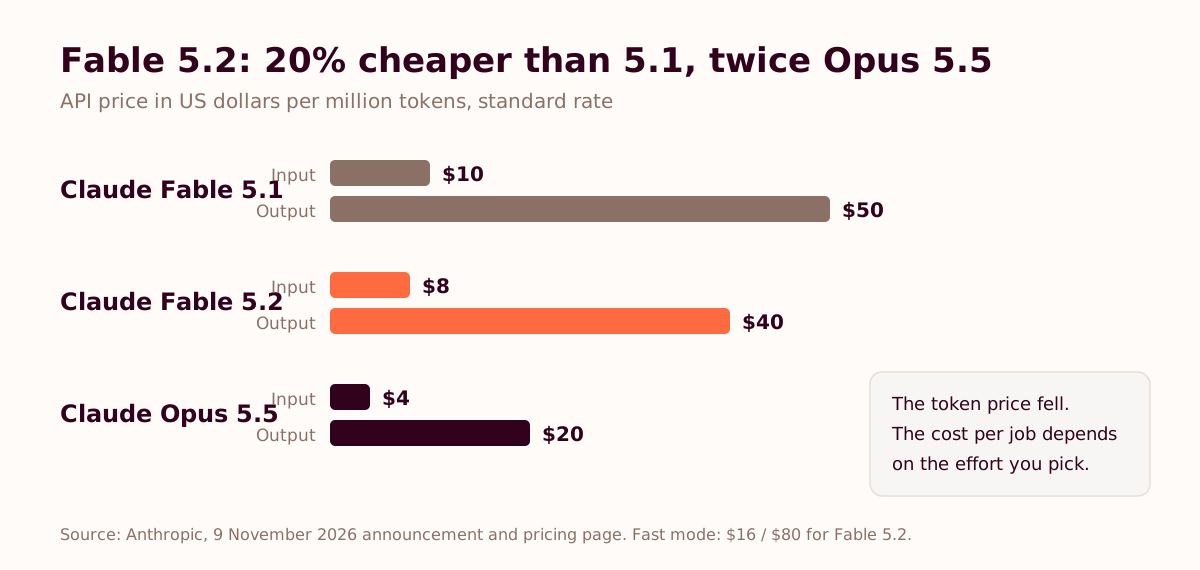
| Spec | Claude Fable 5.2 | Claude Fable 5.1 | Claude Opus 5.5 |
|---|---|---|---|
| Released | 9 November 2026 | 1 September 2026 | 22 September 2026 |
| Input price, per 1M tokens | $8 | $10 | $4 |
| Output price, per 1M tokens | $40 | $50 | $20 |
| Cache read, per 1M tokens | $0.20 | $0.25 | $0.20 |
| Context window | 1M tokens | 1M tokens | 1M tokens |
| Longest reply | 128,000 tokens | 128,000 tokens | 128,000 tokens |
| Anthropic's positioning | The most ambitious, open-ended technical work | Replaced by 5.2 | "Our strongest daily driver" |
Prices are from Anthropic's launch post and pricing page. Context, reply length and cache rates are from Kingy AI's spec sheet and ContextBolt's comparison. Fast mode runs up to 2.5 times faster at $16 and $80.
The benchmarks, in business terms
The biggest gap is on long, unsupervised work. On the Remote Labor Index, which scores models on real freelance jobs, Fable 5.2 reaches 41.3% where Opus 5.5 reaches 21.3%. On desktop tasks (OSWorld) the two are two points apart.
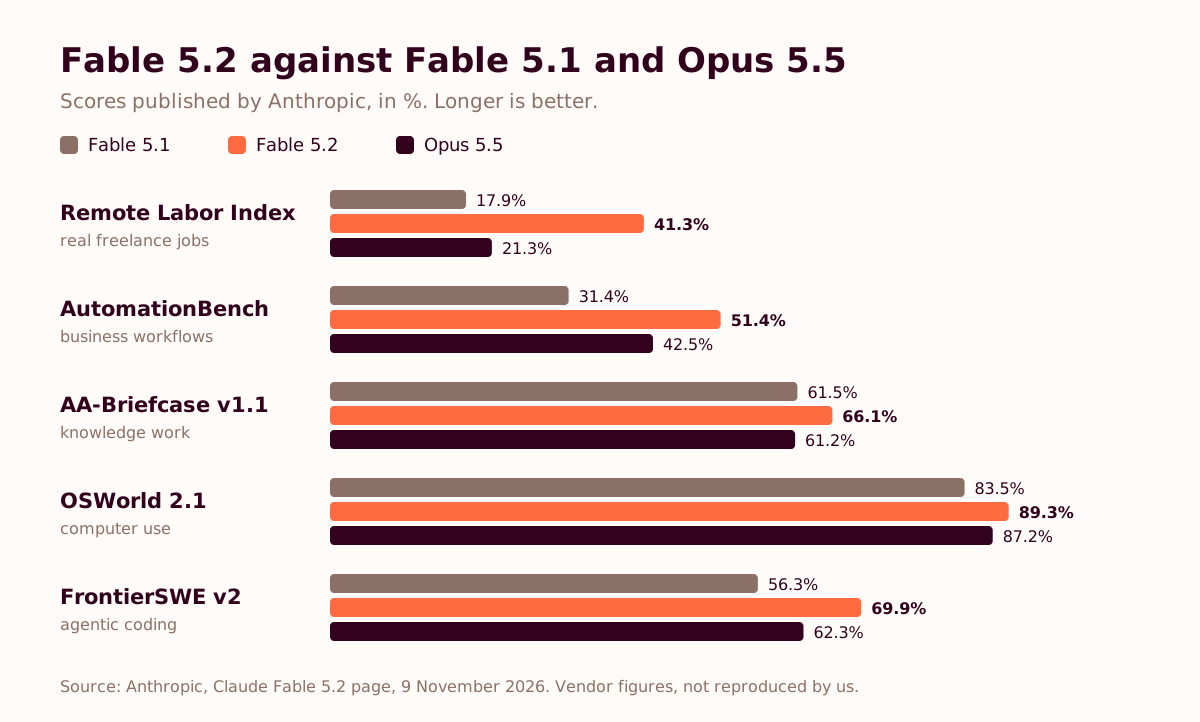
| Benchmark | What it measures | Fable 5.2 | Fable 5.1 | Opus 5.5 |
|---|---|---|---|---|
| Remote Labor Index | Paid freelance projects, start to finish | 41.3% | 17.9% | 21.3% |
| AutomationBench | Multi-step business workflows | 51.4% | 31.4% | 42.5% |
| AA-Briefcase v1.1 | Office knowledge work | 66.1% | 61.5% | 61.2% |
| OSWorld 2.1 | Operating a computer | 89.3% | 83.5% | 87.2% |
| FrontierSWE v2 | Agentic coding | 69.9% | 56.3% | 62.3% |
All five rows come from Anthropic's own table. They're vendor figures. On AA-Briefcase, Opus 5.5 still holds the higher Elo rating (1800 against 1785), which tells you how close the two are on desk work.
What changes for Claude, Cowork and Claude Code users?
Less than the launch week suggests. Anthropic announced no new feature specific to the Claude apps or to Cowork. The model is one more option in the picker, and the differences are in speed, blocks and how fast it eats your limits.
| Where you work | What's new with Fable 5.2 | What stays the same |
|---|---|---|
| Claude (web, desktop, mobile) | Fable 5.2 in the model picker. Medium effort by default. Fewer requests bounced to an older model. | Your default model. Projects, connectors and skills work as before. |
| Claude Cowork | Same model, same picker. Anthropic measured the 55% drop in blocks across Claude, Claude Code and Cowork. | No Cowork-specific feature in the announcement. Long file jobs are where the benchmark gains would show. |
| Claude Code | /model fable from version 2.1.321. Default effort drops from high (5.1) to medium (5.2). Fast mode available, always billed to usage credits. | Opus 5.5 remains the model Anthropic recommends for most coding. |
| API | New ID claude-fable-5-2, lower rates, a Fallback API to configure for blocked requests. | 1M context, 128K output, default effort high. |
The Claude Code effort change matters for anyone comparing before and after. A run that feels cheaper on 5.2 may just be running at a lower effort setting (Kingy AI).
What your plan gets
| Plan | Launch week, 9 to 16 November 2026 | After 16 November |
|---|---|---|
| Free | No Fable | No Fable |
| Pro, Team standard seats | Fable included, up to 50% of weekly limits, plus one Fable reset | Fable runs on usage credits at API rates |
| Max, Ultra, Team premium seats | Fable inside the plan, capped at 50% of weekly limits, plus one to three resets | Same 50% cap. Resets expire 8 March 2027 |
| API and cloud platforms | $8 / $40 per million tokens | $8 / $40 per million tokens |
The number of resets depends on how long you've paid: one under six months, two between six and twelve, three beyond a year. They sit under Settings, then Usage. A reset gives back the weekly usage spent on Fable models and refills the five-hour window (Claude Help Center, launch offers).
Boris Cherny, of Anthropic's Claude Code team, put it this way: "We wanted to do more for the people who've been with us the longest. So with Fable 5.2, the longer you've been subscribed, the more Fable resets you get" (@bcherny on X).
Two things for IT before a rollout. Fable keeps prompts for 30 days by default for safety monitoring, with zero data retention reserved for eligible enterprise customers (Anthropic). And a blocked request gets answered by a weaker model, which a user will notice as a sudden drop in quality.
Does Fable 5.2 actually change anything for your team?
For your hardest jobs, yes. For the rest, the evidence so far says no, and it costs more to find out.
David at ContextBolt ran both models on three ordinary jobs in Claude Code at medium effort on launch day (ContextBolt, 9 November 2026):
| Job | Fable 5.2 | Opus 5.5 | Result |
|---|---|---|---|
| Build a sales dashboard | $0.90 to $1.23, 74 to 97 seconds | $0.19 to $0.24, 36 to 45 seconds | One Opus page came out blank |
| Fix four planted bugs | $0.32, 23 seconds | $0.19, 22 seconds | Both passed all tests, both found a fifth bug |
| Keyword research | $0.80 | $0.17 | Same verdict |
That's one author and three tasks, so read it as an anecdote. The ratio ran from 1.7 to 6.5 times the cost for the same answer.
Anthropic's numbers point the other way on hard work. At high effort, Fable 5.2 roughly matches Opus 5.5 at max effort on FrontierCode 2.0 for about half the cost per task. At medium effort on the WANDR search benchmark, it matches Opus 5.5's top score for about 40% of the cost (Anthropic).
Both can be true. On a job Opus can already do, Fable writes more tokens to reach the same place. On a job that pushes Opus to its ceiling, Fable gets there at a lower effort setting and a smaller bill.
The effort setting is the real price tag. Dishant Sharma pulled Artificial Analysis's figures: output tokens per task went from 118,000 on Fable 5.1 to 274,000 on 5.2 in that index. His conclusion: "So the per-token price fell 20% and the per-task cost roughly doubled" (DEV Community). A Hacker News commenter added the missing detail: those charts show max effort by default.
What are people saying about Fable 5.2?
Three camps formed within a day. People who got early access and pushed it hard are impressed. People on subscriptions are counting their limits. People doing ordinary coding shrug.
On X
- Ethan Mollick, Wharton professor: "I had early access to Fable 5.2 for a bit & I think it crosses the line into being a sort of Jagged AGI. Here, I have it launch a business, do academic research, hack hardware, build 3D models & more. I think it is a good illustration of limits & powers" (@emollick).
- Matthew Berman, AI YouTuber: "I've burned over 100 billion tokens early testing Fable 5.2. It is BY FAR the best model I've ever used" (@MatthewBerman).
- Anthropic: "Claude Fable 5.2 is available today on all paid plans, on the Claude Platform, and on all major cloud platforms. It's $8 per million input tokens and $40 per million output tokens, down from $10 and $50" (@claudeai).
Mollick's longer write-up is the useful one for a manager. Fable built six working games on a USB keyboard on the first try and wrote a research paper he judged close to a real contribution. It also produced a 182-page paper with nothing cut, and a rulebook that grew to 204 sections. His line: "I would still not trust it to run a business on its own" (One Useful Thing).
On Hacker News
The main thread reached 444 points and 733 comments (Hacker News, "Claude Fable 5.2 and Mythos 5.2"). The comments worth your time:
- postalcoder: "I personally have a hard time telling the difference between Fable 5.2 and Opus 5.5 for ordinary coding tasks." And in a second comment: "Fable is good, but you really have to push the ambition of your prompt in order to see proper separation from Opus 5.5" (comment).
- nijave: "Have never noticed a difference between Fable and Opus on coding tasks but design/architecture is night and day different."
- advaith08: "It was able to work with an esoteric 600k line fortran codebase."
- kragen: "It used up my 5-hour token budget in half an hour."
- aenis: "I ate 2 resets in under 3 hours, on the pro 200 plan."
- Aurornis: "Fable 5.2 on max (the default) looks like a good way to light your money on fire" (comment, about the default view of the Artificial Analysis charts).
From companies that tested it early
These quotes sit on Anthropic's launch page, so they were chosen by Anthropic. Three describe behaviour you'd want from a colleague:
- Yashodha Bhavnani, VP of AI Products, Box: "it flagged that the salary deposits and the bank statement's balance didn't match."
- Andrew Mager, Staff Engineer, Uber: "It works until the job is actually complete instead of stopping at a plausible checkpoint."
- Adhyyan Sekhsaria, Cognition: "Claude Fable 5.2 says it doesn't know things instead of hallucinating."
Read the three camps together and one pattern holds. The people who saw a difference brought a hard, specific job. The people who saw none brought the work they already did yesterday.
The model doesn't create the use case
My read, from the adoption side: every release since 2023 has arrived with the same quiet promise, that this one will be the version people finally use. The usage report doesn't move on its own.
Fable 5.2 can hold a job for hours, read a million tokens and coordinate hundreds of subagents. It can't walk into your finance team and work out that, say, the month-end reconciliation takes four days because three people rekey the same export. Somebody has to name that job first.
Mollick's test says the same thing from the other end. With one of the strongest models ever released, he still had to kick off and steer every project, and the model rarely noticed when its own output was too long or off target.
The tool was never the problem. Nobody taught them to drive.
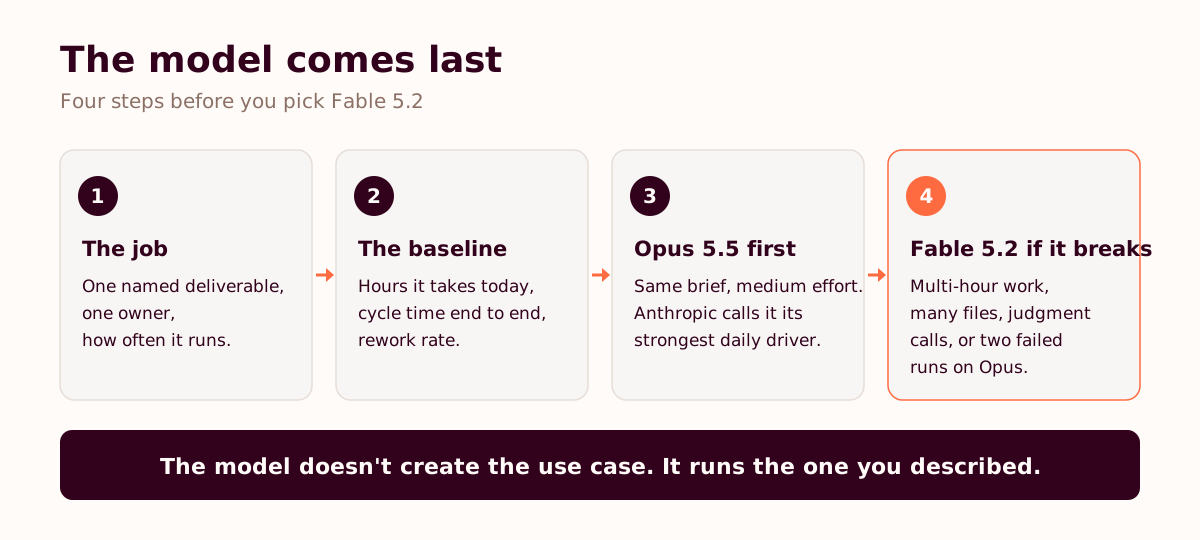
The model picker is the last decision and the smallest. The first is a sentence: which deliverable, who owns it, how long it takes today. A team that can write that sentence gets value from Opus 5.5 this afternoon and knows within a week whether Fable is worth the extra spend. A team that can't write it gets nothing from either.
Free, 8 minutes
Before you pay for a bigger model, find out what's holding usage back.
The AI Maturity Audit places your company on the WCS AI Maturity Model in 21 questions.
You get your stage, the barrier in the way (people, leadership, process or foundations) and what to fix first.
Free personalised report, no credit card.
Run the free AI Maturity Audit →How to use Claude Fable 5.2: a full walkthrough
This is the procedure, start to finish, on an example job: a quarterly supplier review. Forty contracts in PDF, one pricing spreadsheet, and a two-page memo for the CFO listing which contracts renew in the next 90 days and which price clauses were triggered. The job is illustrative. Swap in your own.
Step 1. Write the job and its baseline
One sentence for the job, three numbers for the baseline: hours spent today, days from request to delivery, and how often the memo comes back for corrections. Without those numbers there's nothing to compare a model against.
Step 2. Prepare the files
Forty PDFs are the expensive part. Claude reads every page you attach, layout included. Convert the contracts to Markdown first and the same content costs a fraction of the tokens. The method is in Stop hitting Claude AI usage limits, which explains why document work burns through usage and how to build a private converter.
Step 3. Run it on Opus 5.5 first
Same brief, default effort. If the memo is right, you're done and Fable has nothing to add. Note the time and what it got wrong.
Step 4. Switch to Fable 5.2
- In Claude: open the model picker under the message box and choose Claude Fable 5.2. Leave effort on medium.
- In Cowork: update Claude Desktop, point Cowork at the folder holding the Markdown files and the spreadsheet, and choose Fable 5.2 in the same picker.
- In Claude Code: type
/model fable(version 2.1.321 or later). Skip fast mode unless speed is worth $16 and $80 per million tokens from your usage credits.
Step 5. Give it a brief with an ambition level
Fable separates from Opus when the brief asks for the whole job. A brief that works:
Goal. Produce the Q4 supplier review memo for the CFO, two pages maximum.
Inputs. The 40 contracts in /contracts (Markdown) and pricing.xlsx. Treat the contracts as the source of truth when the two disagree.
What done looks like. A table of contracts renewing within 90 days of 1 January, a list of price clauses triggered this quarter with the clause quoted, and three recommendations ranked by euros at stake.
Rules. Show me your plan before you start. Cite the file and section for every figure. List anything you couldn't verify in a separate section. Stop at two pages.
The last rule matters. Mollick's 182-page paper happened because nothing told the model when to stop.
Step 6. Read the plan, then let it run
Fable will propose steps. Correct the plan before it starts, because corrections after an hour of work cost an hour of tokens. In Claude Code and Cowork, cap the delegation in plain words: "use at most four subagents." One Hacker News commenter reported nested subagents draining a full five-hour window in under 20 minutes.
Step 7. Check the output like a manager
Open the "couldn't verify" section first. Then pull three figures at random and trace each to its contract. Box's tester saw Fable flag a mismatch between salary deposits and a bank balance on its own. Yours may not, so check.
Step 8. Compare against the baseline and keep the cheaper pass
Two questions. Did it beat the human baseline on time and corrections? Did Fable beat Opus by enough to justify twice the rate? If Opus passed in step 3, the job goes on Opus. If only Fable passed, you've found your first real Fable use case, and you can say what it's worth.
How to keep the token bill down on Fable 5.2
Fable models consume plan limits faster than other Claude models, and Anthropic says so on its help page. Four habits do most of the work:
- Stay on medium effort. It's the default in the apps and Claude Code for a reason. Raise it for one job, then put it back.
- Feed it text. Markdown in place of PDF, CSV in place of a formatted workbook. Details in Stop hitting Claude AI usage limits.
- Start a new conversation per job. A long thread resends its whole history with every message.
- Keep Opus 5.5 as the default. Fable for the job that failed, Opus for everything else.
The full list, with the reasoning behind each tactic, is in How to protect your Claude usage limits: 18 tactics to stop burning credits at work.
Fable 5.2 or Opus 5.5: which model for which job?
| The job | Model | Why |
|---|---|---|
| Emails, summaries, meeting notes, first drafts | Opus 5.5 (or Sonnet 5.5) | No measurable gain from Fable, and it costs twice the rate |
| A dashboard, a bug fix, a research brief | Opus 5.5 | Same answers in ContextBolt's test for 1.7 to 6.5 times less |
| A job that failed twice on Opus 5.5 at high effort | Fable 5.2, medium effort | Anthropic reports Opus-at-max results for about half the cost |
| Multi-hour work across dozens of files or a large codebase | Fable 5.2 | The Remote Labor Index gap: 41.3% against 21.3% |
| Architecture, design and judgment calls | Fable 5.2 | Where Hacker News users report the clearest difference |
| Your weekly limit is nearly gone | Opus 5.5 | Fable is capped at half the week and drains it faster |
For the earlier releases in this line, see the guides to Claude Fable 5 and Claude Opus 5.
Frequently Asked Questions
What is Claude Fable 5.2?
Claude Fable 5.2 is Anthropic's most capable generally available AI model, released on 9 November 2026. It shares its underlying model with the restricted Claude Mythos 5.2 and adds safeguards for cybersecurity and biology. Anthropic positions it for the hardest technical work in coding, finance and the sciences. Its API name is claude-fable-5-2.
How much does Claude Fable 5.2 cost?
$8 per million input tokens and $40 per million output tokens on the API, down from $10 and $50 for Fable 5.1. Cache reads cost $0.20 per million. Fast mode runs up to 2.5 times faster at $16 and $80. Opus 5.5 costs $4 and $20, so Fable 5.2 is twice the rate.
Is Claude Fable 5.2 included in Claude Pro?
Only during launch week. From 9 to 16 November 2026, Pro and standard Team seats get Fable models for up to 50% of their weekly usage limits, plus one Fable reset. After that, Fable on Pro runs on usage credits at API rates. Max, Ultra and premium Team seats keep Fable inside the plan, capped at 50% of weekly limits.
What is the difference between Claude Fable 5.2 and Opus 5.5?
Fable 5.2 is the more capable and more expensive model: twice the token price, and it uses plan limits faster. Anthropic recommends Opus 5.5 as the daily driver for most coding and knowledge work, and Fable 5.2 for the most ambitious, open-ended technical work. On Anthropic's Remote Labor Index, Fable 5.2 scores 41.3% against 21.3% for Opus 5.5. On ordinary tasks, early testers report little or no difference.
Does Fable 5.2 change anything in Claude Cowork?
Anthropic announced no Cowork-specific feature with Fable 5.2. The model is available in the picker, and Anthropic reports about 55% fewer safeguard blocks than Fable 5.1 in early testing across Claude, Claude Code and Cowork. The practical gain is on long jobs across many files. The default model does not change.
How do I use Fable 5.2 in Claude Code?
Update Claude Code to version 2.1.321 or later and type /model fable. The default effort level for Fable 5.2 is medium, where Fable 5.1 defaulted to high. Fast mode is available and is always billed to usage credits at $16 and $80 per million tokens, even with plan usage left.
Why does Fable 5.2 use up my Claude limits so fast?
Fable costs twice the token rate of Opus 5.5, writes more output on the same task in third-party tests, and at high effort levels spends many more reasoning tokens. Anthropic's help page states that Fable models consume usage limits faster than other models. Staying on medium effort, converting documents to Markdown and limiting subagents all reduce the drain.
Should my company switch to Claude Fable 5.2?
Switch job by job. Keep Opus 5.5 as the default, and move a job to Fable 5.2 when it runs for hours, spans many files, or has failed on Opus 5.5 at high effort. A new model doesn't create a use case: a team needs a named deliverable and a baseline before any model choice pays off.
Sources
- Anthropic, Introducing Claude Fable 5.2 and Claude Mythos 5.2, 9 November 2026
- Anthropic, Claude Fable 5.2 product page (benchmarks, pricing, safeguards, customer quotes)
- Claude Help Center, Claude Fable 5.2 launch offers
- Claude Platform Docs, Pricing
- Ethan Mollick, Fable 5.2 and Jagged AGI, One Useful Thing
- David, ContextBolt, Fable vs Opus: Claude Fable 5.2 or Opus 5.5? Tested, 9 November 2026
- Kingy AI, Claude Fable 5.2: specs, benchmarks, evals, pricing and what changed
- Dishant Sharma, Claude Fable 5.2: Faster, Cheaper, and Still Hard to Justify, DEV Community
- Hacker News, Claude Fable 5.2 and Mythos 5.2, discussion thread
- X posts by @claudeai, @emollick, @MatthewBerman and @bcherny, 9 November 2026