OpenAI and Anthropic each sell seven plans, and the names hide the decision. For a company, the choice comes down to four shapes: a personal plan (ChatGPT Free, Go, Plus, Pro; Claude Free, Pro, Max) that trains on chats by default and has no admin, a standard workspace seat at about £16 to £20 a month (ChatGPT Business, Claude Team), a premium seat at about £80 to £100 for the people who use the flagship model all day, and an Enterprise contract for single sign-on, audit logs and, on OpenAI's side, European data residency. Most teams we meet should buy standard seats, count who hits the ceiling for a month, then upgrade those people. The full comparison table and the use case for each plan are below.
In short
- Both vendors sell the same two workspace seats at nearly the same price. On annual billing a standard seat is about £16 a month ex VAT at OpenAI and £18 including VAT at Anthropic, and a premium seat is about £80 ex VAT against about £90 including VAT. What's inside differs. ChatGPT Business puts its flagship, GPT-6 Astra, inside the standard seat with a message cap. Claude Team bills its flagship, Fable 5.1, as pay-as-you-go on a standard seat and includes it on premium.
- Personal plans (Plus, Pro, Claude Pro, Max) train on your conversations unless each person switches it off, and nobody at the company can check. The first day two colleagues share a client file is the day to move to a workspace plan.
- Enterprise is a different purchase. ChatGPT Enterprise is a quote in dollars, reported between $45 and $75 a seat (roughly £36 to £60 before VAT), with UK and EU data residency included. Claude Enterprise is $20 a seat (about £16) plus usage at API rates, from 20 seats, with no European residency inside the chat product.
- The provider question matters less than the seat mix. A team that buys 40 premium seats without measuring who needs them pays about £3,200 a month before VAT for capacity 30 people never touch.
The spreadsheet on the COO's desk
You've got a column of expense claims. ChatGPT Plus, £19.20, eleven times. Claude Pro, £18, four times. One Max at £90 for the head of product, who says she needs it. A ChatGPT Pro at £192 nobody can explain. The CFO wants one line instead of seventeen, IT wants to know where the client data went, and you've been asked to pick a plan by the end of the month.
The vendor pricing pages don't help much. OpenAI lists Free, Go, Plus, Pro, Business, Enterprise and Edu. Anthropic lists Free, Pro, Max, Team, Enterprise, plus two seat types inside Team. Fourteen options, two of which are the same price with different things inside.
We help companies choose and roll out these tools for a living, and most of the ones who call us have already bought the wrong tier. Usually too much, sometimes too little, almost always without counting. This guide covers every plan from both providers as of 12 September 2026, the need each one solves, and the rule we use to pick.
Every ChatGPT and Claude plan, side by side
The two vendors bill UK companies differently, and the table reflects what you'll see at checkout. OpenAI prices its personal plans in pounds before VAT and adds 20% at checkout (OpenAI, multi-currency billing); its Business seats are still priced in dollars, converted by your card and then taxed, so the pound figures for those rows are approximate at a rate of about 0.80. Anthropic shows UK visitors sterling prices with VAT already included (AIToolsReview's September 2026 UK guide); its Enterprise plan stays in dollars. A VAT-registered company reclaims the 20% either way, as long as the invoice is in the company's name. Where a vendor doesn't publish a price, the table says so and cites what customers report.
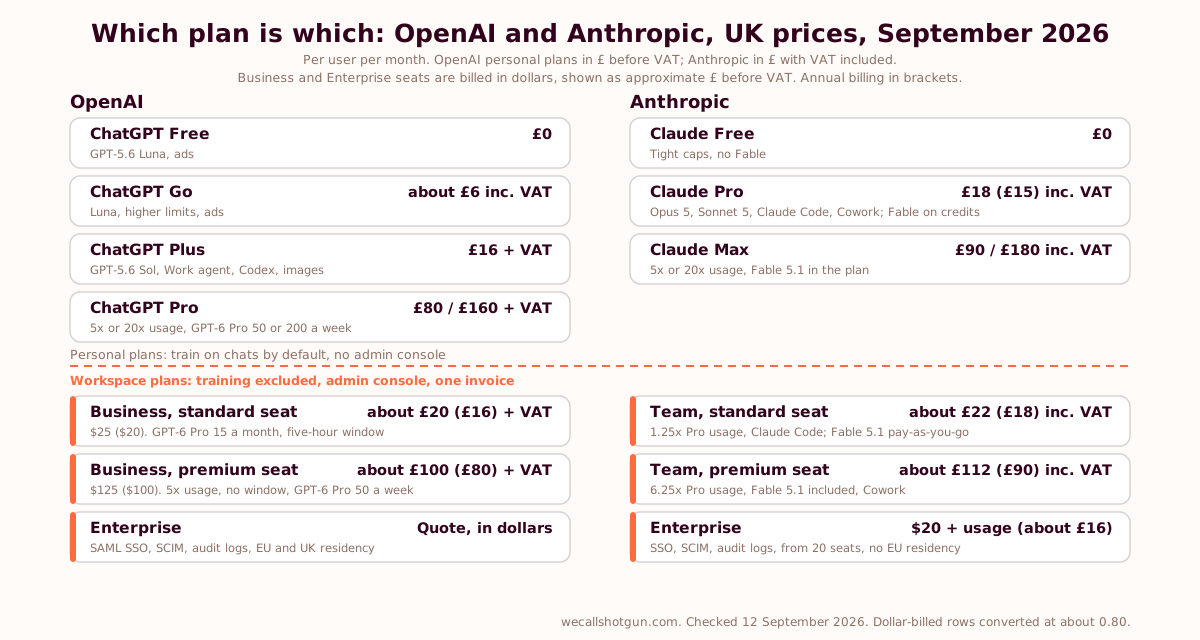
| Plan | UK price (monthly / annual) | US list | Built for | Flagship model access | Trains on your data? | Admin console, SSO |
|---|---|---|---|---|---|---|
| OpenAI, ChatGPT | ||||||
| Free | £0 | $0 | Trying it. Personal use. | GPT-5.6 Luna in chat, unlimited text since August 2026. No GPT-6. Ads (US first). | Yes, unless the user opts out | No |
| Go | About £6 inc. VAT | $8 | Personal use with more room | Same Luna default with higher limits, lighter deep research. Still ads. No GPT-6. | Yes, unless the user opts out | No |
| Plus | £16 + VAT (£19.20) | $20 | One professional | GPT-5.6 Sol by default, ad-free. GPT-6 Astra only inside ChatGPT Work and Codex, on an allowance. | Yes, unless the user opts out | No |
| Pro | £80 or £160 + VAT (£96 or £192) | $100 or $200 | One heavy user | 5x or 20x Plus usage. GPT-6 Pro in chat: 50 messages a week on the £80 plan, 200 on the £160 plan. | Yes, unless the user opts out | No |
| Business, standard seat | Billed in dollars: about £20 / £16 + VAT | $25 / $20 | Teams, bought by card | GPT-6 family day to day. GPT-6 Pro: 15 messages a month once an admin enables it. Five-hour usage window. | No, by default | Admin console, SSO. No SCIM. |
| Business, premium seat | Billed in dollars: about £100 / £80 + VAT | $125 / $100 | The heavy users in that team | 5x standard usage, no five-hour window. GPT-6 Pro: 50 messages a week. | No, by default | Same workspace, seats mix |
| Enterprise | Quote in dollars. Reported $45 to $75 a seat, annual (about £36 to £60 + VAT). | Quote | Large deployments | Everything in Business plus credit-based extra usage. | No, contractual | SAML SSO, SCIM, RBAC, audit logs, compliance API, data residency (EU, UK, US and seven more regions) |
| Edu | Quote | Quote | Universities | Enterprise feature set for campuses | No, contractual | Same as Enterprise |
| Anthropic, Claude | ||||||
| Free | £0 | $0 | Trying it. Personal use. | Tight caps. No Fable. | Yes, unless the user opts out. Five-year retention when left on. | No |
| Pro | £18 / £15, VAT included | $20 / $17 | One professional | Opus 5 and Sonnet 5 in the plan. Claude Code and Cowork on the desktop. Fable 5.1 on usage credits, billed on top. | Yes, unless the user opts out | No |
| Max | £90 (5x) or £180 (20x), VAT included | $100 or $200 | One heavy user | Fable 5.1 inside the plan, up to half the weekly limit. Priority access. | Yes, unless the user opts out | No |
| Team, standard seat | About £22 / £18, VAT included | $25 / $20 | Teams, from 2 seats, by card | 1.25x Pro usage. Opus 5, Sonnet 5, Claude Code, Projects, Skills. Fable 5.1 pay-as-you-go. | No, contractual | Admin console, SSO. Up to 150 seats. |
| Team, premium seat | About £112 / £90, VAT included | $125 / $100 | The heavy users in that team | 6.25x Pro usage. Fable 5.1 inside the limits. Adds Claude Cowork. | No, contractual | Same workspace, seats mix |
| Enterprise | Billed in dollars: $20 a seat (about £16) annual, plus usage at API rates | $20 + usage | 20 seats and up (50 through sales) | Every model, metered. No usage bundled in the seat. | No, contractual | SSO, SCIM, audit logs, custom retention, compliance API, customer-managed keys, US-only inference option. No EU residency. |
Two rows in that table decide most purchases. The "trains on your data" column splits every personal plan from every workspace plan, on both sides. And the flagship column shows the one real difference between a ChatGPT Business seat and a Claude Team seat at nearly the same money: OpenAI puts a slice of its best model inside the standard seat, Anthropic sends you a bill for it.
OpenAI's plans, one by one
ChatGPT Free (£0)
Since August 2026, Free users get unlimited text chats on GPT-5.6 Luna, the lightest tier of the GPT-5.6 family, with images, file uploads and voice capped separately. OpenAI started showing ads to Free users in the US, with other countries following (The AI Career Lab's plan comparison). The Work agent and Codex run on GPT-5.6 Terra with limited desktop access.
The need it solves: a colleague who wants to see what the fuss is about before anyone spends money. At work, that's where it should end. Training is on by default, there's no admin, and an ad next to a client brief is a conversation you don't want to have with the client.
ChatGPT Go (about £6 a month)
Go keeps the Luna model and the ads, raises the limits, and adds a lighter form of deep research. No Sites, no Sol, no GPT-6. OpenAI built it for consumers in price-sensitive markets, and £6 doesn't buy the ads off.
The need it solves: a personal account for someone who chats a lot and codes never. We haven't found a company use for it. The £10 gap to Plus is where the work features start.
ChatGPT Plus (£16 a month plus VAT, £19.20 at checkout)
Plus is the first tier that feels like the product people talk about. GPT-5.6 Sol as the default model, ad-free, deep research, agent mode, the ChatGPT Work agent, Codex, Sites for small web apps and dashboards, custom GPTs, Projects, expanded memory and image generation with Images 2.5. GPT-6 Astra is on Plus, but only inside ChatGPT Work and Codex on a limited allowance, and not in regular chat (Notebookcheck).
The need it solves: one professional, working alone, on their own material. A freelancer, a founder before the first hire, a consultant who never pastes client data. For a company it's the plan that appears on expense claims, and that's the problem covered below.
ChatGPT Pro (£80 or £160 a month plus VAT)
Pro is Plus with the meter opened up: five times the usage at £80 (£96 with VAT), twenty times at £160 (£192), plus the Pro-level reasoning modes. Since 3 September 2026, that includes GPT-6 Pro in regular chat, which is GPT-6 Astra with more thinking time: 50 messages a week on the £80 plan, 200 on the £160 plan (The Decoder).
The need it solves: a single person who runs agents for hours, a developer living in Codex, an analyst who hits the Plus ceiling by lunch. It's still a personal account, with training on by default and no admin or workspace behind it. If that person works in a company, a premium Business seat costs about the same £80 a month on annual billing and comes with the admin console. The £160 tier is for someone whose usage a company would rather see on an invoice than on an expense claim.
ChatGPT Business, standard seat ($25 a month, or $20 annual: about £20 or £16 plus VAT)
Business is the workspace plan, bought by card without a sales call. OpenAI still prices it in dollars for UK customers, so the pound figure moves with the exchange rate and VAT is added on top (AI Build Group, OpenAI's UK channel partner). Workspace content and connector data are excluded from training by default, with nothing to opt out of (OpenAI Help Centre). You get an admin console, SSO, shared Projects and custom GPTs, connectors to Drive, SharePoint, Slack and the rest, the Work agent, Codex, deep research, image generation, and the GPT-6 family for daily use. GPT-6 Pro is off until an admin enables it, then capped at 15 messages a month per standard seat, and usage sits inside a five-hour window.
The need it solves: any team of two or more that touches company or client material. A sales team drafting proposals from CRM exports. A marketing team running Images 2.5 on real campaigns. A finance team that wants the same tool for everyone and one invoice. This is the default we recommend on the OpenAI side, and the fifteen GPT-6 Pro messages are enough to find out who needs more.
ChatGPT Business, premium seat ($125 a month, or $100 annual: about £100 or £80 plus VAT)
OpenAI added premium seats to Business in August 2026: five times the usage of a standard seat, no five-hour window, and 50 GPT-6 Pro messages a week (OpenAI's announcement). Standard and premium seats mix in the same workspace, so you pick per person.
The need it solves: the three people in a 30-person workspace who run the Work agent all afternoon and hit the five-hour cap at 3pm. Developers on Codex, an ops lead rebuilding reporting, a strategy analyst on deep research. Those three get premium and the other 27 stay standard, because a premium seat charges about £100 a month whether the person reaches the cap or not.
ChatGPT Enterprise (quote)
OpenAI doesn't publish an Enterprise price. Buyers in 2026 report contracts between roughly $45 and $75 a seat a month, annual, which is about £36 to £60 before VAT, with the lower end for larger or multi-year deals (Layer3 Labs' Enterprise pricing guide; treat these as reported, not list). The seat carries higher limits than Business, with extra usage billed through a credit rate card where a GPT-6 Pro message costs 50 credits (OpenAI rate card). What you're paying for is the control layer: SAML SSO, SCIM provisioning, role-based access, audit logs, a compliance API, enterprise key management, a HIPAA agreement where needed, a customer success manager, and data and inference residency in Europe, the UK, the US and seven other regions at no extra cost (OpenAI, data residency).
The need it solves: a company whose security team has a checklist, and a French or German legal department that wants the data to stay in the EU. Below a few hundred seats, Business does the same work for less, and it already has SSO, which is the feature most mid-sized buyers think they're paying Enterprise for.
ChatGPT Edu (quote)
Edu is the Enterprise feature set priced for universities, with the same residency and no-training terms. If you're a company, it's not for you. If you run a business school, it's the one to ask about.
Anthropic's plans, one by one
Claude Free (£0)
Free gives you the chat product with tight session caps, no Fable models, and the same training question as every consumer plan. Since October 2025, Free, Pro and Max users choose whether their chats train future models. The setting defaults to on, and anyone who leaves it there accepts five-year retention of that data (Anthropic, consumer terms update).
The need it solves: a first look. Same verdict as ChatGPT Free: fine at home, wrong for a client file.
Claude Pro (£18 a month, or £15 annual, VAT included)
Pro is the individual plan and it carries more than its ChatGPT counterpart for about the same money (Anthropic's UK page shows £18 a month with VAT included, or £180 a year): Opus 5 and Sonnet 5 inside the plan, unlimited Projects, connectors through MCP, the Google Workspace integration, Claude Code in the terminal, and Claude Cowork on the desktop for agentic file and task work. Usage is metered on a five-hour session and a weekly cap shared across chat, Code and Cowork. Fable 5.1, the flagship, runs on usage credits billed on top of the subscription.
The need it solves: one person who writes long, reads long documents, or codes. A lawyer reviewing 200-page contracts alone, a solo developer, a founder drafting the board pack. It's still a personal account, with training on by default and nobody able to check it. The usage limits guide explains why Pro users hit the ceiling and what to do about it.
Claude Max (£90 for 5x, £180 for 20x, VAT included)
Max multiplies Pro's limits by five or twenty and includes Fable 5.1 inside the plan, up to half the weekly limit, with the rest on Opus 5 and Sonnet 5 (Anthropic, Fable models on your plan). Priority access at busy times and early access to new features come with it.
The need it solves: a developer running Claude Code all day, a consultant who lives in Cowork, anyone whose Fable 5.1 usage credits on Pro started costing more than the £72 gap. The same caveat as ChatGPT Pro applies: it's a personal account. In a company, a premium Team seat costs about the same £90 a month on annual billing and gives the admin a console.
Claude Team, standard seat (about £22 a month, or £18 annual, VAT included)
Team is the workspace plan, from two seats since 20 July 2026 and up to 150, bought by card. Anthropic's UK page lists the standard seat at £18 a month on annual billing with VAT included, which is £15 net for a VAT-registered company; the monthly figure is about £22. Workspace data is excluded from training as a contractual term, with 30-day default retention. A standard seat carries 1.25 times Pro usage, Opus 5 and Sonnet 5, Claude Code on every seat, shared Projects, Skills, connectors, and an admin console with SSO (Anthropic, Team plan). Fable 5.1 is pay-as-you-go: usage credits billed on top of the seat, per person, as they use it.
The need it solves: the same teams as ChatGPT Business, with a tilt towards document-heavy and code-heavy work. Legal, finance, product, engineering, agencies writing proposals. We covered the UK setup in Claude.ai 101 for business teams. The pay-as-you-go flagship is a feature for a team where three people need Fable 5.1 and 20 don't: the light users cost nothing extra.
Claude Team, premium seat (about £112 a month, or £90 annual, VAT included)
Premium raises the multiplier to 6.25 times Pro, puts Fable 5.1 inside the limits under the same half-of-weekly rule as Max, and adds Claude Cowork for agentic desktop work. Seats mix in one workspace.
The need it solves: the people whose monthly usage credit bill on a standard seat crossed £80, and anyone the team wants on Cowork. Engineering leads, a product manager building internal tools, an analyst running research agents. Same rule as OpenAI: buy it for named people, after a month of counting.
Claude Enterprise ($20 a seat, annual, plus usage: about £16 plus VAT)
Enterprise moved to a usage-based shape during 2026. The seat is $20 a month billed annually, about £16 before VAT, and covers the platform. Enterprise is one of the two Claude plans still priced in dollars for UK buyers. Every token your people spend, in chat, Claude Code or Cowork, is billed on top at standard API rates, with no allowance in the seat (Justin McKelvey's Enterprise pricing breakdown). Self-serve starts at 20 seats; through sales, 50. The seat buys SSO, SCIM, audit logs, custom retention, a compliance API and an analytics API, customer-managed encryption keys, a US-only inference option, and HIPAA-ready configuration for eligible companies.
Two things a European buyer should know. Claude Enterprise doesn't offer EU data residency inside the chat product; storage is US-hosted and GDPR is handled through standard contractual clauses and a data processing agreement, with regional endpoints available through AWS Bedrock, Google Cloud and Microsoft Foundry for API traffic (Compound's EU hosting guide). And Anthropic's Covered Models policy keeps prompts and outputs for its most capable models for 30 days on every platform, Enterprise included, which we unpacked in the zero data retention comparison.
The need it solves: a company with a security checklist, 20 or more seats, and a finance team willing to model usage. The metered shape is the honest one for a heavy-user population: you pay for what runs. It's a bad shape for a company that can't yet say who its heavy users are, because the first invoice will tell them.
Before you pick a seat count, find out how many people would actually use one.
Run the free AI maturity diagnosis →Open the AI ROI calculatorTen minutes, no email gate. Bring the result to the budget meeting instead of the expense report.
Personal plans at work: the expense-claim problem
The seventeen subscriptions on that spreadsheet share one property. Each one is a consumer account, and each consumer account, on both providers, trains on conversations unless the individual found the toggle. On ChatGPT it lives under Settings, Data Controls. On Claude it's the choice presented at signup and again under Privacy. Nobody at the company can see who flipped it.
The other half of the problem is the admin console that doesn't exist. No list of who's using what. No way to remove access when someone leaves. No connector policy. No data processing agreement, because the consumer terms aren't one.
The arithmetic ends the debate in most rooms. Eleven Plus accounts on expenses cost £211 a month with VAT, on invoices in eleven employees' names. Eleven ChatGPT Business seats on annual billing cost about £176 a month before VAT, on one invoice in the company's name, which your accountant will prefer for the reclaim. Same money or less, and the second one comes with the training question answered in the contract and a console that shows the ops lead who logged in this week. The Claude version is the same: Pro at £18 against a Team seat at £18 on annual billing.
"Most of the shadow AI I find in UK companies isn't people using banned tools. It's twelve people expensing a personal Pro subscription and pasting client work into an account with the training toggle still on. The fix costs less than the risk." Toni Dos Santos, in Claude.ai 101 for business teams.
The one honest exception is the Max 20x or Pro £160 user. A company can't buy the top personal tier as a seat; the premium seat tops out at the equivalent of the £80 or £90 tier. If one person genuinely needs 20x usage, they'll either stay personal with the toggle off and a signed acknowledgement, or move to Enterprise where usage is metered. We've seen both. The first is cheaper and the second is cleaner.
Which plan for which need
The table below is the one we draw on the whiteboard. Start from the situation, read across.
| Situation | OpenAI pick | Anthropic pick | Why |
|---|---|---|---|
| One person, own material, no client data | Plus (£16 + VAT) | Pro (£18 inc. VAT) | Cheapest full product. Turn training off in settings. |
| Agency or firm of 2 to 20, proposals and client docs | Business standard | Team standard | Training off by contract, one invoice, an admin who can remove a leaver. Same price as the personal plan on annual billing. |
| Marketing team producing visuals, campaigns, social | Business standard | Team standard for copy, but no image generation | Claude doesn't make images. A marketing team on Claude ends up buying ChatGPT anyway. |
| Legal, finance, research: long documents, careful drafting | Business standard | Team standard, premium for the heavy readers | Long-context work is where Claude users tell us it earns the seat. Fable 5.1 on pay-as-you-go keeps the light users cheap. |
| Engineering team, agentic coding all day | Business premium (Codex) or Pro £160 personal | Team premium (Claude Code, Cowork) | The five-hour window and the weekly cap are where developers live. Premium removes or raises them. |
| Ops or analytics lead running agents for hours | Business premium seat for that person | Team premium seat for that person | One or two premium seats in a standard workspace. Don't upgrade the whole team. |
| 150+ people, SSO, SCIM, audit logs | Enterprise | Enterprise (from 20 seats) | Both give the control layer. ChatGPT is a flat seat, Claude is about £16 plus a meter. |
| Regulated, EU or UK data residency required in the chat product | Enterprise | API via Bedrock, Vertex or Foundry, with your own front end | Only OpenAI offers residency inside the chat product today. |
| Company already paying for Microsoft 365 or Google Workspace AI | Business standard for the two or three jobs Copilot or Gemini does badly | Team standard, same logic | Use the licence you pay for, route the gaps. Our ChatGPT vs Copilot vs Gemini comparison covers the suite question. |
ChatGPT or Claude: how we'd choose between the providers
The plan shapes are now nearly identical, so the provider decision comes down to what's inside the seat and what your people do all day. Our position, which you can argue with:
Broad teams go to ChatGPT Business. Sales, marketing, HR, ops, customer support, people who need images, voice, a familiar interface and the flagship model in the standard seat without a usage bill. OpenAI's bundle in a standard seat is wider: image generation, agent mode, deep research, Codex, custom GPTs, connectors, plus 15 GPT-6 Pro messages a month. Claude has no image generation at all, and that alone settles it for most marketing teams.
Deep work goes to Claude Team. Long documents, code, agentic desktop work through Cowork and Skills, teams that write for a living. In our experience, the teams that pick Claude do it for the data room and the codebase, then stay for Projects and Skills. Pay-as-you-go Fable 5.1 on a standard seat is a feature here: the two people who need the flagship pay for it, the rest don't.
Residency on the checklist means ChatGPT Enterprise. If your DPO's checklist says EU data at rest and EU inference in the chat product, Anthropic can't tick that box today outside the cloud APIs. That's the single clearest technical difference at the Enterprise tier.
We wouldn't buy either on the model benchmark. The two flagships trade places every quarter. When we checked on 6 September, Artificial Analysis had Fable 5.1 at 57 and GPT-6 Astra at 55 on its Intelligence Index, a gap no team feels on a budget reconciliation. We wrote up why the annual pick-a-model exercise fails in AI model fatigue in the enterprise, and why a migration rarely starts from a task in the Claude to ChatGPT switching guide.
Both at once is a real option, and the two-standard-seat version costs about £35 a person a month on annual billing. It works when marketing is on ChatGPT and engineering is on Claude, each with its own admin. It fails when everyone has both and nobody owns either. AI spend visibility covers how to see that from the admin consoles.
What we do before a company signs
The rule is short: standard seats first, count for 30 days, then buy premium for named people. This is how it ran the last few times, with the specifics removed.
The ops lead exports the expense claims and lists every personal subscription with the owner's name. That list becomes the first seat list, and the personal accounts get cancelled on the day the workspace opens, with a two-line note about the training toggle. Nobody argues, because the seat costs the same.
Everyone starts on a standard seat. On ChatGPT, the admin enables GPT-6 Pro so the 15 messages a month are visible. On Claude, usage credits for Fable 5.1 are switched on with a monthly cap per person. Then the team runs its real workflows for a month: the proposal, the monthly close, the sprint, the campaign. Cycle time on each gets written down on day one, which is the baseline the budget conversation needs later.
At the end of the month the admin console answers the question the vendor pricing page couldn't. Who hit the five-hour window on ChatGPT. Whose Fable credits on Claude crossed £80. Those people get premium seats. In our experience they're a small minority of the workspace, and you should count yours before trusting anyone's ratio, ours included. A 40-person ChatGPT Business workspace with four premium seats runs at about £900 a month before VAT on annual billing. The same workspace bought as 40 premium seats, which is what the salesperson suggested, runs at about £3,200.
Then the second question, the one we actually get paid for: the seat is live, so what changed? A team on the right plan with no workflow change looks exactly like the team on expense claims, at the same price. That's the part covered in our procurement guide and the reason every engagement we run ends with a measured change in cycle time on the workflows that were baselined on day one.
Frequently asked questions
Which ChatGPT plan should a company buy?
ChatGPT Business on standard seats, priced in dollars at $25 a month or $20 annual (about £20 or £16 plus VAT), for any team that handles company or client data. Workspace data is excluded from training by default and the admin console shows who's using what. Add premium seats at $125 ($100 annual, about £80 plus VAT) for the few people who hit the five-hour usage window or need 50 GPT-6 Pro messages a week. ChatGPT Enterprise is a quote, reported between $45 and $75 a seat (about £36 to £60), and earns its price with SCIM, audit logs, a compliance API and EU or UK data residency.
Which Claude plan should a company buy?
Claude Team on standard seats, at about £22 a month or £18 on annual billing with VAT included, from two seats. Every seat includes Claude Code, Projects, Skills and connectors, with Fable 5.1 available on pay-as-you-go usage credits. Premium seats at about £112 (£90 annual, VAT included) give 6.25 times Pro usage, Fable 5.1 inside the limits and Claude Cowork. Claude Enterprise costs $20 a seat (about £16) billed annually plus usage at API rates, from 20 seats, and adds SSO, SCIM, audit logs, custom retention and customer-managed keys.
What's the difference between ChatGPT Business and Enterprise?
Business is bought by card at $25 a seat (about £20 plus VAT), has an admin console and SSO, and excludes workspace data from training. Enterprise is a negotiated annual contract that adds SAML SSO with SCIM provisioning, role-based access, audit logs, a compliance API, enterprise key management, a HIPAA agreement, a customer success manager and data residency in the EU, UK, US and seven other regions. Below a few hundred seats, Business covers most companies.
What's the difference between Claude Team and Claude Enterprise?
Team bundles usage into the seat: 1.25 times Pro usage on standard, 6.25 times on premium, up to 150 seats. Enterprise separates the two: $20 a seat (about £16) billed annually for the platform and its controls, then every token billed at API rates with no allowance. Enterprise adds SCIM, audit logs, custom retention, compliance and analytics APIs, customer-managed encryption keys and a US-only inference option, from 20 seats self-serve or 50 through sales.
Do ChatGPT and Claude train on my company's data?
On personal plans, yes by default. ChatGPT Free, Go, Plus and Pro train on conversations unless the user opts out under Data Controls. Claude Free, Pro and Max ask at signup, default to on, and keep the data for five years when left on. On workspace plans (ChatGPT Business, Enterprise and Edu; Claude Team and Enterprise) training is excluded by contract, with nothing to opt out of.
Is ChatGPT Plus or Claude Pro enough for work?
For one person working on their own material, yes, at £16 plus VAT for Plus or £18 including VAT for Claude Pro, with training switched off. The moment two people share client files, a workspace seat costs the same or less on annual billing (about £16 plus VAT for ChatGPT Business, £18 including VAT for Claude Team) and adds the admin console, a data processing agreement and training excluded by default. There's no financial reason to stay on personal plans past the first hire.
Does a standard ChatGPT Business seat include GPT-6 Astra?
Yes, with limits. The GPT-6 family is available day to day, and GPT-6 Pro, the heavier reasoning mode powered by Astra, is capped at 15 messages a month on a standard seat once an admin enables it, and 50 messages a week on a premium seat. A standard Claude Team seat includes Opus 5 and Sonnet 5, with Fable 5.1 on pay-as-you-go usage credits.
How much do ChatGPT and Claude cost in the UK in pounds?
OpenAI bills UK personal plans in pounds before VAT: Go about £6 a month including VAT, Plus £16 (£19.20 with VAT), Pro £80 or £160 (£96 or £192 with VAT). ChatGPT Business and Enterprise are priced in dollars and converted at checkout, so a $25 standard seat is about £20 plus VAT and a $125 premium seat about £100 plus VAT. Anthropic shows UK visitors sterling prices with VAT included: Claude Pro £18 a month or £15 on annual billing, Max £90 or £180, Team standard about £22 a month or £18 annual, Team premium about £112 or £90 annual. Claude Enterprise stays in dollars at $20 a seat plus usage.
Which plan offers EU data residency?
ChatGPT Enterprise and Edu include data and inference residency in Europe, the UK, the US and seven other regions at no extra cost. Claude Enterprise doesn't offer EU residency inside the chat product; its workspace storage is US-hosted, with GDPR handled contractually. For Claude with regional data handling, the route is the API through AWS Bedrock, Google Cloud Vertex AI or Microsoft Foundry.
We sit in the passenger seat for this exact decision
We're We Call Shotgun, a founder-led AI adoption practice working across the UK and France. We're tool-agnostic across ChatGPT Business and Enterprise, Claude Team and Enterprise, Microsoft Copilot and Google Gemini, and every engagement starts with a baseline and ends with a measured change in cycle time on real workflows. 1,500+ professionals coached, 50+ companies, 4.98/5 average rating. UK engagements from £3,500.
Run the free AI maturity diagnosis Book a free 20-minute callSources and further reading
- OpenAI, ChatGPT pricing and ChatGPT Business overview: plan list, seat prices, training defaults, admin features
- OpenAI, Premium seats are coming to ChatGPT Business: $125 / $100 pricing, 5x usage, removal of the five-hour window
- The Decoder and Notebookcheck: GPT-6 Astra and GPT-6 Pro availability and message limits per plan
- OpenAI, ChatGPT rate card and data residency for ChatGPT: credit pricing and residency regions
- The AI Career Lab and Layer3 Labs: Free, Go, Plus and Pro feature split, reported Enterprise price range
- OpenAI, multi-currency billing, AI Subscription Comparison, ChatGPT UK pricing in GBP plus VAT and AI Build Group, ChatGPT Business pricing UK: sterling billing for personal plans, VAT at checkout, dollar pricing on Business
- AIToolsReview, Claude pricing UK (September 2026) and The AI Consultancy, Claude pricing UK worked example: Anthropic's sterling, VAT-inclusive prices for Pro, Max and Team
- Anthropic, Claude pricing, Team plan, Max plan and Fable models on your plan: seat prices, multipliers, minimum seats, Fable 5.1 inclusion rules
- Anthropic, updates to consumer terms: the training choice on Free, Pro and Max and the five-year retention
- Justin McKelvey and tl;dv: Claude Enterprise $20 seat plus usage, 20 and 50 seat minimums, control features
- Compound, Claude EU hosting: residency position and the cloud API routes
- Artificial Analysis: Intelligence Index scores quoted for Fable 5.1 and GPT-6 Astra on 6 September 2026
Prices and plan contents were checked on 12 September 2026 against the pages linked above. Pound figures marked "about" are conversions from dollar list prices at roughly 0.80, before VAT, and will move with the exchange rate; Anthropic's monthly Team figures follow the same ratio it applies to its published annual prices. Enterprise prices for ChatGPT are customer-reported ranges, not list prices. The seat-mix ratios and the rollout sequence come from our own client work and are described without client names; we don't publish figures we can't attribute.