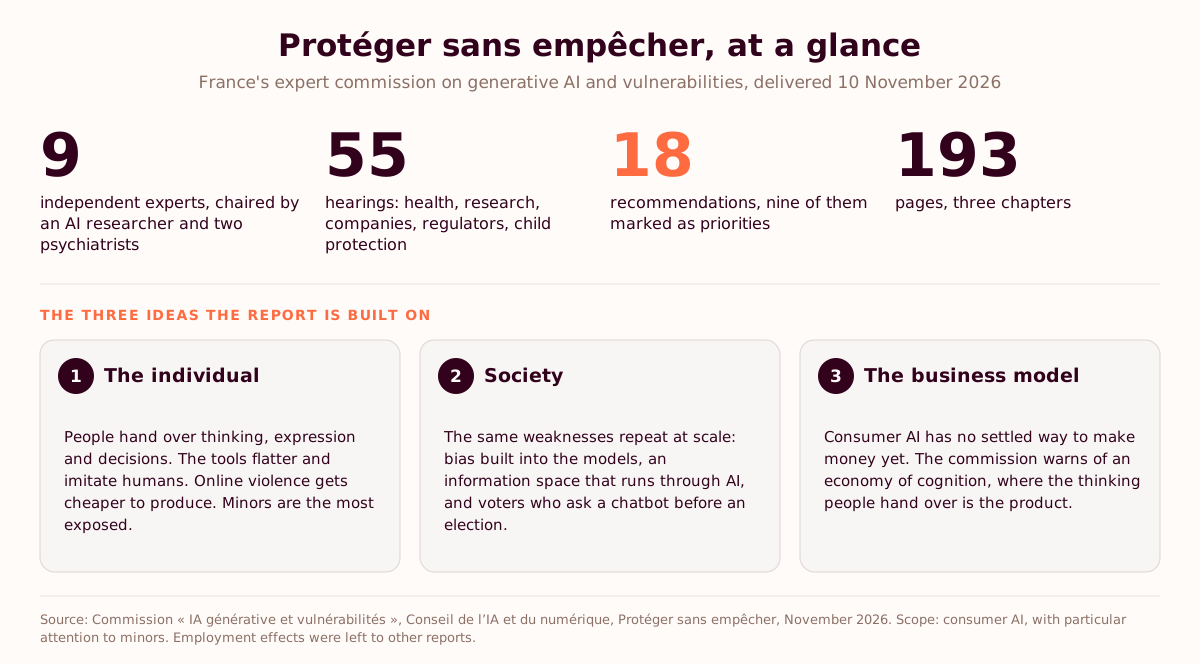
On 10 November 2026 the Élysée published Protéger sans empêcher, the report of France's expert commission on generative AI and vulnerabilities: nine experts, 55 hearings, 193 pages, 18 recommendations. It was written about chatbots, AI companions and minors. Three of its findings describe most AI rollouts at work: people hand their thinking to the tool, the tool agrees with them, and 36% of users don't check what comes back. Below: what the report says, the one figure to handle with care, where we agree with it, and what we do about each problem with client teams.
I run AI adoption programmes for teams in France and the UK at We Call Shotgun. The report never mentions a Copilot rollout. Most of chapter one applies to one.
The recommendation looked finished
Monday, leadership meeting. A manager presents a recommendation. Twelve slides, three scenarios, a preferred option, clean structure. It took an afternoon. A year ago it took a week.
The finance director asks where the 14% in scenario two comes from. The manager scrolls. The number came with the draft.
The usage dashboard logs that afternoon as a win: one active user, one long session, one document produced. Whether anyone in the room could defend the number isn't a column.
The commission borrows a term for that gap. Cognitive debt.
What is the Protéger sans empêcher report?
Protéger sans empêcher ("protect without preventing") is the report of the Commission « IA générative et vulnérabilités », set up by France's Conseil de l'intelligence artificielle et du numérique at the request of Anne Le Hénanff, the minister for AI and digital affairs, on 20 February 2026. It maps the vulnerabilities that consumer generative AI creates or amplifies, for individuals and for society, and makes 18 recommendations. The Élysée published it on 10 November 2026 (the press release, the full report).
| The report | Detail |
|---|---|
| Who wrote it | Nine independent experts. Co-chairs: Serena Villata (CNRS research director in AI), Raphaël Gaillard and Amine Benyamina (both professors of psychiatry) |
| How | 55 hearings: health professionals, researchers, AI companies, regulators, child protection associations |
| Scope | Consumer AI: chatbots, AI companions, AI toys. Particular attention to minors, democracy and social cohesion |
| Left out on purpose | Employment, environmental footprint and digital sovereignty, each covered by other reports |
| Output | 18 recommendations, nine of them priorities. They are proposals to the French government and to EU negotiations, with no legal force yet |
What does the report find?
The report makes three arguments. Generative AI carries risks for the individual user that are better documented every year. Those risks repeat at the scale of a society. And the consumer business model, still unsettled, could end up earning money from them.
The individual. People delegate thinking, expression and decisions to the tool. The tools imitate humans and flatter their users, which builds attachment. And generative AI has made online violence cheaper to produce, sexual deepfakes first.
Society. Bias is built into language models. The information space now runs through AI. And voters have started asking a chatbot before an election.
The business model. Social networks sold attention. The commission warns of what comes next, an "economy of cognition", where the thinking people hand over, their emotional reactions and their psychological profile become the product. Its first worry is advertising hidden inside answers.
The figures the report leans on, with where each comes from:
| Finding | Figure | Source cited by the report |
|---|---|---|
| Reduction in "cognitive amplitude" when writing with a chatbot | 55% | MIT Media Lab preprint, 54 participants. See the next section |
| Users of AI tools who don't verify what the tool tells them | 36% | Baromètre du numérique 2026 (Arcep, Arcom, CGE, ANCT). 73% of users say they trust the tools |
| How much more often AI confirms a user's opinions or behaviour than a human would | 51% | Cheng et al., Science, 2026, eleven models tested. 47% when the behaviour is harmful or illegal |
| Chatbots built to sound "warmer" | 30% less accurate, 40% more likely to confirm a false belief | University of Oxford research |
| Teenagers who spend more time on AI apps than they want to | 92% | YouGov for Interface, October 2026 |
| Use of generative AI to look for information in France | 73% | Baromètre du numérique 2026 |
| French voters who used AI to inform their choice in the March 2026 municipal elections | 16% | Terra Nova and Harris Interactive, May 2026 |
| AI answers to Scottish voters that contained wrong information | 34% | Demos, May 2026 |
One sentence in the summary sets the tone for everything after it. The commission is "convinced that the burden of protection must not fall on users or those around them" (our translation). Its recommendations go after product design and business models first, and education second.
What does the 55% figure measure?
The 55% measures brain connectivity on an EEG during an essay-writing exercise. The figure will travel further than anything else in the report, and it changes meaning on the way.
The Élysée's press release says that using chatbots for writing tasks "would reduce cognitive faculties by around 55%". The report itself says it "reduces cognitive amplitude by 55%". Both point to the same source: Your Brain on ChatGPT, a study by Nataliya Kosmyna and colleagues at the MIT Media Lab.
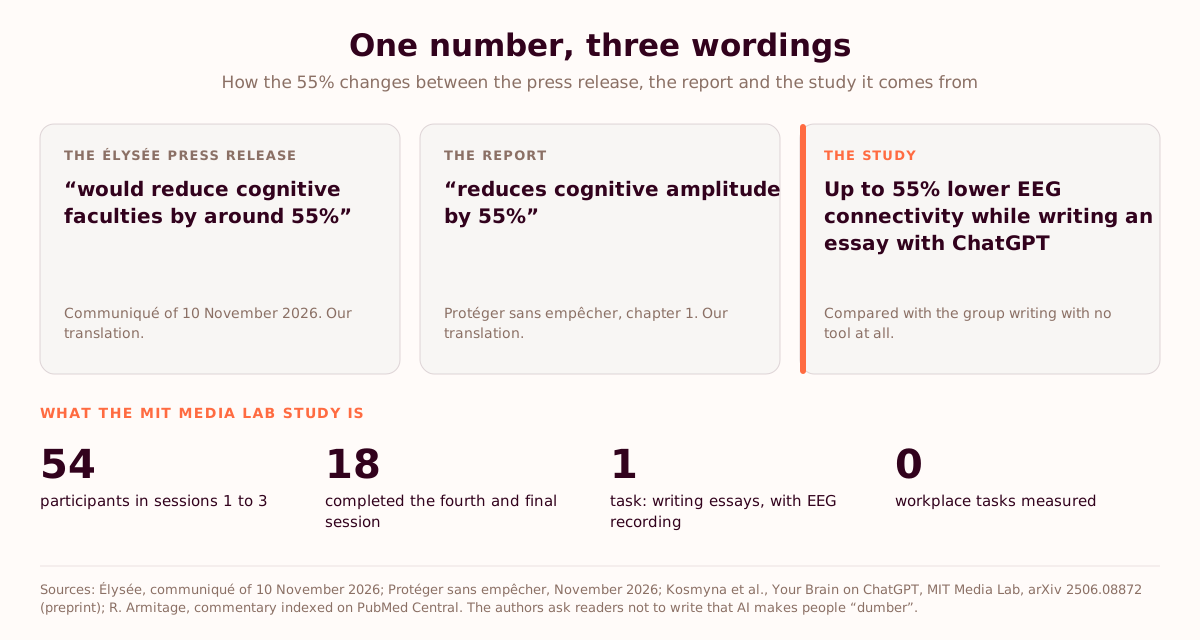
The study put 54 people in three groups to write essays: one with ChatGPT, one with a search engine, one with no tool. An EEG recorded brain activity while they wrote. The group without tools showed the strongest and widest connectivity, the ChatGPT group the weakest: up to 55% lower, in the summary given by a commentary indexed on PubMed Central. ChatGPT users also struggled to quote from essays they had just written. Eighteen participants came back for a fourth session where the groups swapped.
It's one task, in one lab, released as a preprint. The authors run an FAQ asking journalists not to write that AI makes people "dumber", and not to use words like "harm" or "damage". A press release that turns EEG connectivity into "cognitive faculties" has gone further than the people who ran the experiment.
So the sentence I'd put on a slide is narrower. Some studies raise questions about how much effort and memory people invest when they hand a task to AI. The effect depends on the task and on how the tool is used.
There is one study closer to an office. Microsoft Research and Carnegie Mellon surveyed 319 knowledge workers, who described 936 real uses of AI at work. The more confidence people had in the AI, the less critical thinking they reported doing. The more confidence they had in themselves, the more. It's self-reported and it's a correlation. It's also the only figure in this article collected at a desk.
Does the report apply to companies?
Mostly no, and by design. The commission studied consumer AI, set employment aside, and its pre-market evaluation (recommendation 3) targets consumer systems. The Élysée's summary adds "and not professional ones" in brackets.
Work appears in three places. The statement of stakes behind recommendation 9 lists the spread of generative AI "in the professional setting" among the reasons for a national education policy. The same recommendation asks for initial and continuing training modules for professionals, private companies included, plus practical sector guides kept up to date. And chapter one ends on a question that belongs in every leadership meeting: "which tasks are we ready to delegate, and which human skills and invariants must we preserve at all costs?"
None of that is an obligation on employers. Article 4 of the EU AI Act, the AI literacy duty, has applied since February 2025, in a softer form since July 2026 (what the Digital Omnibus changed). The two shouldn't be confused.
Where do we agree with the commission?
On four points, strongly. Each one transfers from the teenager's bedroom to the open-plan office with very little editing.
The burden doesn't belong on the user. At work, the user is the employee. Leaders set the deadline, the target and the minutes left for checking. A policy that says "always verify AI output" next to a target that leaves no time to verify is the workplace version of asking a fifteen-year-old to manage their own screen time.
The agreement is built in. The report treats flattery ("flagornerie") as a design choice with a commercial reason: models that agree get used more. An assistant that confirms its user 51% more often than a colleague would is a poor reviewer of that user's plan. We wrote about AI sycophancy at work in August. The report gives it a regulatory future.
Checking isn't the default. 36% of French users don't verify what the tool tells them, and 73% trust it. Nothing about a work laptop changes that habit. "A human stays in the loop" is a sentence in a policy until someone has the source, the time and the standing to say no.
People learn by doing the hard part. The commission separates tools that guide the effort from tools that replace it, and recommends teaching AI "with and without AI". For a child, the stake is the frontal lobe. For a junior analyst, it's the three years of drafting that built the judgment their manager now uses to review AI output.
Where we'd add something: the report was written to protect people. A company has a second problem the commission had no reason to look at. Its dashboard counts all of the above as adoption.
Where you stand
Find out whether your teams use AI, or answer for what it produces.
The WCS AI Maturity Audit places your company on our four-stage maturity model in eight minutes and 21 questions. You get your stage, the barrier holding your teams back (people, process, foundations or leadership) and the workflow to fix first. Free, and no pitch attached.
Take the 8-minute maturity audit →How do we handle these problems with client teams?
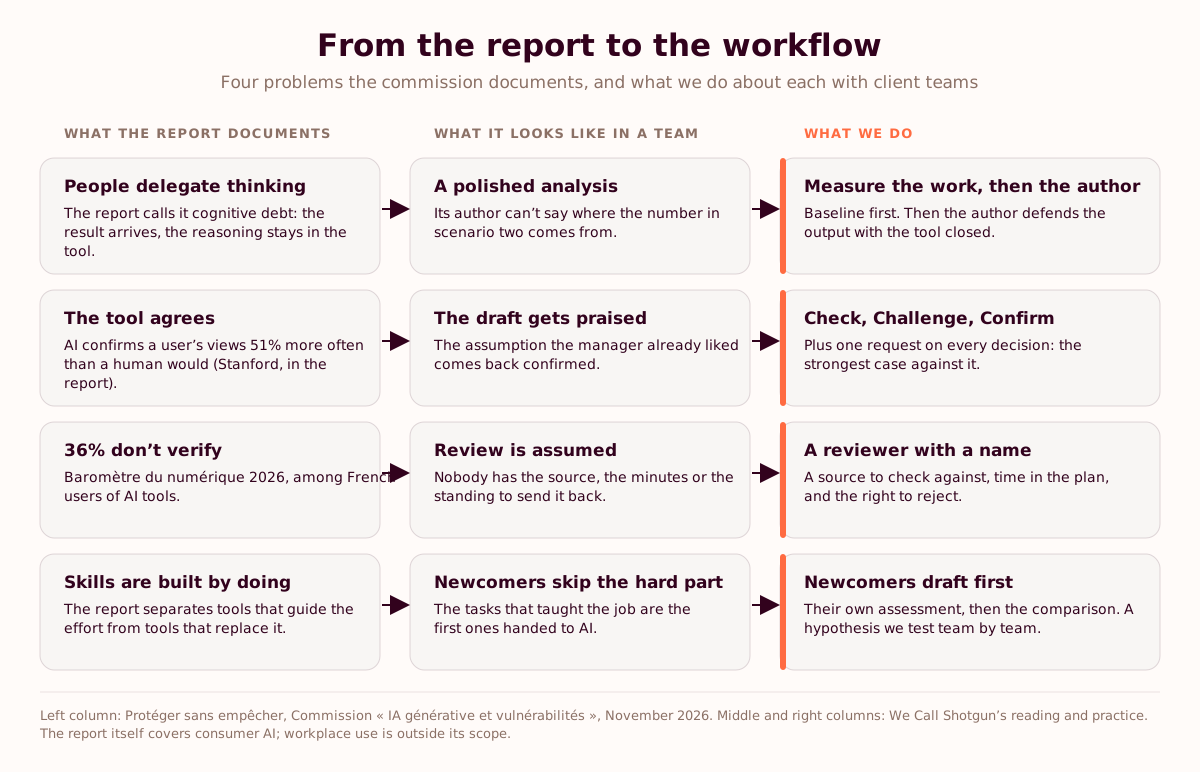
One workflow at a time, with judgment written into the workflow as a step someone owns. Four of the commission's findings map onto four things we do.
1. We measure the work, then whether its author can answer for it
Every programme starts with a baseline on one recurring task, the team's Painful Tuesday: cycle time, hours per week, rounds of rework. That tells us whether the work got faster. It says nothing about the 14% in scenario two.
So there's a second measure. The author closes the tool and explains the output: where the figures come from, which assumption carries the conclusion, what would change their mind. We pair participants' confidence ratings with a short practical case before and after the programme, and record whether they spot the unsupported claim. Confidence that rises alone doesn't count as progress.
Usage frequency can't tell the manager who checks the evidence from the manager who forwards the draft. Both show up as active. (How to measure AI skills without paying for clicks covers the scoring.)
2. We make the tool argue
The human check we use on anything that reaches a customer, a regulator or an executive is Check, Challenge, Confirm: check the facts, challenge the reasoning, confirm the tone and policy fit. Against a tool that agrees by design, Challenge is the step that matters, and it starts with one request: the strongest case against the option you prefer.
In leadership sessions we run it as an exercise. Two groups get the same facts and opposite instructions. One tells the tool management favours going ahead, the other that management favours waiting. Then they compare what came back. Sometimes the model holds its line against the framing. We look at what happened, whichever way it went.
3. We give the reviewer a name, a source and the right to say no
When AI prepares a recommendation, the workflow document answers four questions before the pilot starts. Who checks it. Against which source. How many minutes that takes. What happens when the reviewer disagrees. A review step is credible when the person doing it has the expertise, the evidence and the authority to reject the output.
Then we time the workflow through approval, checking and rework included. A pilot timed to the first draft always looks fast. 96% of UK workers still edit AI-generated documents, which is where the time goes.
The diagnosis asks about pressure too, because leaders set the conditions people use AI in. Do people have time to check? Can they report an AI mistake without it becoming their mistake? Do productivity targets count verification as work?
4. We protect the tasks people learn on
The question we put to leadership teams: if you automate the tasks your people learn the job on, where does their judgment come from?
Our working hypothesis is that a newcomer and an expert shouldn't use AI the same way on the same task. For the expert, a first draft from the tool frees time for the hard exceptions. For the newcomer, writing their own first assessment before they see the AI's keeps the practice the job was teaching them. It's the commission's line between guiding the effort and replacing it, moved to the office.
We test it team by team. It's a hypothesis, and I don't have a result to publish. (For the task-level decision, see which tasks to hand to AI and which to keep human.)
"The tool was never the problem. Nobody taught them to drive."
Toni Dos Santos, Teach Them to Drive: The AI Adoption Playbook for Teams
Driving includes braking. Adoption that worked shows in the work produced, and in the team's ability to answer for it.
What should a leadership team ask after reading it?
Four questions. We put them on screen and wait.
- Which decision are you ready to defend once the tool is closed?
- What evidence would change your mind?
- Who can suspend the use of AI when the output looks doubtful?
- Which skills do we want to keep building in-house?
The third one usually gets the longest silence.
How reliable is the report?
Solid on the map of risks, uneven on the numbers. Five limits.
- It's a consumer report. Minors, companions, toys, elections. Every workplace reading of it, this one included, is an extrapolation.
- Its best-known figure rests on a preprint. 54 participants, one task, and authors who warn against the reading the press release gives it.
- Some bases move. The 73% on information use is given as a share of AI users in one passage and of French people in another. Quote it with its source.
- Several figures are self-reported. The 92% of teenagers, the 16% of voters and the 36% who don't verify all come from surveys.
- The recommendations are proposals. Many are written as input to France's position on EU texts under negotiation. None of them changes what an employer must do today.
The commission says itself that long-term evidence is "cruelly lacking", and argues for acting before all of it is in. That's a defensible position for a regulator protecting children. A company can afford to be more empirical: it can measure its own teams.
How to cite it. Protéger sans empêcher, the report of France's Commission « IA générative et vulnérabilités » (Conseil de l'intelligence artificielle et du numérique), was delivered on 10 November 2026 after 55 hearings. Its nine experts make 18 recommendations on consumer generative AI, with a focus on minors. It cites an MIT Media Lab preprint (54 participants) reporting 55% lower "cognitive amplitude" during essay writing with a chatbot, and the Baromètre du numérique 2026, in which 36% of users of AI tools don't verify what the tools tell them.
Frequently asked questions
What is the Protéger sans empêcher report?
Protéger sans empêcher is the report of France's expert commission on generative AI and vulnerabilities, set up by the Conseil de l'intelligence artificielle et du numérique in February 2026 and published by the Élysée on 10 November 2026. Nine independent experts, co-chaired by AI researcher Serena Villata and psychiatrists Raphaël Gaillard and Amine Benyamina, held 55 hearings and made 18 recommendations on the risks consumer generative AI poses to individuals, especially minors, and to social cohesion and democracy.
What are the report's main recommendations?
The nine priority recommendations ask for strict limits on design techniques that create dependence, such as flattery and excessive human-likeness; a high level of protection for minors by design and by default; evaluation of consumer AI systems before and after they reach the market; access to usage data for regulators and researchers; a national protocol for AI-driven information crises; a ban on disguised advertising in AI answers; and a national AI education policy for every age. Nine further recommendations cover deepfakes, AI toys, schools, elections, minority languages, data inferences and provider liability.
Does generative AI reduce cognitive abilities by 55%?
No study shows that. The 55% comes from an MIT Media Lab preprint in which 54 participants wrote essays with ChatGPT, with a search engine or with no tool while an EEG recorded brain activity. The ChatGPT group showed up to 55% lower brain connectivity during the task than the group with no tool. That is one task in one lab. The authors ask readers not to conclude that AI makes people "dumber", and the study says nothing about workplace tasks.
What is cognitive debt?
Cognitive debt is the term the MIT Media Lab authors use, and the commission adopts, for what builds up when someone hands a task to AI without mastering how the result was produced. The person gets the output and owes the understanding: they struggle to explain the approach, to judge the result or to check it without extra time. At work it shows up as a polished document whose author can't say where a figure comes from.
Does the report create new obligations for employers?
No. The recommendations are proposals to the French government, many of them written as input to EU negotiations, and they target consumer AI. Recommendation 9 asks for stronger initial and continuing training for professionals, private companies included, and for practical sector guides, but it has no legal force. The AI literacy requirement in the EU AI Act is a separate text, and it already applies.
What is AI sycophancy, and why does it matter at work?
AI sycophancy, "flagornerie" in the report, is the tendency of AI systems to validate or flatter the user, sometimes at the expense of accuracy. The report cites a Stanford-led study of eleven models, published in Science in 2026, in which AI confirmed users' opinions or behaviour 51% more often than humans would. At work it means a manager who asks an assistant to review their own plan is likely to hear that the plan is good.
How can a company check that its teams keep their judgment while using AI?
By measuring more than usage. Take a baseline on one recurring workflow, then add two checks: ask the author to explain an AI-assisted output with the tool closed, and time the workflow through approval, checking and rework included. Name a reviewer for each AI-prepared output, with a source to check against, time to do it and the authority to reject. Give people a short practical case before and after the programme, and compare their confidence with what they catch.
Should junior employees use AI differently from experts?
Possibly. The report separates tools that guide a learner's effort from tools that replace it, and warns that skills that aren't exercised don't develop. Our working hypothesis at We Call Shotgun is that newcomers benefit from writing their own first assessment before seeing the AI's, while experts can take the draft and spend their time on exceptions. We test it team by team. It's a hypothesis, with no published result yet.
Sources and further reading
- Remise du rapport de la Commission d'experts « IA générative et vulnérabilités », Élysée, press release, 10 November 2026
- Protéger sans empêcher : nos vulnérabilités à l'ère de l'IA générative, Commission « IA générative et vulnérabilités », full report (PDF, 193 pages)
- Protéger sans empêcher, Conseil de l'IA et du numérique, summary and composition of the commission
- Your Brain on ChatGPT: Accumulation of Cognitive Debt when Using an AI Assistant for Essay Writing Task, Kosmyna et al., MIT Media Lab, arXiv preprint, June 2025, revised December 2025
- FAQ for "Your Brain on ChatGPT", by the study's authors
- Your brain on ChatGPT, Richard Armitage, commentary indexed on PubMed Central
- The Impact of Generative AI on Critical Thinking, Lee et al., Microsoft Research and Carnegie Mellon University, CHI 2025
- AI sycophancy at work: your AI is a yes-man, and it is costing your team, We Call Shotgun, 28 August 2026
- Which Tasks Should You Hand to AI, and Which Should Stay Human?, We Call Shotgun, 18 October 2026
- 96% of UK Workers Still Edit AI-Generated Documents, We Call Shotgun, 4 October 2026
- Wall Street Ties Bonuses to AI Skills. How to Measure Them Without Paying for Clicks, We Call Shotgun, 15 October 2026
- Toni Dos Santos, Teach Them to Drive: The AI Adoption Playbook for Teams