The average UK business now spends £20.6 million a year on AI, 27% more than in 2025, and 11% of UK businesses say they invest in it strategically. Seven in ten are piloting agents. Almost half say the agents are arriving faster than the rules for running them. Those are the headline figures from the 2026 edition of the Value of AI in the UK, the SAP and Oxford Economics study published on 14 October 2026. Below: every figure with what it counts, where the government's own numbers agree, and the sequence we use to turn a budget line into a workflow that runs differently.
I run AI adoption programmes for teams in the UK and France at We Call Shotgun. In October the calls change. Nobody asks about tools any more. They ask what to put in the budget paper.
The budget went up. The week didn't change
You sit on the leadership team of a 400-person company. The AI line in next year's budget is bigger than this year's, which was bigger than last year's. Marketing has Copilot. Finance has an agent a vendor set up in August to match invoices. Customer service has a different one, from a different vendor. IT has an AI policy, version three, which nobody in either pilot has read.
A board member asks what changed this year because of AI. The honest answer is the invoices.
SAP and Oxford Economics have now measured that answer across UK businesses, for the second year running.
What did the SAP Value of AI in the UK 2026 report find?
UK AI spending rises every year, and most businesses still spend it one department at a time. The average UK business spends £20.6 million a year on AI, up 27% on 2025, and plans to raise that by another 45% over the next two years. Businesses expect a 22% return on that spend this year and 39% within two years. 11% describe their approach to AI investment as strategic and company-wide, up from 7% a year ago. 41% call their approach piecemeal, and 40% invest at departmental level. 70% are piloting agents, 49% say agents are being deployed faster than they can be governed, and 9% say their governance skills are fully ready.
Oxford Economics ran the study for SAP as an online survey of 2,600 director-level and above respondents across 13 countries, between March and May 2026. The UK findings went out on 14 October 2026 (SAP's release, the full report).
Every headline figure, with what it counts:
| Finding | Figure | What it counts |
|---|---|---|
| Average annual AI spend per UK business | £20.6m | A mean, converted from US dollars. Up 27% on 2025 |
| Planned rise in AI investment over the next two years | +45% | An intention |
| Expected return on AI investment | 22% in 2026, 39% within two years | Expectations, not measured returns |
| Strategic, company-wide approach to AI investment | 11% | Up from 7% in 2025 |
| Piecemeal approach to AI investment | 41% | Self-described |
| AI investment made at departmental level | 40% | Self-described |
| Piloting agent-based use cases | 70% | Pilots, not production |
| Agents deployed faster than they can be standardised and governed | 49% | Agree with the statement |
| Governance skills and expertise fully ready | 9% | 61% are still developing the formal processes and oversight |
| Expected average return from agentic AI | £2.7m in 2025, £12.6m within two years | Expectations |
| Data quality or availability limits the value they get from AI | 70% | Agree with the statement |
| Getting the most from AI needs workforce transformation beyond technical upskilling | 79% | Agree with the statement |
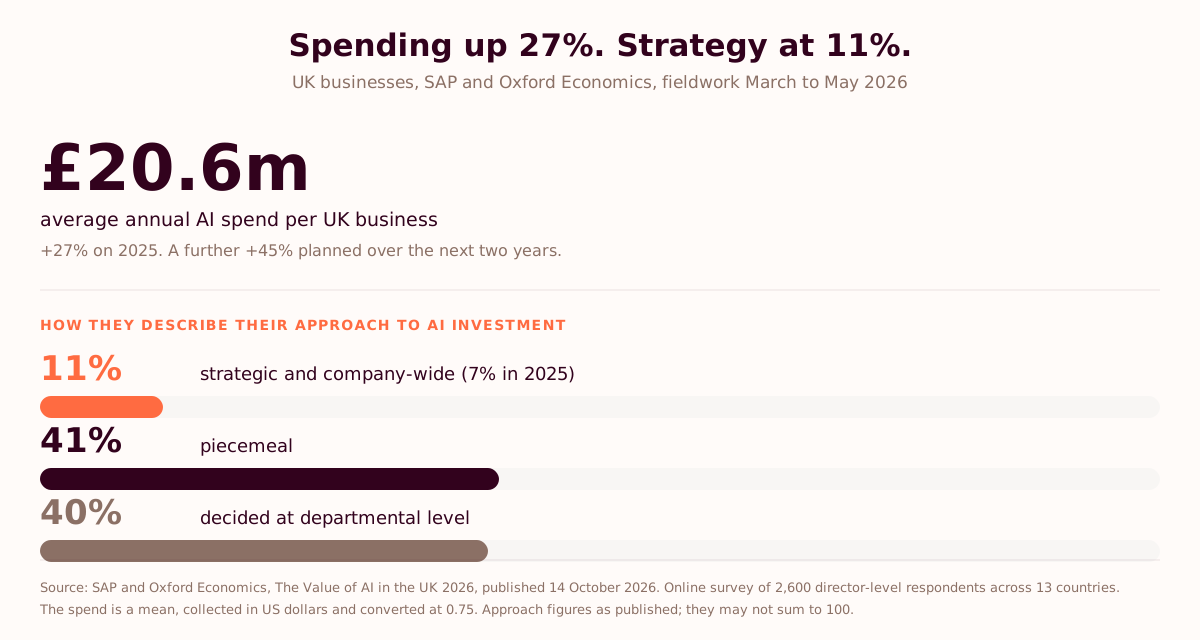
Three of those numbers will travel: the spend, the return and the 11%. Read them together. A budget that grows 27% in a year while the strategic share sits at 11% is a budget approving departmental requests faster than anyone joins them up.
Why does AI spending rise while strategic adoption stays scarce?
AI spending rises faster than strategy because a budget is easy to approve and a strategy needs someone to own a workflow. Each department has a budget holder, a vendor and a use case. Nobody has the Tuesday. So the licences get bought, the pilots get started, and the 41% piecemeal figure is what three budget cycles of that look like from the top.
The pattern held from one edition to the next. In 2025 the strategic share was 7% and the plan was to raise investment by 40% over two years. In 2026 the investment went up and the strategic share moved four points. Money moves faster than operating models, which is not a finding anyone needed a survey for.
In our glossary the first state is activation: people have the tool and log into it. Adoption is when a piece of work runs differently because of it. A departmental purchase buys activation. Adoption needs a process owner, a baseline and a check, and none of those come with the licence.
"The tool was never the problem. Nobody taught them to drive."
Toni Dos Santos, Teach Them to Drive: The AI Adoption Playbook for Teams
The same shape shows up on my intro calls. In September 2026 I counted the last 16 with new leads: 13 companies already had AI tools rolled out, and ten said usage was low or stuck on the basics (the count, in our piece on UK adoption plans). They had spent the money. What they couldn't name was a workflow that ran differently because of it.
Why are AI agents arriving faster than governance?
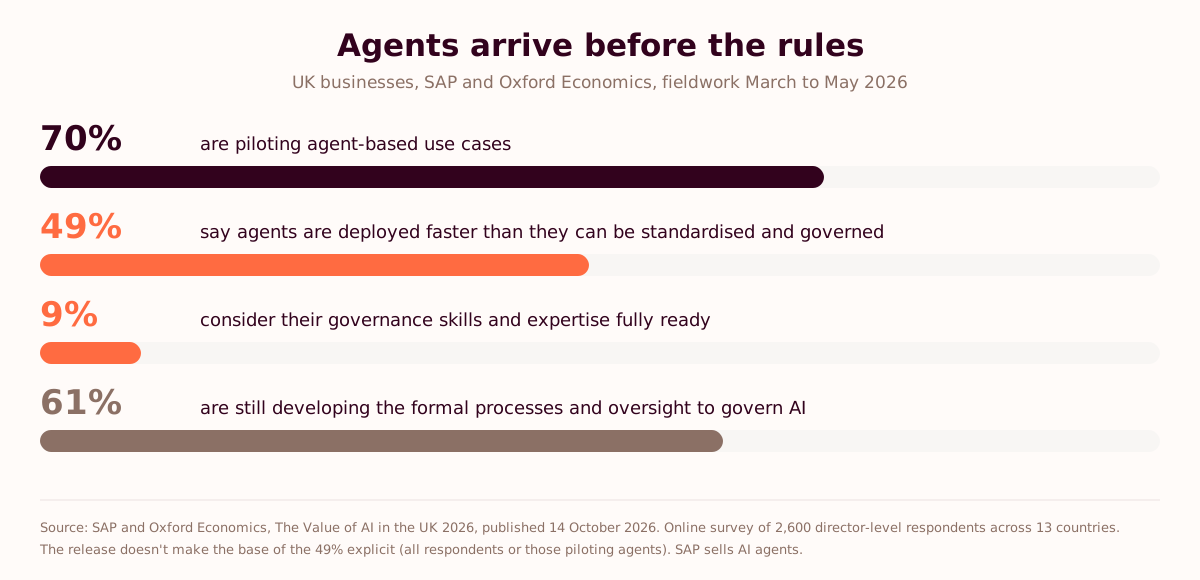
AI agents outrun governance because a vendor can switch an agent on in days and a governance process takes a quarter. In the SAP and Oxford Economics survey, 70% of UK businesses are piloting agent-based use cases. 49% say agents are being deployed faster than they can be standardised and governed. 9% consider their governance skills and expertise fully ready, and 61% are still developing the formal processes and oversight needed to govern AI at all.
An agent is software that takes several steps on the company's behalf to reach a goal: reads the invoice, matches it to the order, drafts the query to the supplier, retries when the portal times out. A chatbot answers and stops. An agent keeps going. That's the appeal, and it's the governance problem in one sentence. The thing keeps going.
Governing an agent takes four things written down before the pilot starts, and none of them needs a committee. Who owns the workflow it runs. What the process is, step by step, exceptions included. Where the human check sits and what it checks: we use Check, Challenge, Confirm, which is check the facts, challenge the reasoning, confirm the tone and policy fit. And what gets logged, so that when the agent does something odd on a Thursday evening, someone can see what it did and stop it.
The 49% describes a sequencing problem, and sequences can be fixed. Pilots arrive first because a vendor can set one up in days, and the vendor's interest ends at the pilot. Governance arrives second because it has to be written by the people who own the process, who are busy running it. My guess is that the 9% wrote the process down before they bought the agent. Nobody sells that step.
A second 70% is the quieter one. Seven in ten UK businesses say data quality or availability limits the value they get from AI. An agent working from bad data reaches the wrong answer faster, at scale, with a log entry to prove it.
For the regulatory side, what the ICO expects from UK companies on AI governance covers the framework, our piece on shadow AI covers the tools nobody approved, and which tasks to hand to AI and which to keep human is the decision an agent pilot forces. The free AI policy generator drafts the written policy in a few minutes, which still leaves the process to write.
Where you stand
Find out whether your company is in the 11% or the 41%.
The WCS AI Maturity Audit places your company on our four-stage maturity model in eight minutes and 21 questions. You get your stage, the barrier holding your teams back (people, process, foundations or leadership) and the workflow to fix first. Free, and no pitch attached.
Take the 8-minute maturity audit →What does the UK government's own data say?
The government's own data says AI use in UK businesses is broad and shallow. The Office for National Statistics found 35% of UK businesses with 10 or more employees using at least one AI technology in June 2026, up from about 12% in late 2023. It described adoption as "relatively shallow": adopters used about 1.6 AI technologies on average, and 10% of them used AI extensively. Its October 2026 business survey put use at 30% across businesses of all sizes in September 2026. The Department for Science, Innovation and Technology's own adoption research, based on 3,500 business interviews in 2025, found 16% using AI and a further 5% planning to.
The three government figures differ because they count different things: every business or only those with 10 or more staff, a telephone survey in 2025 or an online one in 2026. None of them disagrees on the shape. Use is rising, and it's thin.
Put the vendor survey next to the official ones. SAP asked directors of companies that can spend millions how much they spend and what they expect back. The ONS asked every size of company whether anyone uses AI at all.
One dataset is counted in pounds and the other in "relatively shallow". Two views of the same country: from the boardroom and from the desk, and the desk is where the return gets made. (Our breakdown of the ONS figures; every UK SME AI statistic with its source, updated monthly.)
What does Teach Them to Drive say about budget without strategy?
Teach Them to Drive reads a rising budget without a workflow owner as the leadership problem solved on paper, with the other two problems, people and process, handed to whoever signed the purchase order. Three ideas from the book line up with the figures.
The budget is a leadership decision. The workflow is a process decision. Neither works alone. The book diagnoses stalled adoption as three problems: people, process and leadership. A budget settles one of them. The 41% piecemeal figure is what the other two look like after a few budget cycles of delegation.
Value Migration explains why governance became the expensive part. When AI collapses the cost of execution, the value on a team moves to judgment, framing and evaluation. An agent is execution at near-zero cost. The value now sits with whoever decides what it may do, checks what it did and owns the result. In the book's terms, the 9% moved people to where the value went, which is the same move as writing the process down and naming the check before the agent arrived. That's my reading of the figure, not the report's.
One workflow, one number. The book's second half is a 90-Day Playbook: six two-week phases that take one team from "we have the tool" to "this workflow runs differently, and here's the before-and-after". It was written for the manager who has the licences and no mandate. It works the same for the director who has the budget and no workflow, because the first phase is identical: pick the job.
How do you turn AI spend into measured change?
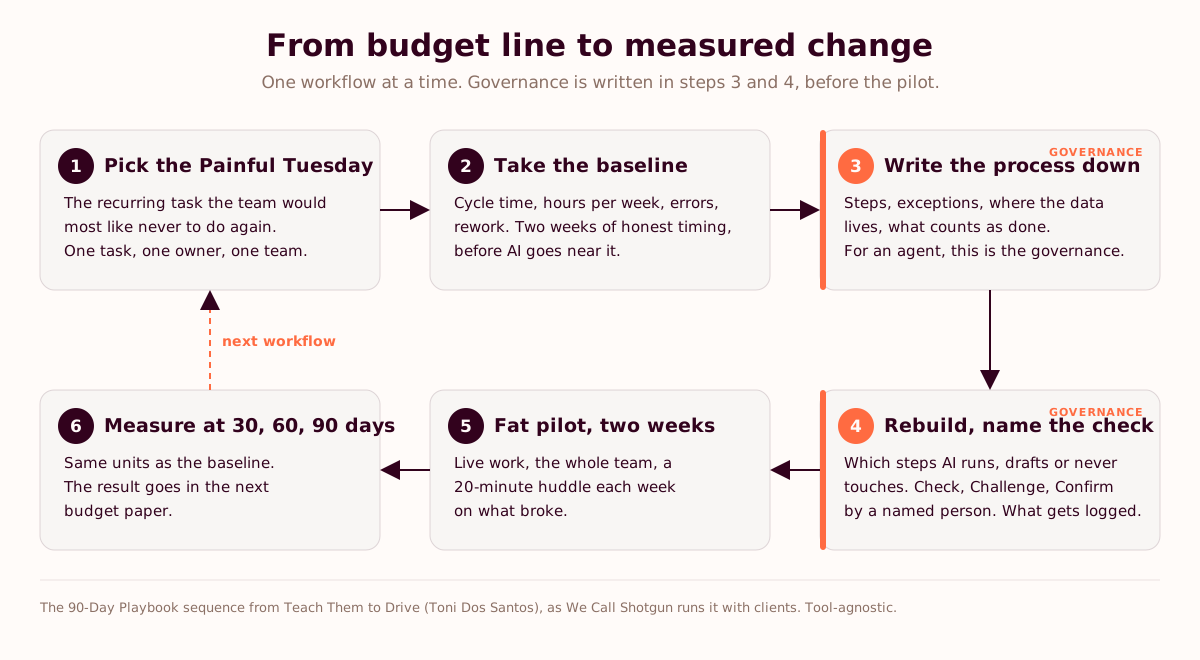
One workflow at a time, with the number taken before anything changes and the governance written as part of the pilot rather than after it. This is the sequence we run with clients. It fits inside one budget cycle.
- Pick the Painful Tuesday in the department with the biggest AI line. The recurring task the team would most like never to do again: month-end close, invoice matching, first-line support triage, proposal assembly, supplier onboarding. One task, one owner, one team.
- Take the baseline before AI goes near it. Cycle time, hours per week, error rate, rounds of rework. Two weeks of honest timing. This is the number the board will ask for in March, so take it in October.
- Write the process down, exceptions included. Step by step: who does what, where the data lives, what counts as done. For an agent, this document is the governance. If it can't be written, the agent can't be governed, and the pilot waits.
- Rebuild it with AI on the steps where it saves time, and put the human check in writing. Which steps the tool or agent handles, which it drafts, which it never touches. A named person runs Check, Challenge, Confirm on anything that reaches a customer, a supplier, a regulator or the ledger. What gets logged, and who reads the log.
- Run a fat pilot: two weeks, live work, the whole team. Real invoices, real tickets, everyone who touches the task, a 20-minute huddle each week on what broke. Thin pilots with two volunteers and test data produce slides. Fat pilots produce a number.
- Measure at 30, 60 and 90 days against the baseline, in the same units. If the number moved, the next budget paper has a line that says what changed. If it didn't, the problem is upstream in the process or the data, and it gets fixed before the next workflow starts.
What the two approaches look like from the inside:
| Piecemeal (the 41%) | Workflow-first (the way into the 11%) | |
|---|---|---|
| Who owns it | Whoever signed the purchase order | The person who runs the workflow |
| What's measured | Licences, logins, seats activated | Cycle time and hours against a baseline |
| Where governance lives | A policy document, read by its author | Inside the written process: the check, the log, the owner |
| What agents run | Whatever the vendor demoed | A process that was written down first |
| What the board sees | Spend, up 27% | One workflow, before and after, then the next |
That sequence is the method behind our AI strategy consulting and our AI consulting for UK SMEs and mid-market companies, tool-agnostic across ChatGPT, Copilot, Gemini and Claude. The AI ROI calculator turns the baseline into a £ figure for the budget paper. If you can't yet see what each team spends and uses, start with the spend dashboard. For the agent-specific choices, our vendor-neutral benchmark of enterprise AI agents covers what each one can be allowed to do.
The line in the budget
Bring the AI budget line you can't yet explain to the board.
Twenty minutes with Toni or Meera. You'll leave knowing which workflow to start with, the baseline to take this week, and what a 90-day sprint on it would change. Tool-agnostic, so nobody on the call is selling you a licence or an agent.
Book a 20-minute call →How reliable is the SAP and Oxford Economics research?
Reliable enough to quote for the shape, with five limits attached.
- It's vendor-commissioned. SAP sells AI, agents included, and the questions about agentic returns are the questions a vendor would ask. Read the diagnosis (49%, 9%, 61%) and the remedy separately.
- The sample is senior and the companies are large. 2,600 director-level and above respondents across 13 countries, online, March to May 2026. The release doesn't state the UK sub-sample. An average spend of £20.6 million describes companies that can spend £20.6 million. It says nothing about a 60-person firm.
- The spend is a mean. A few very large budgets pull it up. The figures were collected in US dollars and converted at 0.75.
- Returns are expectations. The 22%, the 39% and the £12.6 million are what directors expect, not what finance has measured.
- Some bases aren't explicit. Coverage reads the 49% both as all respondents and as those piloting agents. The three approach figures (11%, 41%, 40%) are reported separately and may not come from one question. Quote them as published.
For a weighted official series, use the ONS, which surveys around 38,000 businesses a wave and publishes its method.
How to cite it. Research by SAP and Oxford Economics, published on 14 October 2026 and based on an online survey of 2,600 director-level respondents across 13 countries between March and May 2026, found that the average UK business spends £20.6 million a year on AI, up 27% on 2025. 11% of UK businesses described their approach to AI investment as strategic and company-wide. 70% were piloting agent-based use cases, and 49% said agents were being deployed faster than they could be standardised and governed.
How does your company compare with the report?
Six questions. The report answers the first five for its sample. Only your own budget paper answers the sixth, and it's the one that matters.
| Question | Report figure | How to answer it for your company |
|---|---|---|
| Is the AI budget going up? | +27% in 2026, +45% planned | Probably yes. The least useful of the six answers |
| Is there one approach to the spend? | 11% strategic, 41% piecemeal, 40% departmental | List the AI purchases of the last 12 months and who signed each. More signatures than workflows puts you in the 41% |
| Are you piloting agents? | 70% | Name them, and name the person who owns each one's process |
| Are the agents governed? | 49% say they outrun governance, 9% ready | For each agent: is the process written, is the check named, is there a log. Three yeses, or it's ungoverned |
| Does the data hold up? | 70% say it limits value | Ask the pilot team what they fix by hand before the agent can run |
| Has one workflow changed, with a number? | Not asked | Name it and the before-and-after. The other five hang on this one |
The one most leadership teams can't answer is the last. It's also the only one that belongs in a budget paper.
The playbook
Teach Them to Drive: The AI Adoption Playbook for Teams
The 90-Day Playbook in the second half is the six-step sequence above, with the worksheets: the Painful Tuesday inventory, the four metrics, the 90-Day Scorecard we use with clients. Written for the manager who has the licences and not the Tuesday, and for the director who has the budget and not the workflow.
Get the book →Frequently asked questions
What is the SAP Value of AI in the UK 2026 report?
The SAP Value of AI in the UK 2026 report is the second annual study of AI investment and returns in UK businesses, run by Oxford Economics for SAP. It's based on an online survey of 2,600 director-level and above respondents across 13 countries between March and May 2026, with UK findings published on 14 October 2026. The headline figures: the average UK business spends £20.6 million a year on AI, 11% take a strategic, company-wide approach to that investment, 70% are piloting agent-based use cases and 49% say agents are being deployed faster than they can be standardised and governed.
How much do UK businesses spend on AI in 2026?
£20.6 million a year on average, according to the SAP and Oxford Economics report, up 27% on 2025. Businesses plan to raise that by a further 45% over the next two years and expect returns of 22% in 2026 and 39% within two years. The figure is a mean across a director-level sample of large companies, collected in US dollars and converted to sterling, so it doesn't describe a typical UK SME.
What percentage of UK businesses have a strategic approach to AI?
11% of UK businesses take a strategic, company-wide approach to AI investment, up from 7% in 2025, according to SAP and Oxford Economics' Value of AI in the UK 2026. 41% call their approach piecemeal and 40% invest at departmental level; the report publishes the three figures separately. In practice, a strategic approach means a named owner for each AI-assisted workflow, a baseline taken before the tool arrives and a measured before-and-after, rather than a set of departmental purchases.
How many UK businesses are piloting AI agents?
70% are piloting agent-based use cases, according to the SAP and Oxford Economics report. Expected average returns from agentic AI rise from £2.7 million in 2025 to £12.6 million within two years. Those are pilots and expectations: the report doesn't say how many agents have reached production or how many returns have been measured.
Why are AI agents being deployed faster than governance?
Because a vendor can switch an agent on in days, while governance has to be written by the people who own the process. That's our reading; the report measures the gap, not its cause. In SAP and Oxford Economics' 2026 survey, 49% of respondents said agents are being deployed faster than they can be standardised and governed, 9% considered their governance skills fully ready and 61% were still developing the formal processes and oversight. The fix is sequencing: write the process down and name the human check before the pilot starts.
What does AI agent governance involve in practice?
AI agent governance in practice is four things written down before the pilot starts: who owns the workflow the agent runs, the step-by-step process including exceptions, where the human check sits and what it checks (Check, Challenge, Confirm: the facts, the reasoning, the tone and policy fit), and what gets logged so someone can see what the agent did and stop it. None of it needs a committee. All of it needs the process on paper, which is the step most pilots skip.
How does the SAP data compare with ONS figures on AI adoption?
They measure different things. SAP surveyed directors of large companies about spend and expected returns. The ONS found 35% of UK businesses with 10 or more employees using at least one AI technology in June 2026 and 10% of adopters using it extensively, and called adoption "relatively shallow". Its October 2026 survey put use at 30% across all businesses. DSIT's 2025 adoption research found 16% using AI. Read together, the spend is large and the use is thin.
How can a company move from piecemeal AI spending to a strategy?
One workflow at a time, with a number attached. Pick the recurring task in the department with the biggest AI line, take a baseline of cycle time and hours before anything changes, write the process down with its exceptions, rebuild it with AI and a named human check, run it live for two weeks with the whole team, then measure at 30, 60 and 90 days against the baseline. The measured result goes in the next budget paper, and the next workflow starts.
Does the £20.6m average apply to UK SMEs?
No. The £20.6 million is a mean across a director-level sample of companies that can spend millions on AI, collected in US dollars and converted to sterling, and the release doesn't state the UK sub-sample. For a UK SME the official series is more useful: the ONS found 35% of businesses with 10 or more employees using AI in June 2026 and 28% of those with fewer than 10. The number that matters for an SME is its own: the hours one workflow takes before and after AI.
Sources and further reading
- Average UK business spending £20.6 million on AI, with returns set to rise to 39% by 2028, SAP UK News Center, 14 October 2026
- The Value of AI in the UK 2026, SAP and Oxford Economics, full report (PDF)
- The Value of AI 2026, Oxford Economics, methodology and global findings
- UK business investment in AI to rise by 40% on average over the next two years, SAP UK News Center, October 2025 (the 2025 edition, with the 7% strategic share)
- UK firms are spending more on AI than ever before, but still think data is holding them back, TechRadar Pro, October 2026
- Artificial intelligence in UK businesses: 2023 to 2026, Office for National Statistics, 20 July 2026
- Business insights and impact on the UK economy: 8 October 2026, Office for National Statistics
- AI Adoption Research, Department for Science, Innovation and Technology, with IFF Research and Technopolis Group, updated February 2026
- 35% of UK Businesses Now Use AI. The ONS Says It's Shallow, We Call Shotgun, 28 September 2026
- UK SME AI Adoption Statistics 2026: Every Number Worth Citing, We Call Shotgun, updated monthly
- AI Governance for UK Companies: What the ICO Expects, We Call Shotgun
- Enterprise AI Agents in 2026: The Vendor-Neutral Benchmark, We Call Shotgun, 29 August 2026
- UK AI Adoption Plans Say the Hard Part Is People, Workflow and Leadership, We Call Shotgun, 4 October 2026
- Toni Dos Santos, Teach Them to Drive: The AI Adoption Playbook for Teams