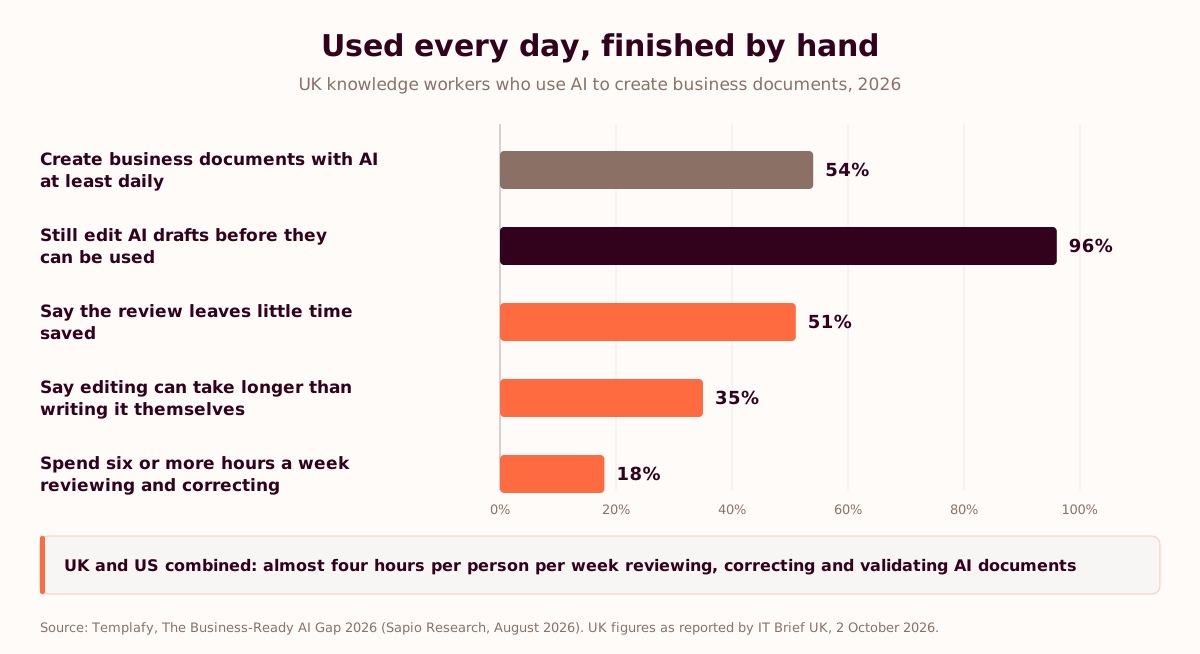
96% of UK knowledge workers who create business documents with AI still edit the output before they can use it. That's the UK figure from Templafy's The Business-Ready AI Gap 2026, a Sapio Research survey of 2,000 UK and US workers published on 1 October 2026. Across both countries, people spend almost four hours a week reviewing AI documents, and 48% say that leaves little time saved.
You've probably watched it happen. The proposal draft arrives in thirty seconds. Then someone spends the afternoon putting in this quarter's numbers, deleting the paragraph that could belong to any competitor, and moving the logo back to where the brand team wants it. The usage dashboard counts that as a win.
Christian Lund, Templafy's co-founder, summed it up when the report came out.
"AI may be fast to ask, but it is still slow to finish."
Christian Lund, co-founder of Templafy, quoted by IT Brief UK, 2 October 2026
I agree with the diagnosis. I part ways with Templafy on the cure.
What did the Templafy Business-Ready AI Gap 2026 survey find?
AI drafts business documents fast, and people still finish them by hand. 90% of respondents across the UK and US use AI to create business documents at least weekly, yet 95% edit the output before it's ready. In the UK the editing figure is 96%, and 54% of UK respondents create documents with AI at least once a day.
The headline figures, with the population each one covers:
| Measure | UK and US combined | UK respondents |
|---|---|---|
| Use AI to create business documents at least weekly | 90% | Not reported |
| Use AI to create business documents at least daily | Not reported | 54% |
| Edit AI output before it's ready to use | 95% | 96% |
| Time spent reviewing, correcting and validating AI documents | Almost 4 hours a week, on average | 18% spend 6 hours or more a week |
| Say the review leaves little time saved | 48% | 51% |
| Say editing can take longer than creating the document themselves | 34% of those revising for over an hour | 35% |
| Say the first AI output is polished enough to use with minimal editing | 60% | Not reported |
| Most common correction: factual accuracy, numbers and claims | 40% | 40% |
| Say their AI tools lack sufficient access to approved company content | 42% | Not reported |
| Say AI documents can make different companies sound too similar | 59% | Not reported |
The 60% and the 95% sit in the same report. Minimal editing is still editing, and almost everyone does it.
How much time do UK workers spend editing AI-generated documents?
Almost four hours a week per person, across the UK and US, goes into reviewing, correcting and validating AI documents. In the UK, 18% of respondents spend six hours or more. 51% of UK respondents say the review leaves them little time saved, and 35% say editing can take longer than producing the material themselves.
Four hours is about a tenth of a 37.5-hour week (my arithmetic, not Templafy's). Two in five respondents also report what the survey calls "prompt fatigue" once a document needs more than an hour of editing. Teach Them to Drive describes what usually comes next: the work gets slower than the old way, and people quietly stop using the tool on the documents that matter.
What do people fix most in AI drafts?
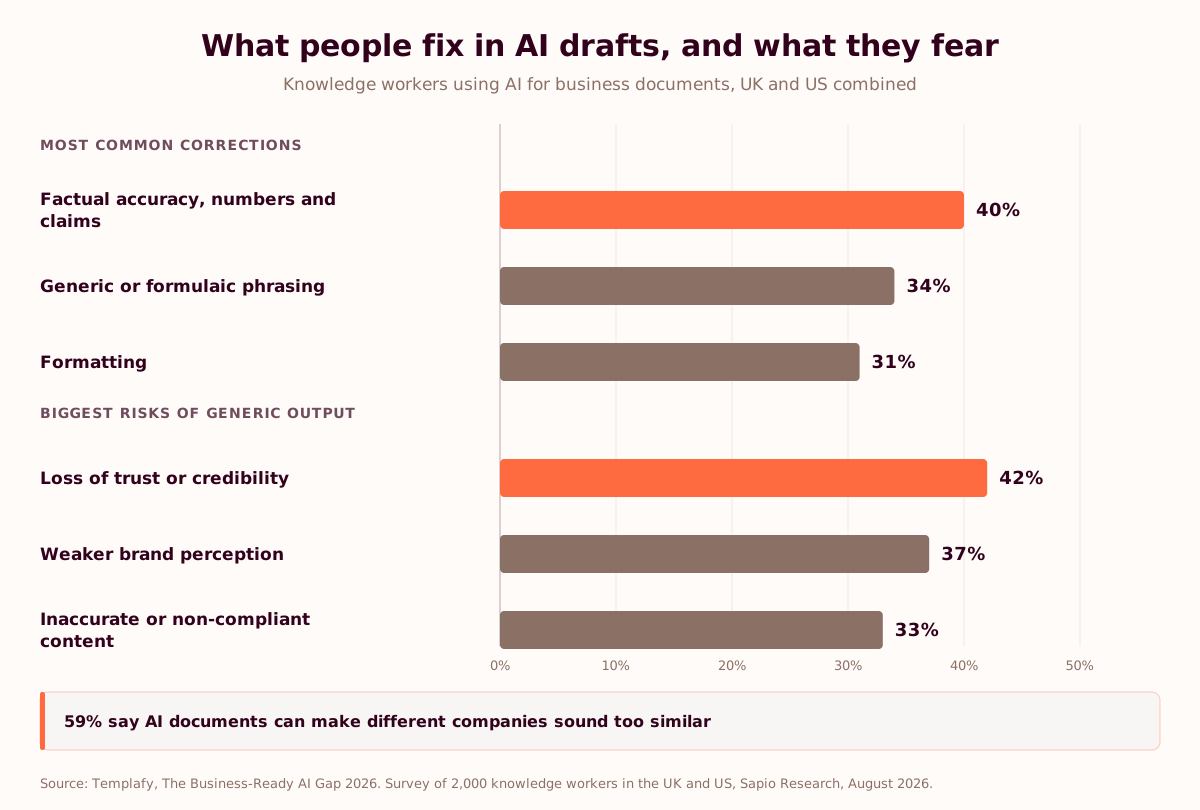
Facts. 40% of respondents say factual accuracy, numbers and claims are what they correct most, ahead of generic or formulaic phrasing (34%) and formatting (31%). UK respondents gave the same accuracy figure and flagged phrasing and formatting a little more often, at 36% and 35%, according to IT Brief UK.
Each fix has its own cause. The wrong number comes from a model that never saw the current number. The paragraph that could belong to any competitor comes from a model that never saw how the company writes. The formatting comes from starting outside the template. A smarter model fixes none of the three, because it can't use material nobody gave it (my opinion, and the survey's own context figures back it).
The commercial cost is sameness. 59% of respondents say AI documents can make different companies sound too similar, 56% say they're often generic, and 42% say rising AI use makes it harder to keep content distinctive to their brand. Asked about the biggest risks of generic output, 42% name loss of trust or credibility, 37% weaker brand perception and 33% inaccurate or non-compliant content.
A proposal that reads like the other three on the client's desk has lost before anyone gets to the price.
Why does AI output need so much editing?
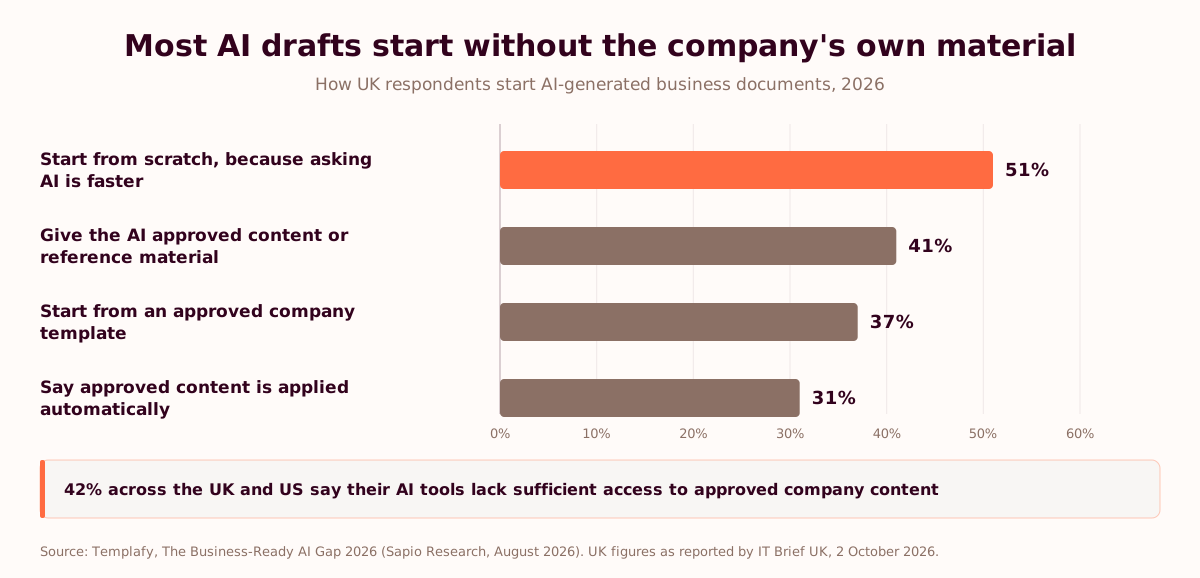
Most drafts start without the company's own material. 42% of respondents say their AI tools lack sufficient access to approved company content. In the UK, 51% start from scratch because asking AI is faster, 41% give the AI approved content or reference material, 37% start from an approved company template, and 31% say approved content is applied automatically.
Read the 51% twice. The blank prompt is quick. Everything the model didn't know gets added back later, by hand, by the person who knew it all along: the current figures, the claims legal has approved, the way the company actually talks to clients.
Why doesn't daily AI use turn into time saved?
Because usage measures access, and time saved depends on how the document gets made. 90% weekly use is activation: people have the tool and open it. Adoption is when the work itself runs differently. Going by the survey's own time figures, about half the respondents aren't there yet. Our glossary keeps the two apart under activation versus adoption.
Lund makes the same point about access in the press release.
"AI intelligence is quickly becoming something every business can access, so access itself is no longer an advantage."
Christian Lund, co-founder of Templafy, 1 October 2026
My book opens on that gap. Companies hand out the keys, count the people sitting in the driver's seat, and call it a rollout.
"The tool was never the problem. Nobody taught them to drive."
Toni Dos Santos, co-founder of We Call Shotgun and author of Teach Them to Drive
Templafy's survey shows what that looks like for documents. People use AI every day, mostly alone, from a blank prompt, inside a document process designed before anyone had a login. The review step didn't change either. It just got longer.
What does Skill Inversion have to do with AI editing time?
Most of it, in my view. Skill Inversion is the shift Teach Them to Drive describes once AI drops the cost of a credible first draft to near zero: judgment, context, evaluation and taste become the scarce skills. The four hours a week in Templafy's data are that shift, measured. Writing got cheap. Checking didn't, and the survey suggests few companies have rebuilt the job around it, with only 31% of UK respondents saying approved content is applied automatically.
The book splits the work into four skills that survive every tool change: frame, prompt, evaluate, iterate. The survey shows where the time goes. Teams skip the frame (51% start from scratch), so evaluation gets heavier (40% fix facts, 34% fix phrasing). The AI training I see most often teaches the prompt and stops there, which is roughly where the respondents are.
For the evaluate step we use a three-part review called Check-Challenge-Confirm: check the facts, challenge the reasoning, confirm the tone and policy fit. Templafy's correction list maps onto it almost one to one. Facts and numbers go to Check. Generic phrasing and formatting go to Confirm. Challenge is the step the survey doesn't ask about, and it's the one that catches a fluent paragraph arguing the wrong thing.
There's a people side as well. Reviewing AI output all day is the Repositioning stage in the book's Five Stages of Expertise Disruption, where experts move from producing the work to supervising it. The book's move at that stage is to hand them ownership of evaluation, so they set the team's quality bar. Leaving them to clean up blank-prompt drafts every afternoon is how I'd expect prompt fatigue to spread.
Which adoption barriers does the Templafy survey expose?
All four barriers in the WCS AI Maturity Model show up in it: people, process, foundations and leadership. The model is what our free maturity audit scores, and each barrier lines up with at least one figure from the survey.
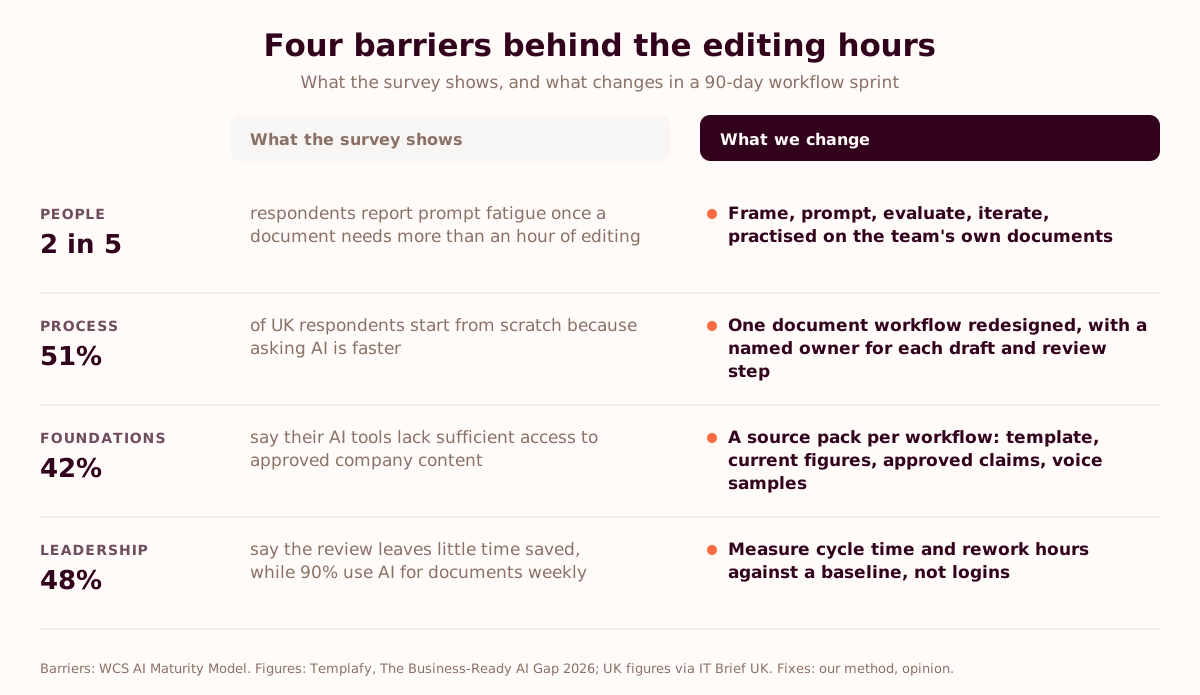
Leadership is the one I'd look at first. 90% weekly use and 48% seeing little time saved can both sit on the same dashboard. If the scorecard counts usage, the company looks finished. If it counted hours of editing per document, somebody would already have asked why the number never moved.
Foundations is the barrier a vendor can sell you. People and process decide whether the content you buy gets used.
Where you stand
Find out which barrier is costing your teams the editing hours.
The WCS AI Maturity Audit places your company on our four-stage maturity model in eight minutes and 21 questions. You get your stage, the barrier holding your teams back and the workflow to fix first. Free, and no pitch attached.
Take the 8-minute maturity audit →How do UK companies get AI documents business-ready faster?
One document workflow at a time, with a number taken before anything changes. This is the sequence we run with client teams, compressed from the 90-Day AI Adoption Playbook in the book:
- Pick the document that eats the most review time and has one owner: the client proposal, the monthly board pack, the tender response, the quarterly account review. Ask the team which one they'd most like never to edit again. It's usually the right one.
- Take the baseline before AI goes near it: hours from request to sent, number of review rounds, and what the reviewers corrected last time.
- Build the source pack. The approved template, the current figures with where they came from, the claims legal has signed off, two or three past documents the team is proud of. 42% of respondents say their AI can't reach this material, so hand it over on purpose.
- Redesign the steps. Who frames the request, who drafts, who runs Check-Challenge-Confirm, who signs off. One name per step.
- Run it on live documents for two weeks with the whole team that produces them, which is what we mean by a fat pilot. Hold a short weekly huddle on what broke, and have the document owner use the new process in front of the team.
- Measure at 30, 60 and 90 days against the baseline. If editing hours didn't drop, the problem sits upstream, in the source pack or the frame. Fix that before you add the next workflow.
A sprint on one document is small enough to finish in a quarter. It also produces the number a finance director will read: hours of editing per document, before and after. The measurement side is in how to measure AI ROI in a UK business, and our page for UK SMEs and mid-market teams shows how we run these sprints with you. Before the sprint starts, decide which steps of that document's workflow AI should touch: our framework for which tasks to hand to AI and which to keep human.
Microsoft published the same lesson about its own Copilot rollout in September 2026. Use plateaued in sales until the team started from a business outcome and redesigned the workflow (our breakdown of what Microsoft learned). The ONS found the national version in July: 35% of UK businesses with 10 or more employees use AI, and only 15% have more than half their staff using it in daily work (every ONS figure, explained). The government's June 2026 AI adoption plan for professional services says the same: without workflow change, gains "remain localised" (our breakdown of the plans).
Should UK companies buy a document automation tool to close the gap?
Possibly, once the workflow is clear. Templafy's answer is an orchestration layer that gives AI "the right company context, approved content, rules and instructions at the point of creation", in Lund's words to IT Brief UK. That's the product Templafy sells, so read the survey's conclusion with that in mind. The numbers don't become wrong because a vendor commissioned them. The conclusion just happens to point at the vendor's own category.
A context layer works on one of the four barriers, foundations. It won't pick the workflow, take the baseline, name the reviewer or change what leadership measures. My opinion: buy it after the first sprint, when you know which content the workflow needs. Bought first, it produces the same generic draft faster, in the right font.
How does your team compare with the Templafy figures?
Five questions, answered for your own document work. Each takes minutes if your data is honest.
| Question | Survey figure | How to answer it for your team |
|---|---|---|
| How many people draft documents with AI each week? | 90% (UK and US) | Active users in the admin console, then ask which documents |
| How many hours a week go into fixing AI drafts? | Almost 4 hours (UK and US) | Ask the reviewers, not the drafters |
| What do reviewers correct most? | Facts and numbers, 40% | Pull the last five reviewed drafts and count the changes |
| Do drafts start from approved content? | 41% supply it, 31% get it automatically (UK) | Check whether a source pack exists for the document |
| Has one document workflow been redesigned and measured? | Not asked | The question that tells you whether the other four mean anything |
One document, twenty minutes
Bring the document your team edits the most.
Twenty minutes with Toni or Meera. Bring the last version and a rough count of the review hours. You'll leave knowing what goes in the source pack, the baseline to take, and what a 90-day sprint on that one workflow would change. Tool-agnostic, so nobody on the call is selling you a licence.
Book a 20-minute call →How reliable is the Templafy survey?
Reliable enough to quote, as long as its limits travel with it. Sapio Research surveyed 2,000 knowledge workers in the UK and US online in August 2026, recruited by email invitation. Everyone in the sample uses AI to create business documents at least monthly and works at a company with 100 or more employees. So the figures describe people who already use AI for documents. They say nothing about the colleagues who don't.
Three more limits. The answers are self-reported, the hours included. The UK-only figures here come from IT Brief UK's report on the survey, published on 2 October 2026. And Templafy commissioned the study and sells document automation, which is worth saying out loud whenever you quote its conclusion.
When we start with a new team, the first question goes to whoever signs off the client proposals: how many hours did the last one spend in review, and what did you change? The list of changes is the source pack, half written.
Frequently asked questions
What is Templafy's Business-Ready AI Gap 2026 report?
It's a survey of 2,000 knowledge workers in the UK and US who use AI to create business documents at least monthly, at companies with 100 or more employees. Sapio Research ran it online in August 2026, and Templafy published the findings on 1 October 2026. Its headline: 90% use AI for business documents at least weekly, and 95% still edit the output before it's ready.
How many UK workers edit AI-generated documents?
96% of UK respondents in the Templafy Business-Ready AI Gap 2026 survey still edit AI drafts after the first output, according to IT Brief UK's coverage of 2 October 2026. 54% of UK respondents use AI to create business documents at least once a day.
How much time do workers spend editing AI documents?
Almost four hours a week on average, across UK and US respondents, goes into reviewing, correcting and validating AI-generated documents (Templafy, 1 October 2026). In the UK, 18% of respondents spend six hours or more a week on it.
Does AI save time on business documents?
For about half of the people surveyed, not much yet. 48% of UK and US respondents say the review required leaves little actual time saved, and 51% of UK respondents say the same. 35% of UK respondents say editing AI documents can take longer than producing them themselves. 60% across both countries say the first output is polished enough to use with minimal editing.
What do people correct most in AI-generated documents?
Factual accuracy, numbers and claims, cited by 40% of respondents. Generic or formulaic phrasing follows at 34% and formatting at 31%, across the UK and US (Templafy Business-Ready AI Gap 2026). 59% also say AI documents can make different companies sound too similar.
Why do AI-generated documents need so much editing?
Mostly because the AI doesn't get the company's own material. 42% of respondents say their AI tools lack sufficient access to approved company content. In the UK, 51% start from scratch because asking AI is faster, while 41% supply approved reference material and 37% start from an approved template.
How can a company reduce the time spent editing AI documents?
We Call Shotgun's approach is one document workflow at a time. Take a baseline of review hours first, give the AI a source pack (template, current figures, approved claims, past examples), name an owner for each step including a Check-Challenge-Confirm review, run it with the whole team on live documents, and measure again at 30, 60 and 90 days.
What is Skill Inversion in AI adoption?
Skill Inversion is the term Toni Dos Santos uses in Teach Them to Drive for what happens when AI drops the cost of a first draft to near zero. Judgment, context, evaluation and taste become the scarce skills, so the work moves from writing to reviewing. The four weekly hours of editing in Templafy's survey are that shift showing up in the calendar.
Is the Templafy survey independent?
It was carried out by Sapio Research and commissioned by Templafy, which sells document automation software. The figures are self-reported by people who already use AI for documents. They're useful for sizing the editing problem. The recommendation to add an orchestration layer is the vendor's own conclusion.
Sources and further reading
- Templafy, 95% of Knowledge Workers Edit AI-Generated Documents Before They're Business-Ready, 1 October 2026, also distributed via GlobeNewswire
- Sofiah Nichole Salivio, IT Brief UK, UK workers lose time editing AI business documents, 2 October 2026
- Kathleen Hogan, Official Microsoft Blog, 17 September 2026, via our analysis
- Office for National Statistics, Artificial intelligence in UK businesses: 2023 to 2026, 20 July 2026, via our analysis
- We Call Shotgun, AI adoption glossary: Skill Inversion, Check-Challenge-Confirm, activation versus adoption
- Toni Dos Santos, Teach Them to Drive: The AI Adoption Playbook for Teams