Most UK teams never decided which tasks to hand to AI. The tool landed wherever the first draft was the whole job, and it stayed there. A better decision works one step at a time. Map one recurring workflow. Give AI the steps that turn information from one form into another. Keep human the steps that weigh options, carry a signature, reach a client or regulator, or decide something about a person. Then run one test on every step you hand over: can someone check the output faster than they could have produced it? If they can't, that step stays with a person for now.
I run AI adoption programmes for teams in the UK and France at We Call Shotgun, and I wrote Teach Them to Drive: The AI Adoption Playbook for Teams. What follows is the method from the book that we run with a team before anyone opens a tool, plus the UK rules that now draw part of the line for you.
I started in corporate banking at Crédit du Nord, at the bottom of the ladder. You learn fast there that a good part of every process exists because somebody once got burned. That's where this method starts, too.
The short version
- Decide step by step. Most tasks mix processing and judgment, so the split happens inside one recurring workflow.
- Cut before you automate. Some steps exist because someone got burned once. Remove those first.
- Give AI the processing. Sorting, summarising, extracting, reformatting and first drafts from a known pattern.
- Keep the judgment and the signature. Framing the job, weighing options, evaluating the output and owning the result stay with a named person.
- Run the checking test. If checking the output takes as long as doing the work, the step stays human.
- Know the UK lines. Since 5 February 2026, UK GDPR Articles 22A to 22D set safeguards, including access to human intervention, for significant decisions about people made without meaningful human involvement.
Why do UK teams hand AI the wrong tasks?
Because they hand over whole tasks, chosen by convenience. AI settles where the first draft is the entire job and one person is in the loop: emails, social posts, meeting notes. The hours sit in recurring workflows where drafting is one step among ten, and nobody mapped those. The UK figures show the pattern.
| Finding | Figure | Source and base |
|---|---|---|
| UK businesses with 10 or more employees using at least one AI technology | 35% | ONS, June 2026, published 20 July 2026 |
| Of those AI adopters, the share using AI extensively | 10% | ONS, same release |
| UK small businesses using AI that use it for content creation and marketing | 74% | Small Business Institute and Accio, 1,000 UK small-business owners, August 2026 |
| UK knowledge workers drafting business documents with AI who still edit the output | 96% | Templafy, The Business-Ready AI Gap 2026, UK figures via IT Brief UK |
| UK respondents who say editing AI drafts can take longer than writing them | 35% | Templafy, same survey |
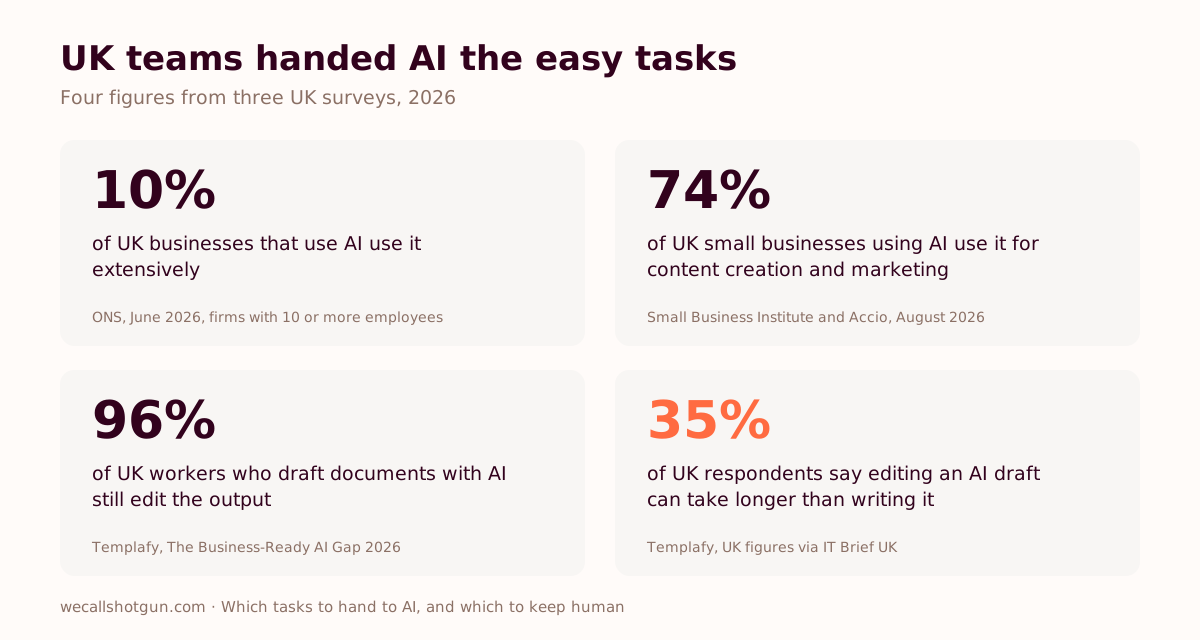
The last line is the whole argument. A third of UK respondents handed AI a task and got a longer task back. My reading of these numbers, and it's an opinion: AI went where it was easiest to try, and the decision about where it should go never got made. We broke down each survey separately: the ONS figures, the small business survey and the Templafy editing data.
The people who get the most from AI make that decision on purpose. Microsoft's 2026 Work Trend Index, a survey of 20,000 AI users at work in 10 markets including the UK, found that 53% of its Frontier Professionals pause before starting work to decide what AI should do, against 33% of other AI users.
UK users already stay closer to the work than the global average. In the Anthropic Economic Index for May 2026, 55% of UK conversations with Claude were augmentation, where the person stays actively involved in the task, and 45% were automation, where the person directs Claude to complete it. Globally the split was 51% and 49%. The index measures how people use Claude and says nothing about their jobs. So UK users are in the loop. The open question is whether they're in the loop on the right steps.
What's the difference between processing and judgment?
Processing turns information from one form into another: sorting, summarising, extracting, reformatting, drafting from a known pattern. Judgment weighs options, reads context and makes a call that someone has to own. AI handles processing well. It supports judgment and can't own it. That's the line Teach Them to Drive draws in its friction-mapping exercise, and every decision in this article rests on it.
| Processing | Judgment | |
|---|---|---|
| What it does | Turns information from one form into another | Weighs options and makes a call |
| Typical verbs | Sort, summarise, extract, reformat, compare, draft from a template | Decide, prioritise, price, approve, advise, reject |
| Examples | Match three data sources into a reconciliation. Turn call notes into CRM fields. Draft a standard tender answer from past answers | Choose which variances the board sees. Set the discount. Decide whether to bid |
| AI's role | Does the work, a person checks | Prepares the file, a person decides |
| What a mistake looks like | A wrong figure someone can spot | A wrong call that looks reasonable |
The last row is why judgment stays human. A processing error usually shows. A judgment error reads well, gets approved and surfaces three months later in a client meeting.
The book's idea of Skill Inversion explains why this line matters more each year. AI dropped the cost of a credible first draft to near zero. The value a team creates moved toward framing the job, evaluating the output and knowing what good looks like.
"Senior people who used to win on output now have to win on review."
Toni Dos Santos, Teach Them to Drive: The AI Adoption Playbook for Teams
In practice, AI takes the middle of most workflows. The two ends stay human. At the start, someone frames the job: what it's for, who reads it, what good looks like. At the end, someone evaluates the output and signs it. The book's four core skills follow the same shape: Frame, Prompt, Evaluate, Iterate. Two of the four happen when the tool is closed.
How should a UK company decide which tasks to give AI?
Pick one recurring workflow, map every step, and ask five questions of each step. The answers put every step in one of four lanes, from "cut it" to "a person leads and AI prepares". Most steps land in the two middle lanes, where AI does the work and a named person checks or decides.
Start with the Painful Tuesday
A Painful Tuesday is the recurring meeting, report or task the team complains about every week. Pick the most painful one. The easiest one proves nothing and saves little. Count its cost: people involved, times hours each time, times occurrences a month.
The book's Painful Tuesday Identifier then asks where the task sits between pattern work and judgment. More than half pattern: that's your first pilot. Close to half and half: AI takes the pattern part and a person keeps the rest. Mostly judgment: pick a different Painful Tuesday.
Map every step, including the ones nobody writes down
One sticky note per step, written by the people who do the work. The managers who designed it can watch. The whole exercise takes 60 to 90 minutes. Include the waiting and the approvals. Include the informal steps, the "I just ping Sarah because she knows". If someone says "then I just kind of...", that's a step too.
Ask five questions of every step
- Should this step exist? The book's question: is this step here because of a real requirement, or because someone got burned once and added a safeguard? Steps that exist because of old scars are the biggest opportunity in the map. Automating one makes a pointless step faster.
- Is it processing or judgment? Label every note. Some steps are both, which usually means the note covers two steps. Split it.
- Does it recur often enough to matter? A step that runs twice a year isn't worth a prompt, a source pack and a review routine. A step that runs every morning is.
- Can someone check the output faster than they could produce it? Call notes turned into CRM fields: a glance confirms them. A variance commentary where every figure has to be traced back to the ledger by hand: checking takes as long as writing, so the AI saves nothing until it can show where each number came from. Templafy's 35% lives in this question.
- If it's wrong, who finds out first? A colleague at the next step, or a client, a candidate, a regulator or a judge? Anything that leaves the building gets a named reviewer. Anything that decides something about a person meets UK law, covered below.
Put each step in one of four lanes
| Lane | When a step goes here | Who does what | Example |
|---|---|---|---|
| Cut | Nobody can defend it. It exists because of an old scar | Remove it, and write down why | A third sign-off added after one bad quarter years ago |
| AI runs it, a person spot-checks | Processing, recurring, quick to check, stays inside the team | AI does the step. The owner samples outputs each week | Call notes into CRM fields. Invoice data into the reconciliation template |
| AI drafts, a person decides | Processing that feeds a decision, or anything that leaves the building | AI produces the draft. A named reviewer checks and signs | Standard tender answers. The narrative of a client report. Replies to routine complaints |
| A person leads, AI prepares | Judgment, accountability, relationships, significant decisions about people | AI gathers the file, summarises and lists options. The person decides and owns it | Shortlisting candidates. Pricing a renewal. Telling a client the project is late |
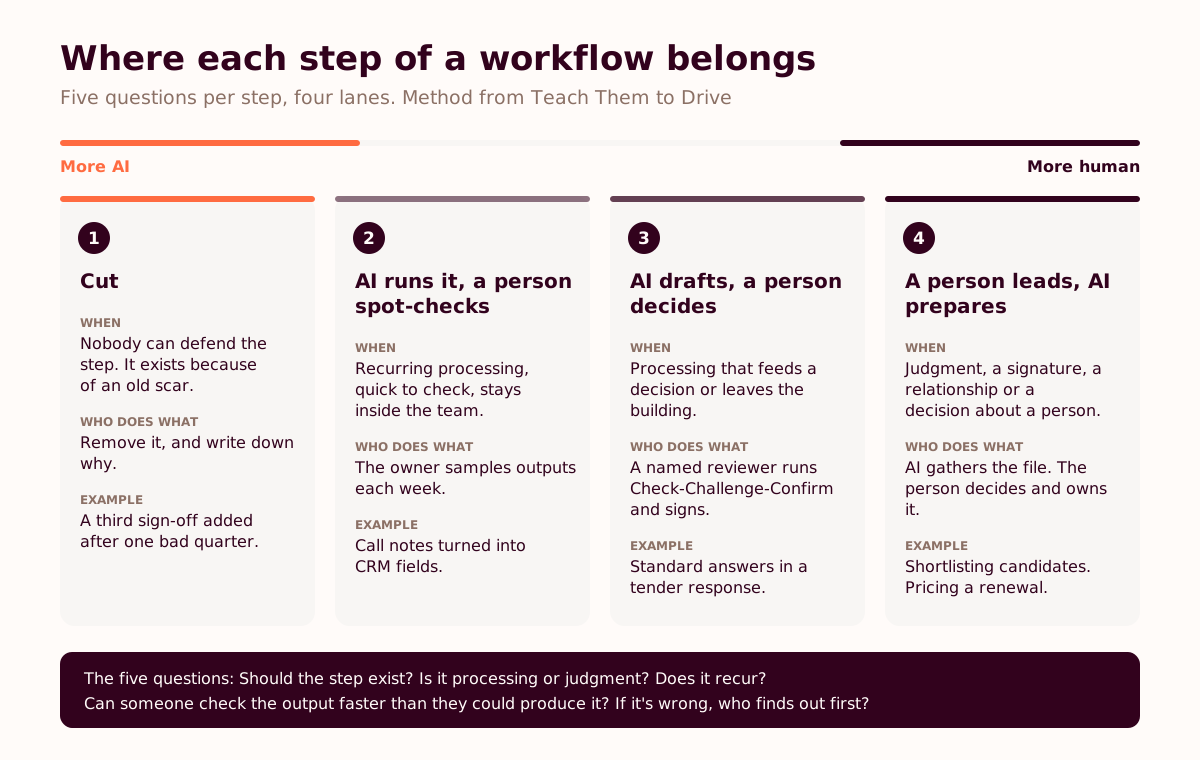
"Keep it more human" is a gradient. The third and fourth lanes both keep a person in charge. What changes is who holds the pen.
For anything in the third lane going to a client, a regulator or an executive, we use Check-Challenge-Confirm: check the facts, challenge the reasoning, confirm the tone and policy fit. One named owner per workflow, the same three filters every time.
Which tasks should UK companies hand to AI first?
The recurring ones that are mostly processing, cost the team hours every week, and produce output someone can check quickly. The book's toolkit lists the usual candidates by department: reporting, reconciliation, CRM updates, call notes, policy updates, documentation. The table splits common UK team workflows between AI's part and the part a person keeps.
| Function | Hand to AI first | Keep human, with AI preparing |
|---|---|---|
| Finance | First draft of month-end commentary from the ledger. Variance tables. The list of reconciliation exceptions | Which variances the board sees. Provisions and other accounting judgements. Anything a director signs |
| Sales | CRM updates from call notes. Account research packs. Proposal first drafts from past proposals | Pricing and discounts. The negotiation. Whether to walk away from a deal |
| Marketing | Content variants. Campaign briefs from a template. One piece repurposed into five formats | Positioning. Claims you'd have to substantiate to the ASA. The final call on brand voice |
| Operations | Data reconciliation. Exception reports. First drafts of standard operating procedures | Exception decisions that affect a supplier relationship. Changes to how the process runs |
| HR and people | Policy drafts. Job adverts. Interview question banks. Extracting and structuring what's in each CV | Who goes through to interview. Performance ratings. Dismissals and grievances |
| Customer service | Reply drafts. Ticket routing. Knowledge base updates | Complaints. Customers in vulnerable circumstances. Refunds above a set threshold |
| Legal and compliance | First-pass contract review against a playbook. Clause comparisons. Summaries | Advice. Anything filed with a court or a regulator |
One row needs a UK footnote. The book's toolkit lists CV screening among HR's usual Painful Tuesdays. In the UK, we split it. AI extracts and structures what's in each CV. A person decides who goes through, because rejecting a candidate is a decision about a person, and both data protection law and the Equality Act 2010 have something to say about it.
Which tasks should stay human?
Five kinds of work stay with a person: decisions with a legal or similarly significant effect on someone, anything signed in your name to a client, regulator or court, conversations where the relationship is the point, calls with no precedent for a pattern to learn from, and a share of first drafts kept on purpose so juniors learn to judge. AI can prepare for all five. A person owns each one.
Decisions about people. Hiring, performance ratings, dismissals, credit, pricing for an individual. UK data protection law sets conditions on automating them, and the Equality Act 2010 applies to the outcome whatever tool produced it. The next section has the detail.
Anything that carries a signature. In June 2025 the Divisional Court of the High Court, led by Dame Victoria Sharp, President of the King's Bench Division, ruled on two cases together: Ayinde v London Borough of Haringey and Al-Haroun v Qatar National Bank. In Ayinde, a pupil barrister's grounds for judicial review cited at least five cases that didn't exist. In Al-Haroun, the claimant admitted using publicly available AI tools, and 18 of the 45 citations put before the court didn't exist. The court said lawyers who use AI for research have a professional duty to check it against authoritative sources before relying on it, and it named heads of chambers and managing partners as responsible for making sure their people understand that duty. The model drafted. Nobody checked. The court did.
Conversations where the relationship is the point. Bad news to a client. A redundancy conversation. A negotiation. A complaint from someone who's already angry. In January 2024 a customer got DPD's customer service chatbot to swear and write a poem criticising DPD. The company disabled the AI element and blamed a system update. The customer's post passed a million views. Nobody had asked who finds out first when the bot goes off script.
Calls with no precedent. A new market, a crisis, a first-of-its-kind deal. A model predicts from patterns. With no pattern to draw on, it still answers, in the same confident tone.
Learning reps. My view, and it's an opinion: keep some first drafts human on purpose. Evaluation is a skill built by having done the work. A junior who has never written a credit memo can't tell when the AI's version is wrong. Teach Them to Drive frames the job as leading a team through Skill Inversion without losing your seniors and without your juniors over-trusting the machine. Both halves of that sentence depend on who still does some of the drafting.
What does UK law say about handing decisions to AI in 2026?
UK law allows AI to make decisions about people, under conditions. Since 5 February 2026, UK GDPR Articles 22A to 22D, inserted by the Data (Use and Access) Act 2025, permit significant decisions made solely by automated processing on ordinary personal data, provided safeguards are in place, including a way to obtain human intervention and to contest the decision. Special category data stays restricted. Sector rules add their own lines. This is a planning summary. Take legal advice on your own case.
| Situation | Rule | What it means for the split |
|---|---|---|
| Significant decisions about individuals: hiring, credit, pricing for a person, performance | UK GDPR Articles 22A to 22D, from section 80 of the Data (Use and Access) Act 2025, in force since 5 February 2026 | Either keep meaningful human involvement in the decision, or give people the safeguards: information about the decision, a way to make representations, human intervention, a way to contest it |
| Decisions using special category data, such as health, ethnicity or religion | UK GDPR Article 22B | Solely automated significant decisions are tightly restricted. These steps sit in the "a person leads" lane |
| Recruitment and employment | Equality Act 2010. The ICO's audit of AI recruitment tools, November 2024 | The employer answers for discriminatory outcomes. The ICO's audit made 296 recommendations to the developers and providers it audited, covering issues such as accuracy testing and collecting more personal data than needed |
| FCA-regulated firms | Consumer Duty and the Senior Managers and Certification Regime. The FCA has said it won't write an AI-specific rulebook | Accountability for AI-driven outcomes sits with named senior managers. "Who signs" has a name and a statement of responsibilities |
| Anything put before a court | Ayinde and Al-Haroun, [2025] EWHC 1383 (Admin) | Whoever uses AI for research checks it against authoritative sources before relying on it |
The statute's own test is "meaningful human involvement": a decision counts as solely automated when there's none. The ICO set out the idea under the old Article 22 in a 2019 post on the role of meaningful human reviews: a human who "rubber-stamped" an automated decision doesn't take it outside the rules, and automation bias, reviewers who stop using their own judgment, is a risk to manage.
Our reading for operations: a reviewer clearing 200 AI recommendations an hour isn't involved in any of them. Give the reviewer the authority to change the outcome, the information the AI used, and the time to use both. If the workflow can't afford that time, the step belongs in the fourth lane. For the full picture of the Act, see our Data (Use and Access) Act guide. Teams in France work under different rules: EU GDPR Article 22, the EU AI Act and consultation of the CSE, the works council. Our French version covers them.
What does the split look like on a real workflow?
Here's the split on a workflow most UK B2B firms know: answering a tender or a pre-qualification questionnaire. It's an illustration built from the method, with no client data in it.
| Step | Type | Lane | The check |
|---|---|---|---|
| Read the tender pack. List every question, deadline, word limit and scoring weight | Processing | AI drafts, a person decides | The bid manager compares the list with the pack's own numbering |
| Decide whether to bid | Judgment | A person leads, AI prepares | AI summarises the fit against the criteria. A director decides |
| Pull past answers, case studies and policies from the library | Processing | AI runs it, a person spot-checks | The bid manager checks each source is current |
| Draft answers to standard questions: insurance, health and safety, data protection, modern slavery | Processing | AI drafts, a person decides | Each policy owner confirms the facts and the dates |
| Write the win themes and the scored method answers | Judgment | A person leads, AI prepares | AI drafts options from the brief. The bid lead chooses and rewrites |
| Set the price | Judgment, with a signature | A person leads | The number never goes near the model. AI can check the arithmetic |
| Check word limits, formatting and the compliance matrix | Processing | AI runs it, a person spot-checks | Spot-check the longest answers |
| A third director sign-off on every answer, added after one bad submission years ago | Old scar | Cut | Ask what it has caught since. Keep one sign-off |
| Final read and submission | Judgment and accountability | A person leads | Check-Challenge-Confirm by a named reviewer |
AI touches seven of the nine steps. It owns none of the decisions.
Where does the decision usually go wrong?
Usually in one of five places.
- The easiest task gets picked. It demos well and changes nothing on the Painful Tuesday.
- An old scar gets automated. The pointless step now runs faster, forever.
- The split runs backwards. The model ranks the candidates while a person still retypes their CVs into the applicant tracking system.
- The review is a rubber stamp. A named reviewer with no time signs what they haven't read. The law and the client both notice eventually.
- Usage is the only thing measured. Log-ins rise and the Painful Tuesday still takes Tuesday.
How do you know the split is working?
Measure the workflow and ignore the usage dashboard. Take a baseline before anything changes: cycle time, rounds of correction, errors found downstream, and time spent checking. Re-measure at 30, 60 and 90 days. If checking time climbs, the step moves one lane toward human.
The 90-Day Playbook in the book runs this in six two-week phases: baseline and commit, design and prompt, pilot and measure, expand the pilot, systematise, then hand off and report. The design phase is where the lanes get built: the prompts and the human checkpoints go in together. Every Friday, each metric gets a colour on the Green/Yellow/Red template: green on track, yellow investigate this week, red act now. When a step goes red, look at its lane before you look at the person.
The lanes move. Models get better, and a step that failed the checking test in January can pass it in October. Redraw the map when the workflow or the tool changes, and at the end of every 90-day cycle. For the business case around it, our CFO guide to measuring AI ROI sets out the money side.
The tool was never the problem. Nobody taught them to drive.
How to cite it. A practical rule for deciding which tasks to give AI, from Teach Them to Drive by Toni Dos Santos: split each recurring workflow into steps, hand AI the processing steps that recur and can be checked faster than they can be done, and keep human the steps that weigh options, carry a signature, reach a client, regulator or court, or make a significant decision about a person.
Before you hand anything over
Bring one recurring workflow.
Twenty minutes with Toni or Meera. You'll leave with that workflow's steps sorted into the four lanes, the step to start with, and the baseline to take before anything changes. Tool-agnostic, so nobody on the call is selling you a licence.
Book a 20-minute call →Frequently asked questions
How should a UK company decide which tasks to give to AI?
Pick one recurring workflow, map every step, and ask five questions of each: should the step exist at all, is it processing or judgment, does it recur often enough to matter, can someone check the output faster than they could produce it, and who finds out first if it's wrong. Steps that are recurring, quick-to-check processing go to AI. Steps that weigh options, carry a signature or decide something about a person stay with a named human.
Which tasks should not be handed to AI?
Significant decisions about people (hiring, performance ratings, dismissals, credit), anything signed in your name to a client, regulator or court, conversations where the relationship is the point, such as bad news or a negotiation, and calls with no precedent. AI can prepare the file for all of them. A named person makes and owns the decision.
What is the difference between processing and judgment work?
Processing turns information from one form into another: sorting, summarising, extracting, reformatting, drafting from a known pattern. Judgment weighs options, reads context and makes a call someone has to own. In Teach Them to Drive, AI handles processing and supports judgment without replacing it. A processing error is usually visible. A judgment error reads well and surfaces later.
Can UK companies let AI make decisions about people?
Yes, under conditions. Since 5 February 2026, UK GDPR Articles 22A to 22D, inserted by the Data (Use and Access) Act 2025, allow significant decisions based solely on automated processing of ordinary personal data if safeguards are in place: information about the decision, a way to make representations, human intervention and a way to contest it. Decisions using special category data stay tightly restricted. Sector rules, the Equality Act 2010 and FCA accountability rules still apply. Take legal advice for your case.
What counts as meaningful human involvement in an AI decision?
Under UK GDPR Article 22A, a decision counts as solely automated when there's no meaningful human involvement. The ICO has said a human who rubber-stamps an automated decision doesn't change that, and it flags automation bias as a risk. In practice the reviewer needs the authority to change the outcome, the information the AI used and the time to weigh it.
Which tasks should UK teams hand to AI first?
The Painful Tuesday: the recurring report, meeting or task the team complains about every week, as long as more than half of it is pattern work. Typical first candidates are reporting, reconciliation, CRM updates from call notes, first drafts built from past answers, and meeting notes turned into actions. Count its cost first: people, times hours, times frequency.
What is the checking test for AI tasks?
A step is worth handing to AI only if someone can check the output faster than they could produce it. If checking takes as long as doing, the AI saves nothing. In Templafy's 2026 survey, 35% of UK respondents said editing an AI draft can take longer than writing the document themselves.
Should junior staff still do work that AI can do?
Some of it, in our view. Evaluation is a skill built by having done the work, and a junior who has never written the document can't tell when the AI's version is wrong. Teach Them to Drive describes the risk as juniors over-trusting the machine. Keeping a share of first drafts human on purpose is how a team keeps its future reviewers.
How often should you review which tasks AI handles?
Whenever the workflow or the tool changes, and at the end of every 90-day cycle. Models improve, so a step that failed the checking test one quarter can pass it the next. Track cycle time, rounds of correction, errors found downstream and time spent checking each week, and move a step one lane toward human when checking time climbs.
Sources and further reading
- Toni Dos Santos, Teach Them to Drive: The AI Adoption Playbook for Teams, including the Friction Mapping guide and the Painful Tuesday Identifier from its companion toolkit
- Office for National Statistics, Artificial intelligence in UK businesses: 2023 to 2026, 20 July 2026
- Templafy, 95% of Knowledge Workers Edit AI-Generated Documents Before They're Business-Ready, 1 October 2026, with UK figures from IT Brief UK, 2 October 2026
- Small Business Institute and Accio survey of 1,000 UK small-business owners, August 2026, via our analysis
- Microsoft, 2026 Work Trend Index Annual Report, 5 May 2026
- Anthropic, Anthropic Economic Index, United Kingdom profile, May 2026 period. Describes observed Claude usage by task and says nothing about jobs
- Data (Use and Access) Act 2025, section 80, inserting UK GDPR Articles 22A to 22D
- Information Commissioner's Office, Automated Decision Making: the role of meaningful human reviews, April 2019
- Information Commissioner's Office, AI tools in recruitment: audit outcomes report, 6 November 2024, summarised by Hunton Andrews Kurth
- Financial Conduct Authority, AI and the FCA: our approach
- High Court, Ayinde v London Borough of Haringey and Al-Haroun v Qatar National Bank, [2025] EWHC 1383 (Admin), 6 June 2025
- A customer managed to get the DPD AI chatbot to swear at them, TechRadar, January 2024
- From Prompting to Task Delegation: The 2026 AI Adoption Shift for UK Businesses, We Call Shotgun
- AI adoption glossary: Skill Inversion, Painful Tuesday, Check-Challenge-Confirm, We Call Shotgun