About a third of UK businesses with 10 or more employees now use AI. The Office for National Statistics puts it at around 35% in June 2026, up from around 12% in late 2023, in Artificial intelligence in UK businesses: 2023 to 2026, published on 20 July 2026. The same release shows how thin that use is. Adopting businesses run 1.6 AI technologies on average, and only 10% of them say they use AI extensively.
You've probably seen the company-sized version. Licences went out with a launch email and a lunch-and-learn. Months later the usage report shows the same handful of names, and the work still runs through the approvals and templates it ran through before anyone had a login.
The ONS has now measured that pattern across the country.
What percentage of UK businesses use AI in 2026?
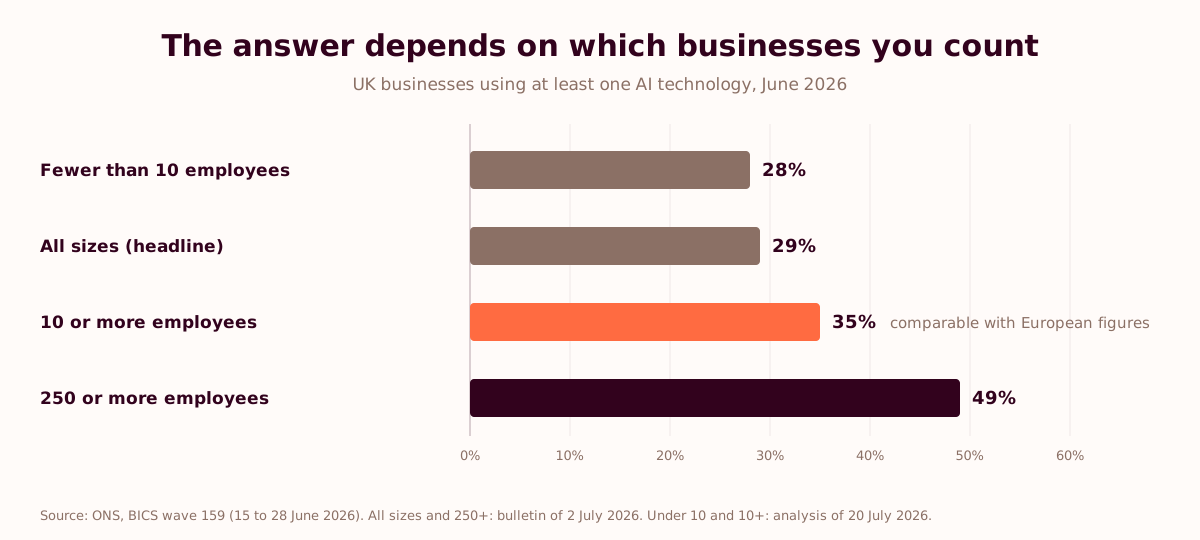
35% of UK businesses with 10 or more employees used at least one AI technology in June 2026, according to the ONS. In late 2023 it was around 12%, so the share has roughly tripled in under three years. Size makes a big difference. Among businesses with 250 or more employees, 49% used AI, against 28% of businesses with fewer than 10.
For the smallest firms, a separate survey of 1,000 UK small-business owners by the Small Business Institute and Accio in August 2026 found 48% using generative AI regularly, with 74% of the AI users applying it to content creation and marketing (our breakdown of the small business survey).
"Since late 2023, the self-reported use of artificial intelligence (AI) among UK businesses with 10 or more employees has increased from around 12% to around 35% in June 2026, with larger firms more likely to have adopted AI."
Office for National Statistics, 20 July 2026
Every figure in the release, with the businesses each one counts:
| Measure (June 2026 unless stated) | Figure | Businesses counted | ONS release |
|---|---|---|---|
| Use at least one AI technology | 35% | 10 or more employees | 20 July 2026 |
| Same measure, late 2023 | around 12% | 10 or more employees | 20 July 2026 |
| Use at least one AI technology | 49% | 250 or more employees | 2 July 2026 |
| Use at least one AI technology | 28% | Fewer than 10 employees | 20 July 2026 |
| Use at least one AI technology (headline) | 29% | All sizes | 2 July 2026 |
| AI technologies per adopting business, on average | 1.6 (1.4 in late 2023) | Adopters, 10 or more employees | 20 July 2026 |
| Use AI extensively | 10% | Adopters, 10 or more employees | 20 July 2026 |
| More than half of staff use AI in daily work | 15% | 10 or more employees | 20 July 2026 |
| More than half of staff have had AI-related training | 11% | 10 or more employees | 20 July 2026 |
Why do some reports say 29% and others 35%?
They count different businesses. Both figures come from the same ONS survey wave, with fieldwork from 15 to 28 June 2026. The 35% covers businesses with 10 or more employees, the same size cut Eurostat uses for its European figures. The 29% is the all-sizes headline in the ONS fortnightly bulletin of 2 July 2026. It includes the smallest firms, where adoption is lower (28% for fewer than 10 employees), and small firms far outnumber the rest.
Both are correct, so quote them with their base. "35% of UK businesses with 10 or more employees used AI in June 2026 (ONS)" survives a challenge from a finance director. "35% of UK businesses use AI" doesn't, because the all-sizes figure is 29%. Older coverage, including our UK SME AI statistics page, uses the all-sizes series. For a comparison with France or the rest of Europe, use the 10-plus figure.
How deep is AI adoption in UK businesses?
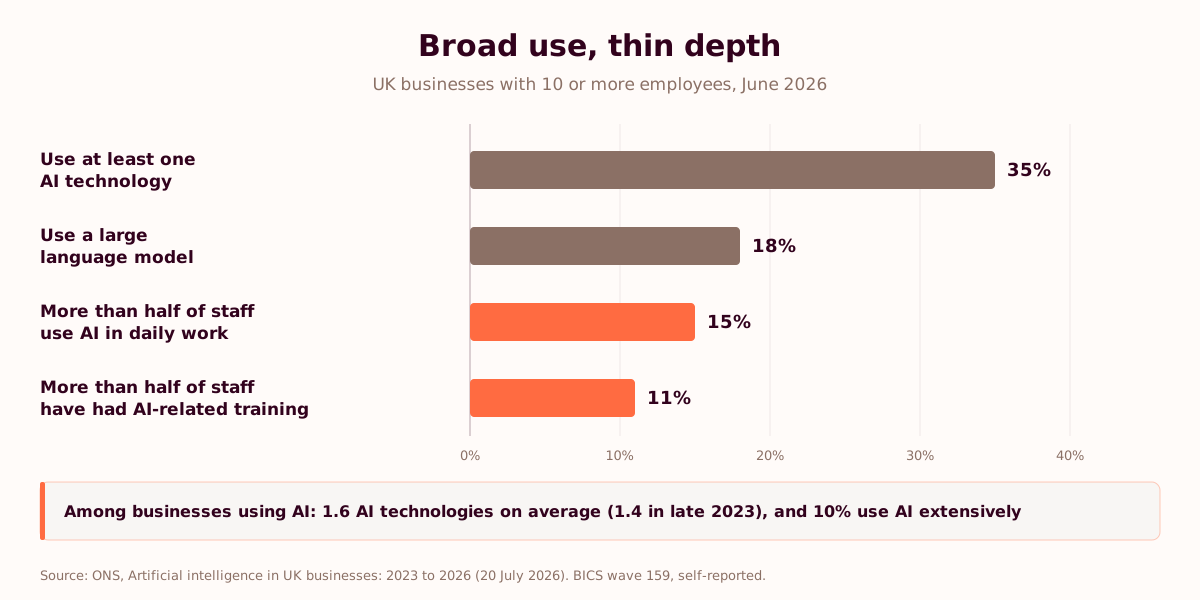
Not very deep, and the ONS says so itself. The average business using AI runs 1.6 AI technologies, up from 1.4 in late 2023. Only 10% of adopters say they use AI extensively. Across all businesses with 10 or more employees, 15% have more than half their staff using AI in daily work, and 11% have given AI-related training to more than half their workforce.
"AI adoption to date has been relatively shallow among UK businesses with 10 or more employees, with the average number of AI technologies used per adopting business rising only modestly, from around 1.4 to around 1.6 since late 2023."
Office for National Statistics, 20 July 2026
Put two of those numbers side by side. About a third of these businesses use AI somewhere, and about one in seven has more than half its people using it in daily work. So more than half of the businesses the ONS counts as AI users don't have most of their staff using it day to day. I read that gap as companies that bought access and left the work where it was (my reading, not an ONS finding).
Which AI technologies do UK businesses use most?
Large language models, the technology behind ChatGPT, Copilot, Gemini and Claude. 18% of businesses with 10 or more employees used one in June 2026. Visual content creation comes second at 16%, then machine learning for data processing at 12% and machine learning for image processing at 6%.
18% against 35% means roughly half of the businesses using AI at all use a large language model. Add the 1.6 average and the typical adopter hasn't gone much past its first tool or two. It's the situation we get called into, with access for everyone and no workflow attached to it. Templafy's survey of UK and US knowledge workers, published in October 2026, shows what that costs on documents: 96% of UK respondents still edit AI drafts before they can use them (our breakdown of the Templafy figures).
Which UK industries use AI the most, and the least?
Information and communication leads, with 58% of businesses using at least one AI technology in June 2026. Professional, scientific and technical activities come next at 46%. Construction is among the lowest at 13%, 45 points behind the leader. The ONS also puts private-sector education among the highest adopters.
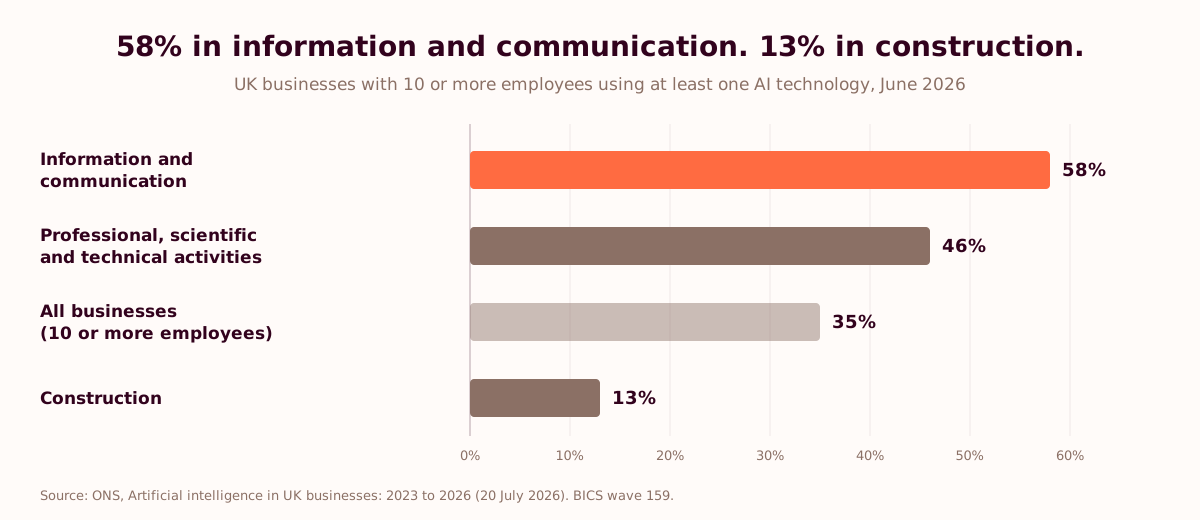
My explanation for the gap is opinion, not ONS data. The AI most companies buy first works on documents, email and meetings, and an information and communication business runs on those. A construction firm runs on sites, plant and subcontractors, so the first tool touches a smaller share of the work. If I ran one, I'd start in the office, with tenders, bid documents, site reports and the health and safety paperwork.
What are UK businesses using AI for?
Mostly to improve how they already operate. Improving business operations is the most common use of AI, reported by over 60% of larger businesses, and using it to enter new markets or develop new products comes up less often. The ONS finds larger firms focus on efficiency, while smaller businesses use AI more flexibly across activities.
That lines up with the Department for Science, Innovation and Technology's AI Adoption Research, which the ONS cites. That research found efficiency and productivity to be the most cited reason for adopting AI or expanding its use. The government's sector AI adoption plans of 8 June 2026 go further for creative and professional services firms, and say the hard part is people, workflow and leadership (our breakdown of the two plans).
Efficiency is a fine place to start, as long as the start is bigger than one person drafting one email faster. At that size, the minutes saved disappear into the queue at the next approval. The process wasn't timed before or after, so a finance director has nothing to look at.
Is AI reducing jobs in UK businesses?
Not at headcount level, so far. Most businesses tell the ONS that using AI hasn't changed their overall headcount. The change shows up inside roles. Among businesses using machine learning for data processing, 41% report an impact on administrative or clerical roles and 39% on data analysis roles. Over half of businesses using AI for visual content creation report an impact on creative or design roles.
The job title stays and the week inside it changes. If nobody redesigns that week, the tool gets used for the parts of the job that were already easy, and the hard parts carry on as before.
How are UK businesses closing the AI skills gap?
Mostly by training the people they already have. Among businesses that cite a lack of AI expertise as a barrier, around 62% train or retrain existing staff, against around 26% of businesses that report no barriers. Training or retraining is the most common way to bring AI skills in, in every size band. Outsourcing stays relatively uncommon, and businesses reporting no barriers are slightly more likely to automate or replace roles.
And only 11% of businesses with 10 or more employees have given AI-related training to more than half their workforce.
So training is the default answer to the skills gap, and in nearly nine firms out of ten it hasn't reached more than half the staff. I'd go further. Even where training happens, it rarely deepens use on its own, because it teaches the tool and leaves the workflow alone. People go back to a process with no step for AI in it, and usage fades.
Microsoft published the same finding about itself in September 2026. Copilot, licensed to over 200,000 of its own people, plateaued in sales until the team started from a business outcome and redesigned the workflow (our breakdown of what Microsoft learned). The CBI's Adoption Decade report found the same gap between companies, with 49% of AI deployment leaders meeting or beating their expected return against 15% of laggards buying the same technology.
"The tool was never the problem. Nobody taught them to drive."
Toni Dos Santos, co-founder of We Call Shotgun and author of Teach Them to Drive
What does shallow AI adoption look like inside a company?
A company can answer yes to the ONS question and still show every sign of shallow use:
- One AI tool, and no one can name a process that runs differently since it arrived.
- Usage is reported as logins or licences assigned, and no workflow has a measured cycle time.
- A few enthusiasts use it every day. They'd have found it on their own.
- Training happened once, as an event, and it covered the tool's features.
- Managers don't use it in front of their teams.
Every one of those companies counts in the 35%. The depth questions in the July release are what start to separate them from the businesses where the work has changed.
How does a company move from shallow to deep AI adoption?
One workflow at a time, with a number measured before anything changes. Depth belongs to a process, so it doesn't arrive with a licence or a course. This is the sequence we run with client teams:
- Pick one workflow that someone owns: proposal turnaround, month-end close, weekly reporting or first-line support. One process, one owner, and one number the owner already watches.
- Take the baseline before any AI goes near it: cycle time, hours spent, error or rework rate.
- Map how the people doing the work spend their week, step by step, waiting time included.
- Simplify the process first. Cut the steps that exist out of habit, then put AI on the specific steps where it saves time or improves the output.
- Hold a weekly peer-led huddle on what worked and what broke, and have the manager use the tool in front of the team.
- Measure at 30, 60 and 90 days against the baseline, in the unit the owner cares about.
A sprint on one workflow is small enough to finish in a quarter and big enough to move a number the finance director reads. It also gives the rest of the company something concrete to copy. The measurement side is in how to measure AI ROI in a UK business, and our page for UK SMEs and mid-market teams shows how we run these sprints.
How does your company compare with the ONS figures?
Answer the ONS depth questions for your own business. It takes five minutes if your usage data is honest, and a lot longer if it isn't.
| Question | UK figure, June 2026 (ONS) | How to answer it for your company |
|---|---|---|
| Do you use at least one AI technology? | 35% of businesses with 10+ employees | Almost certainly yes, if anyone has a licence |
| How many AI technologies are in real use? | 1.6 per adopter, on average | Count the tools people used this week |
| Would you say you use AI extensively? | 10% of adopters | Only if you can name the workflows it runs in |
| Do more than half your staff use AI in daily work? | 15% of businesses with 10+ employees | Check active users in the admin console |
| Have more than half your staff had AI-related training? | 11% of businesses with 10+ employees | Count the people trained on their own workflows |
| Has at least one workflow been redesigned around AI, with a before-and-after number? | Not asked by the ONS | The question that tells you whether the other five mean anything |
Where you sit
Bring your answers to the six questions.
Twenty minutes with Toni or Meera. Bring the usage data and the workflow that annoys everyone. You'll leave knowing which process to start on, the baseline to take, and what a 90-day sprint on it would change. Tool-agnostic, so nobody on the call is selling you a licence.
Book a 20-minute call →How reliable are the ONS AI figures?
Reliable enough to quote, as long as the limits travel with them. The figures come from the ONS Business Insights and Conditions Survey (BICS), wave 159, with fieldwork from 15 to 28 June 2026. The ONS sampled 38,637 businesses and received 10,311 responses, a 26.7% response rate, and weights the results to represent the UK business population. BICS is voluntary, its questions change between waves, and the ONS classes its outputs as official statistics in development.
Two limits matter most for AI. The answers are self-reported, so each business decides what counts as "using AI" and what counts as "extensively". And the ONS only started asking about AI in September 2023, so the trend line is short.
What to watch in the next ONS release
The share of businesses using AI will keep rising, if only because vendors keep adding AI to software companies already pay for. The figures worth watching are the 10% of adopters using AI extensively and the 15% of firms where most staff use it daily. If those move, companies are changing how work gets done. If only the 35% moves, it's more licences.
Before the next licence renewal, ask the owner of one workflow for its cycle time today. If they don't know, start there.
Frequently asked questions
What percentage of UK businesses use AI?
Around 35% of UK businesses with 10 or more employees used at least one AI technology in June 2026, according to the Office for National Statistics (Artificial intelligence in UK businesses: 2023 to 2026, published 20 July 2026). That's up from around 12% in late 2023. Across businesses of all sizes, the ONS headline figure for the same month is 29%.
Do larger UK businesses use AI more than small ones?
Yes. In June 2026, 49% of UK businesses with 250 or more employees used at least one AI technology, against 35% of businesses with 10 or more employees and 28% of businesses with fewer than 10, according to ONS survey data.
Why do ONS figures show both 29% and 35% for AI use?
They count different businesses from the same survey wave (fieldwork 15 to 28 June 2026). The 35% covers businesses with 10 or more employees, the size cut used for European comparisons. The 29% is the headline across all business sizes in the ONS bulletin of 2 July 2026, and it includes micro businesses, where adoption is lower.
What does shallow AI adoption mean in the ONS data?
It means many businesses have started using AI without using much of it. Adopting businesses use 1.6 AI technologies on average (up from 1.4 in late 2023), only 10% of adopters say they use AI extensively, and only 15% of businesses with 10 or more employees have more than half their staff using AI in daily work.
Which UK industries use AI the most?
Information and communication leads, with 58% of businesses using AI in June 2026, followed by professional, scientific and technical activities at 46%. The ONS also places private-sector education among the highest adopters. Construction is among the lowest, at 13%.
Is AI causing job losses in UK businesses?
Not at headcount level so far. Most businesses told the ONS that using AI hasn't changed their overall headcount. The effects show up inside roles: among businesses using machine learning for data processing, 41% report an impact on administrative or clerical roles and 39% on data analysis roles.
How are UK businesses closing the AI skills gap?
Mainly by training existing staff. Around 62% of businesses that cite a lack of AI expertise as a barrier train or retrain their people, against around 26% of businesses reporting no barriers, and outsourcing is relatively uncommon. Only 11% of businesses with 10 or more employees have given AI-related training to more than half their workforce.
Where do the ONS AI adoption figures come from?
From the ONS Business Insights and Conditions Survey (BICS), wave 159, with fieldwork from 15 to 28 June 2026: 10,311 responses from a sample of 38,637 businesses, a 26.7% response rate. BICS is voluntary and self-reported, and the ONS classes its outputs as official statistics in development.
What do the ONS figures mean for a UK company that already uses AI?
Having AI is now common, and using it deeply is rare. Only one adopter in ten says it uses AI extensively. We Call Shotgun's view is that depth comes one workflow at a time. Measure a process before anything changes, redesign it around AI, and measure it again at 30, 60 and 90 days.
Sources and further reading
- Office for National Statistics, Artificial intelligence in UK businesses: 2023 to 2026, 20 July 2026
- Office for National Statistics, Business insights and impact on the UK economy: 2 July 2026
- Office for National Statistics, Business Insights and Conditions Survey (BICS) QMI, the survey's methodology
- Department for Science, Innovation and Technology, AI Adoption Research
- Kathleen Hogan, Official Microsoft Blog, 17 September 2026, via our analysis
- CBI and Oliver Wyman, The Adoption Decade, August 2026, via our analysis
- Toni Dos Santos, Teach Them to Drive: The AI Adoption Playbook for Teams