Seven in ten UK small-business owners say they're confident using generative AI, and fewer than half use it regularly, according to a survey of 1,000 owners run in August 2026 by the Small Business Institute and Accio, Alibaba.com's agentic AI platform, and published on 17 September 2026. Among the businesses that do use AI, 74% use it for content creation and marketing, about a third for data analysis or reporting, and 5% for supply chain management. The release calls that an "AI productivity gap". Below: every figure with the people it counts, what the gap looks like inside a 15-person company, and the one-workflow method we use to close it.
I run AI adoption programmes for teams in the UK and France at We Call Shotgun. The owners who call me rarely describe a technology problem. They describe a week.
The week the AI didn't change
You run a 15-person company. ChatGPT wrote last month's newsletter, the product descriptions and three LinkedIn posts, and it did them well enough that you stopped paying the freelancer. Then you closed the laptop and went back to the quotes, built in the spreadsheet you made in 2019. The supplier emails you chase by hand. The month-end numbers that take a Sunday.
The tool is on. You're confident with it. The week looks exactly like the week before you bought it.
The Small Business Institute and Accio have now measured that week across 1,000 businesses.
What did the Small Business Institute and Accio survey find?
That confidence runs ahead of use, and use runs mostly to marketing. The survey questioned 1,000 UK small-business owners in August 2026. The Small Business Institute is the knowledge and capability hub run by Small Business Britain. Accio is Alibaba.com's agentic AI platform. The results went out as a press release on 17 September 2026, carried by PA Media's Press Release Hub and PR Newswire under the title "UK small businesses want AI to win back time, not just write copy".
Every figure in the release, with the people each one counts:
| Finding | Figure | Who it counts |
|---|---|---|
| Somewhat or very confident using generative AI | 70% | All 1,000 owners |
| Use generative AI regularly | 48% | All owners. "Regularly" isn't defined |
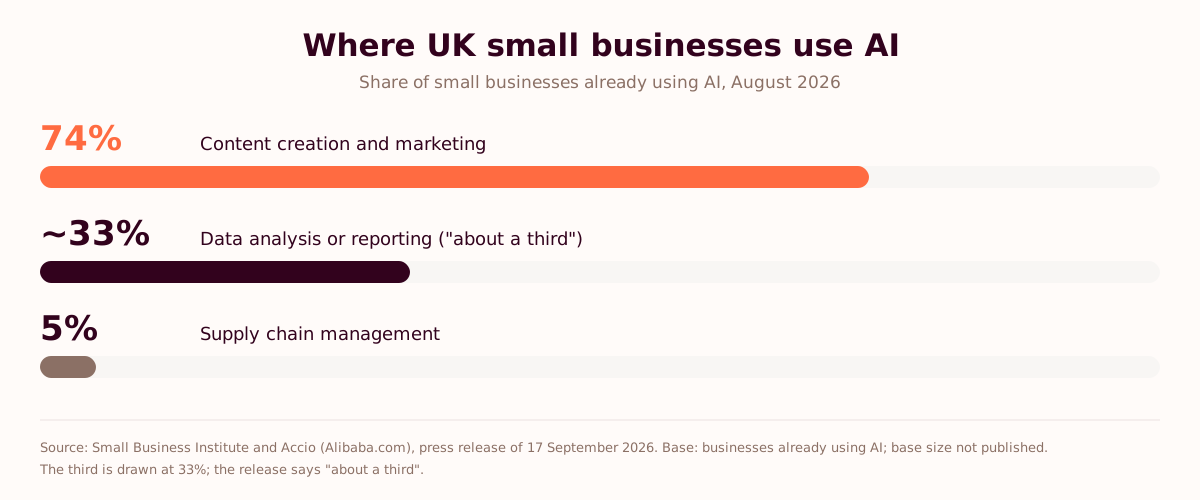
| Use AI for content creation and marketing | 74% | Owners whose business already uses AI |
| Use AI for data analysis or reporting | About a third | Owners whose business already uses AI |
| Use AI for supply chain management | 5% | Owners whose business already uses AI |
| Have heard of agentic AI | 44% | All owners |
| Use agentic AI regularly | 5% | All owners. A separate figure from the supply chain 5% |
| Want to learn more about what agentic AI can do | 68% | All owners |
| See better work-life balance as a potential benefit of agentic AI | 60% | All owners. An expectation |
| Think agentic AI could free up time for marketing and winning customers | 50% | All owners. An expectation |
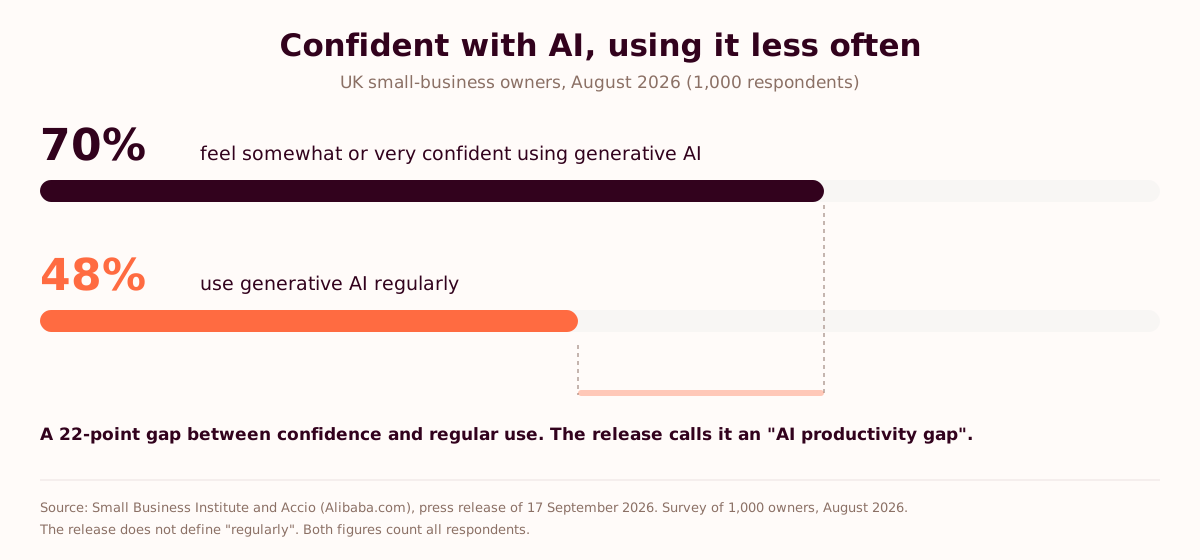
Two sets of figures use different bases, so quote them apart. The 70% and the 48% count all 1,000 owners. The 74%, the third and the supply chain 5% count only the owners whose business already uses AI, and the release doesn't say how many that is. More on the method at the end.
Where do UK small businesses use AI?
In marketing, by a wide margin. Among the small businesses using AI, 74% use it for content creation and marketing. About a third use it for data analysis or reporting. 5% use it for supply chain management.
The order makes sense once you look at the work rather than the tool. A blog post has one author, no system of record and an output the owner can judge in thirty seconds. A quote has a price list, a margin rule, a customer history and a signature at the bottom. A supplier decision has three spreadsheets and a relationship. AI lands first where there's nothing to rebuild and nobody else in the loop.
Which is also why the marketing use case gives back the least. Writing was the cheap part of the owner's week long before AI arrived. The hours live in the quotes, the chasing and the month-end, and those are the rows at a third and at 5%.
The Office for National Statistics sees the same shape in its own survey. 35% of UK businesses with 10 or more employees used AI in June 2026, 28% of those with fewer than 10, and 10% of adopters said they use it extensively. The ONS's own words: "AI adoption to date has been relatively shallow among UK businesses with 10 or more employees" (our breakdown of the ONS figures).
Why is there a gap between AI confidence and regular use?
Because confidence measures the tool, and regular use needs a place in the week. An owner who has written a dozen newsletters with ChatGPT is right to feel confident. Nothing in that experience tells them how to get a quote out of it, so the quote stays in the spreadsheet and the tool stays open in a tab for the next newsletter.
In our glossary the first state is activation: people have the tool and use it on something. Adoption is when a piece of work runs differently because of it. The survey measured 70% activation-ready, 48% activated, and left adoption to the 74-33-5 split, where it shows up as marketing.
"The tool was never the problem. Nobody taught them to drive."
Toni Dos Santos, Teach Them to Drive: The AI Adoption Playbook for Teams
Seventy percent of these owners can drive. Fewer than half take the car out. Most of those drive it to the same shop.
Michelle Lau, managing director of Alibaba.com, said in the release that much of the current adoption is happening "at a surface level". She's selling an agentic platform, so read her diagnosis and her remedy separately. The diagnosis matches what I hear on calls. In September 2026 I counted my last 16 intro calls with new leads: 13 companies already had AI tools rolled out, and ten said usage was low or stuck on the basics (the count, in our piece on the UK adoption plans).
What is agentic AI, and why do only 5% of small businesses use it?
Agentic AI is software that carries out a multi-step task on your behalf: it researches suppliers, compares the quotes, drafts the order and comes back with a shortlist, instead of answering one prompt and waiting for the next. The release describes Accio doing market research, supplier evaluation and day-to-day operations for a business.
The survey's agentic figures, all counting the 1,000 owners: 44% have heard of agentic AI and 5% use it regularly. 68% want to learn more about what it can do. 60% see improved work-life balance as a potential benefit, and 50% think it could free up time for marketing and winning customers.
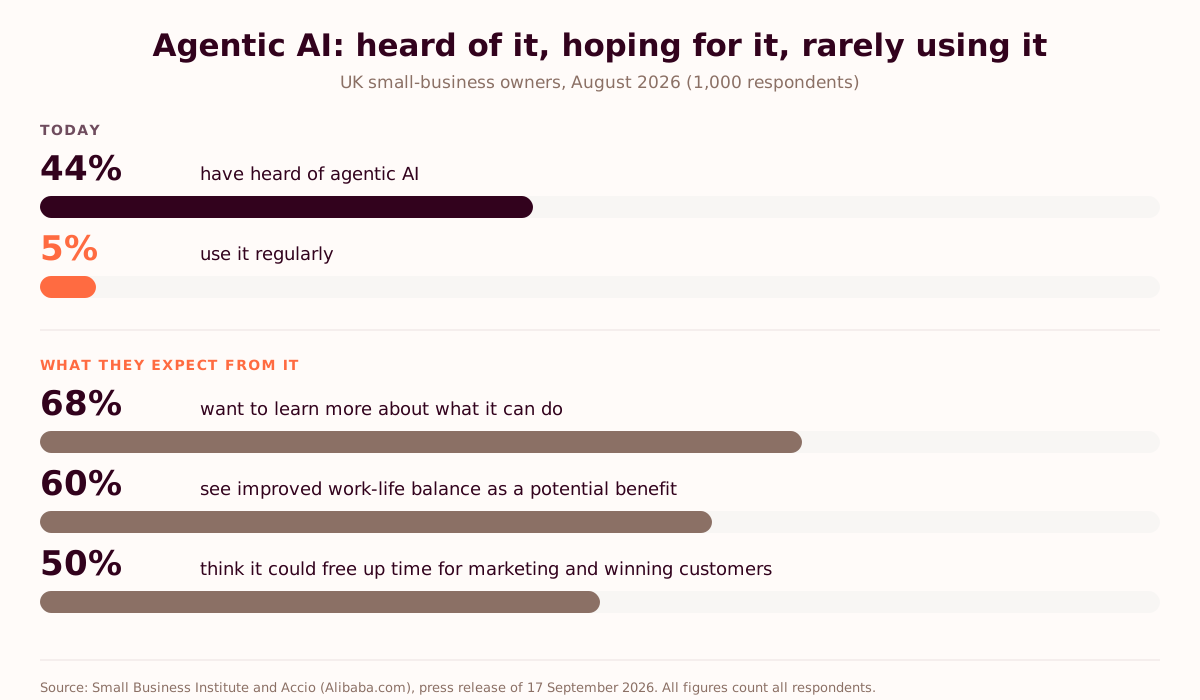
Two of those five numbers describe today and three describe hopes. Nobody in the survey has measured an hour saved by an agent. The 60% on work-life balance is what owners expect, which is useful to know and different from what happens.
The 5% sits where I'd expect it, and that's an opinion. An agent runs a process. If the process lives in the owner's head, with the price in one spreadsheet and the exceptions in memory, the agent has nothing to run. Give it a messy sourcing routine and it automates the mess. The small businesses that get time back from agents will be the ones that wrote the process down first, which is the part nobody is selling.
Michelle Ovens CBE, CEO and founder of Small Business Britain, welcomed the rising confidence in the release and read the figures as a measure of how much of AI's potential, agentic AI's in particular, small businesses haven't tapped yet. On that point, the vendor and the small business champion agree. The 68% who want to learn more suggest the owners do too.
What does Teach Them to Drive say about the small business AI gap?
Three things in the book line up with these numbers.
Skill Inversion explains the 74%. The book's central shift, Skill Inversion, is what happens when AI drops the cost of a credible first draft to near zero and leaves judgment, context and evaluation as the scarce skills. Marketing copy is where that shows up first because the draft was most of the job. In a quote or a monthly report, the draft is a tenth of the job. The rest is a margin rule, a customer history and a number the owner has to stand behind. That's why the operational rows sit at a third and at 5%: AI hasn't yet been given the context, and nobody has rebuilt the check.
The three problems share one chair. The book diagnoses stalled adoption as three problems: people, process and leadership. In a 200-person company each has an owner. In a 15-person company they're all the same person. The owner who is confident with ChatGPT has solved the people problem for one seat, hasn't redesigned a workflow (process), and hasn't protected the time to do it (leadership), because the owner is also the quoting department. That's the 70-to-48 gap in one job description.
One workflow, one number. The book's second half is a 90-Day Playbook: six two-week phases that take one team from "we have the tool" to "this workflow runs differently, and here's the before-and-after". It was written for managers inside larger companies. The structure copies down to a company of ten, with one change: the owner is the sponsor, the pilot team and the reviewer at once, so the workflow chosen has to be the one that eats the owner's evenings.
How does a small business win back time with AI?
One workflow at a time, with a number measured before anything changes. This is the sequence we run with small and mid-size clients, and it's the one an owner can run alone.
- Pick the Painful Tuesday. The recurring task you'd most like never to do again. In small businesses it's usually quotes and proposals, supplier follow-ups, invoice chasing, the monthly numbers or first-line customer emails. One task, one owner.
- Take the baseline before AI goes near it. Hours per week, turnaround time, rounds of correction. Two weeks of honest timing is enough.
- Write the process down. Step by step, with who does what and where the information lives. This is the step the 5% of agent users have done and the rest haven't, and it's where most of the time turns out to be hiding.
- Rebuild it with AI on the specific steps where it saves time. Give the tool the price list, the past quotes and the tone, and put a named human check on anything that reaches a customer, a supplier or HMRC. We use a three-part review for that: check the facts, challenge the reasoning, confirm the tone and policy fit.
- Run it live for two weeks with everyone who touches the task. That's what we call a fat pilot: real quotes, real suppliers, the whole team, with a short weekly huddle on what broke.
- Measure at 30, 60 and 90 days against the baseline. Same units. If the hours didn't move, the problem is upstream in the process or the context you gave the tool, and it gets fixed before the next workflow.
Where the hours tend to be, and what the rebuilt version looks like:
| Workflow | What AI takes on | The human check | The number to watch |
|---|---|---|---|
| Quotes and proposals | Drafts from the price list, past quotes and the customer's brief | Margin and scope, before the owner signs | Hours per quote, turnaround in days |
| Sourcing and supplier follow-ups | Compares options, drafts the chase, builds the shortlist | The relationship and the final choice | Hours per order, days to decision |
| Invoice chasing | Drafts reminders by ageing bucket, flags disputes | Tone on the accounts that matter | Days sales outstanding |
| Monthly numbers | First-pass commentary from the exported ledger | Every figure, before it reaches the bank or the accountant | Hours at month-end |
| Customer emails | Triage and draft replies from the FAQ and order data | Anything with a refund or a complaint in it | Response time, hours per day on the inbox |
That sequence is the method behind our AI consulting for UK SMEs and mid-market companies, which starts at £3,500 for an audit and executive briefing and runs up to a 30/60/90-day adoption programme, tool-agnostic across ChatGPT, Copilot, Gemini and Claude. The free AI adoption audit takes eight minutes and names the barrier holding yours: people, process, foundations or leadership. The AI ROI calculator turns the hours into a £ figure for the accountant. For owners who'd rather run it alone, the 90-Day Scorecard on the book page is the tracker we use ourselves, and the UK SME AI adoption roadmap covers the sequence in more detail.
The task that eats your evenings
Bring the one workflow you'd most like never to do again.
Twenty minutes with Toni or Meera. You'll leave knowing whether it's a good first workflow, the baseline to take this week, and what a 90-day sprint on it would change. Tool-agnostic, so nobody on the call is selling you a licence or an agent.
Book a 20-minute call →How reliable is the Small Business Institute and Accio survey?
Reliable enough to quote for the shape, as long as the limits travel with the figures.
- It's a commercially partnered release. Accio sells agentic AI, and the questions about agentic AI's benefits are the questions a vendor would ask. Treat the 60% and the 50% as appetite, and the quotes from Alibaba.com as positioning.
- The method isn't published. The release gives the sample (1,000 owners) and the month (August 2026). It doesn't give the recruitment method, the weighting, the sector or size mix, the questionnaire, the definition of "regularly" or the size of the AI-using base behind the 74%. I found no methodological report linked from it.
- "Small business" isn't defined. Whether a 2-person studio and a 49-person manufacturer sit in the same sample at the same weight is unknown, and it matters for the operational figures.
- Expectations aren't outcomes. Three of the five agentic figures measure what owners hope for.
- For a weighted official series, use the ONS. Its business survey samples 38,637 firms and publishes its method (the figures). For every UK SME AI number with its source, our UK SME AI adoption statistics page is updated monthly.
How to cite it. Research from the Small Business Institute and Accio, published in September 2026 and based on a survey of 1,000 UK small-business owners conducted in August 2026, found that 70% felt confident using generative AI and 48% used it regularly. Among the small businesses using AI, 74% used it for content creation and marketing. 5% of owners said they use agentic AI regularly.
How does your business compare with the survey?
Six questions, answered on your own week rather than on the dashboard.
| Question | Survey figure (August 2026) | How to answer it for your business |
|---|---|---|
| Are you confident using generative AI? | 70% somewhat or very confident | Probably yes. It's the least useful of the six answers |
| Does anyone use it regularly? | 48% | Count the people who used it on real work this week, by name |
| Is it used beyond marketing? | 74% content and marketing, about a third analysis, 5% supply chain | List the tasks it touched. If they're all copy, you're in the 74% |
| Has one process changed because of it? | Not asked | Name the workflow and the before-and-after number. This is the question the other five hang on |
| Do you use an agent on anything? | 5% | Only if it runs a written process without you in every step |
| Where do your evenings go? | 60% hope agentic AI gives time back | Time the task for two weeks. That's your baseline |
The one most owners can't answer is the fourth. It's also the only one that shows up in the accounts.
Frequently asked questions
What did the Small Business Institute and Accio survey find?
That UK small-business owners' confidence in AI runs ahead of their use of it. In a survey of 1,000 owners conducted in August 2026 and published on 17 September 2026, 70% said they felt somewhat or very confident using generative AI, and 48% said they use it regularly. Among the businesses using AI, 74% use it for content creation and marketing, about a third for data analysis or reporting and 5% for supply chain management. The release calls the pattern an AI productivity gap.
How many UK small businesses use AI regularly?
48% of UK small-business owners said they use generative AI regularly, according to the Small Business Institute and Accio survey of 1,000 owners in August 2026. The release doesn't define "regularly". For comparison, the ONS found that 28% of UK businesses with fewer than 10 employees used at least one AI technology in June 2026, against 35% of businesses with 10 or more employees.
What do UK small businesses use AI for?
Mostly content creation and marketing. Among the UK small businesses using AI in the August 2026 Small Business Institute and Accio survey, 74% use it for content creation and marketing, about a third for data analysis or reporting and 5% for supply chain management. Operational uses such as quoting, sourcing and reporting are where the hours are, and where use is lowest.
What is agentic AI for small businesses?
Software that carries out a multi-step task on the business's behalf, such as researching suppliers, comparing quotes, drafting the order and returning a shortlist, instead of answering a single prompt. Accio, Alibaba.com's agentic AI platform, is described in the release as handling market research, supplier evaluation and day-to-day operations. An agent runs a process, so it needs a process that's written down.
How many UK small businesses use agentic AI?
5% of UK small-business owners said they use agentic AI regularly, and 44% had heard of it, according to the Small Business Institute and Accio survey of August 2026. 68% wanted to learn more about what it can do, 60% saw improved work-life balance as a potential benefit and 50% thought it could free up time for marketing and winning customers. The last three figures describe expectations.
What is the AI productivity gap?
The term the Small Business Institute and Accio release uses for the distance between small-business owners' confidence in AI (70%) and their regular use of it (48%), with use concentrated in content creation rather than operations. In practice it's the gap between having a tool and having a workflow that runs differently because of it, which our glossary calls activation versus adoption.
Why do small businesses use AI mainly for marketing?
Because a piece of marketing copy has one author, no system of record and an output the owner can judge in seconds, so there's nothing to rebuild. A quote, a supplier decision or a monthly report needs data the AI doesn't have, a process that's often undocumented and a check before it leaves the business. Teach Them to Drive describes the mechanism as Skill Inversion: AI made the first draft cheap, and copy is the task where the draft was most of the job.
How can a small business get time back with AI?
By rebuilding one recurring workflow with a number attached. Pick the task that eats the most owner time (quotes, supplier chasing, invoice reminders, month-end), take a baseline of hours and turnaround, write the process down, put AI on the steps where it saves time with a human check on anything that reaches a customer, run it live for two weeks, then measure at 30, 60 and 90 days. Then move to the next workflow.
How reliable is the Small Business Institute and Accio research?
Reliable enough to quote with its limits. The public release gives the sample size (1,000 UK small-business owners) and the fieldwork month (August 2026) but no recruitment method, weighting, sector mix, questionnaire, definition of "regularly" or size of the AI-using base. Accio, which co-produced it, sells agentic AI. For a weighted official series on UK business AI use, use the ONS Business Insights and Conditions Survey.
Sources and further reading
- New Research: UK small businesses want AI to win back time, not just write copy, PA Media Press Release Hub, 17 September 2026 (contributed by PR Newswire)
- The original release, PR Newswire UK, 17 September 2026
- Artificial intelligence in UK businesses: 2023 to 2026, Office for National Statistics, 20 July 2026
- 35% of UK Businesses Now Use AI. The ONS Says It's Shallow, We Call Shotgun, 28 September 2026
- UK SME AI Adoption Statistics 2026: Every Number Worth Citing, We Call Shotgun, updated monthly
- 96% of UK Workers Still Edit AI-Generated Documents, We Call Shotgun, 4 October 2026
- Why AI Training Fails After the Workshop: What Microsoft Learned From 200,000 Employees, We Call Shotgun, 24 September 2026
- Toni Dos Santos, Teach Them to Drive: The AI Adoption Playbook for Teams