Enterprise AI agents are software systems that use large language models to plan and execute multi-step work — reading systems, making decisions, taking actions — with limited human supervision. As of August 2026, the credible platforms come from OpenAI, Anthropic, Microsoft, Google, Salesforce and ServiceNow, plus specialists like Glean and UiPath. This guide benchmarks them, prices them, and covers the risks nobody puts in the demo.
Key Takeaways
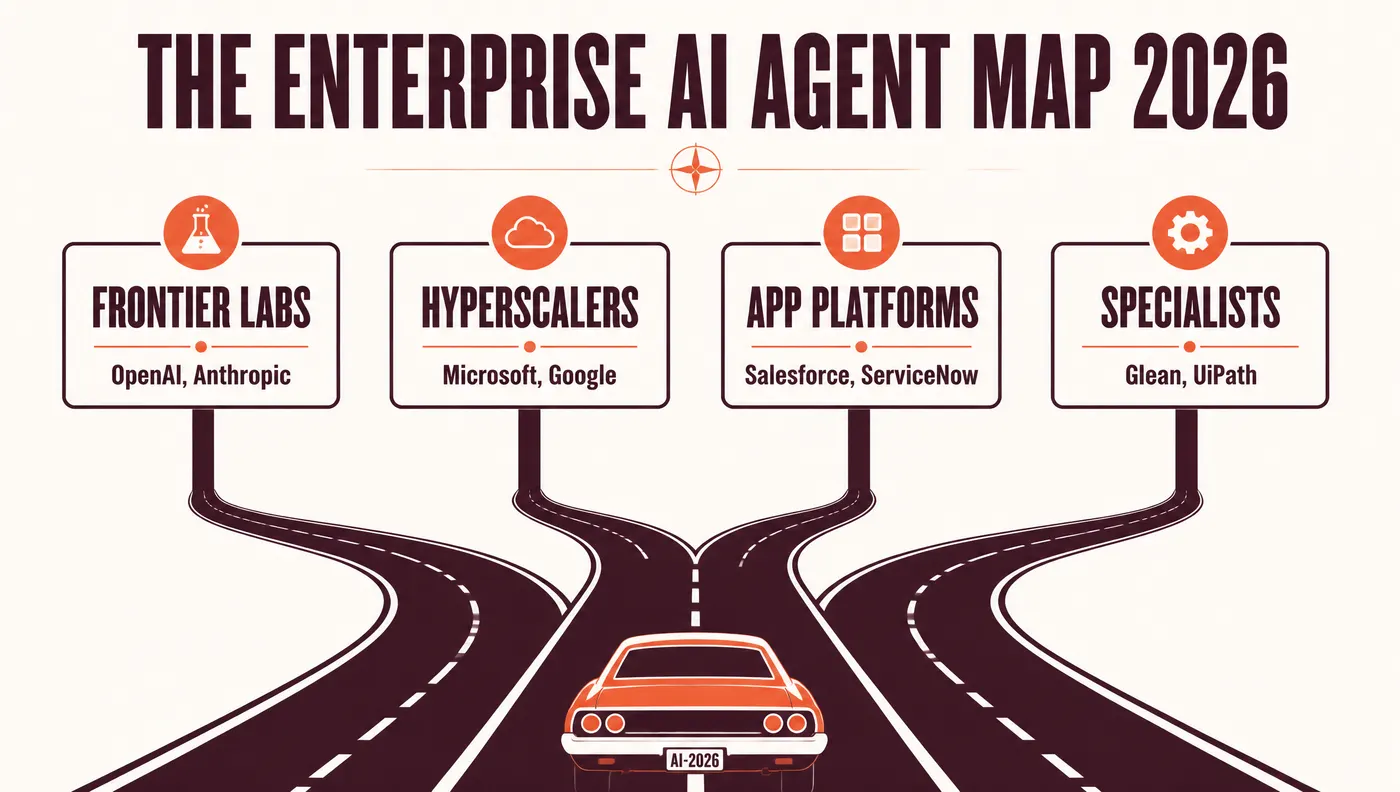
- The market has consolidated into four buying routes: frontier labs (OpenAI, Anthropic), hyperscalers (Microsoft, Google), app platforms (Salesforce, ServiceNow) and specialists (Glean, UiPath, CrewAI). Most companies will end up running more than one.
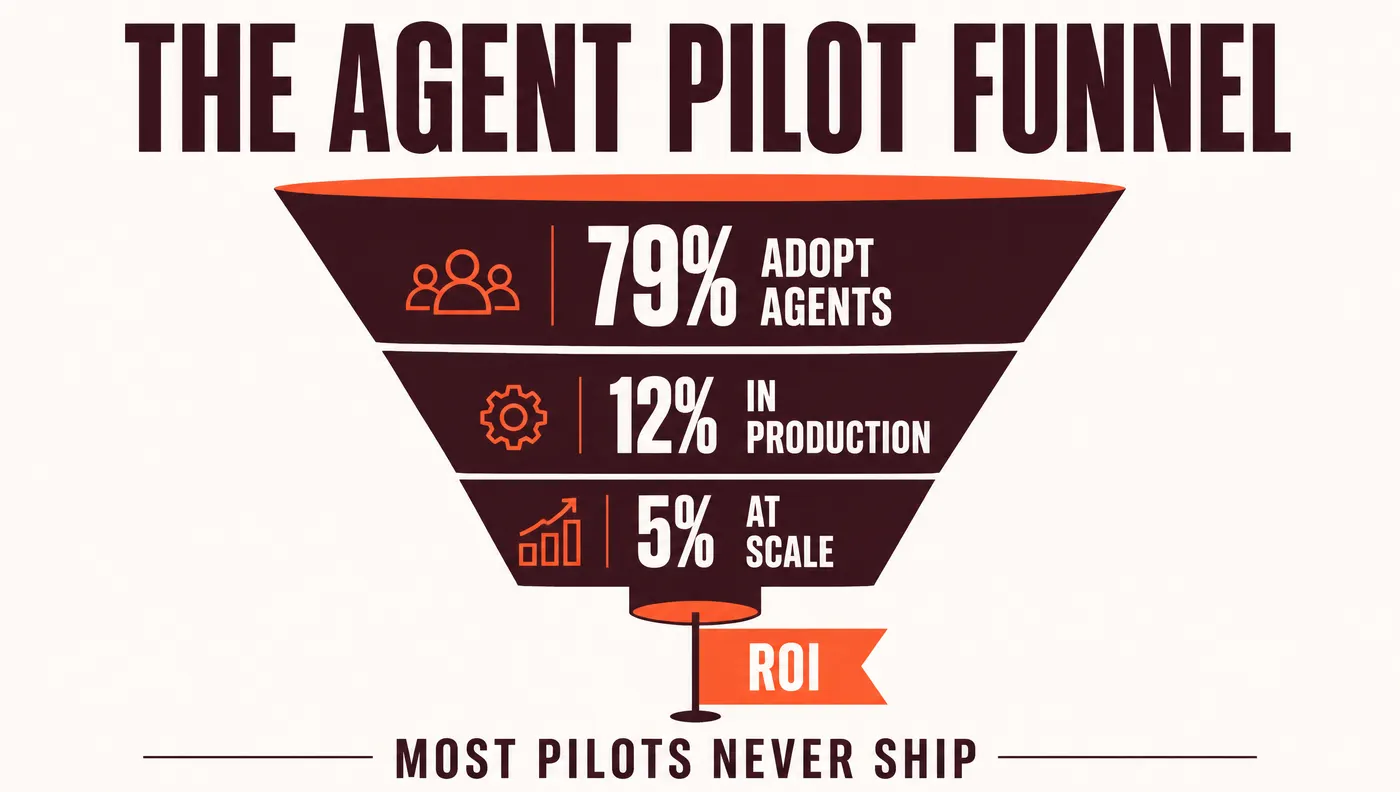
- Adoption is broad, production is rare. Analyst estimates through 2025-2026 consistently find that the large majority of agent pilots never reach production, and Gartner projects over 40% of agentic AI projects will be scrapped by the end of 2027.
- Public benchmarks (GDPval, τ²-bench, OSWorld, Terminal-Bench) rotate leaders every quarter. They tell you a model is competent. They do not tell you it will work on your workflows, with your data, at your error tolerance. Run your own evals.
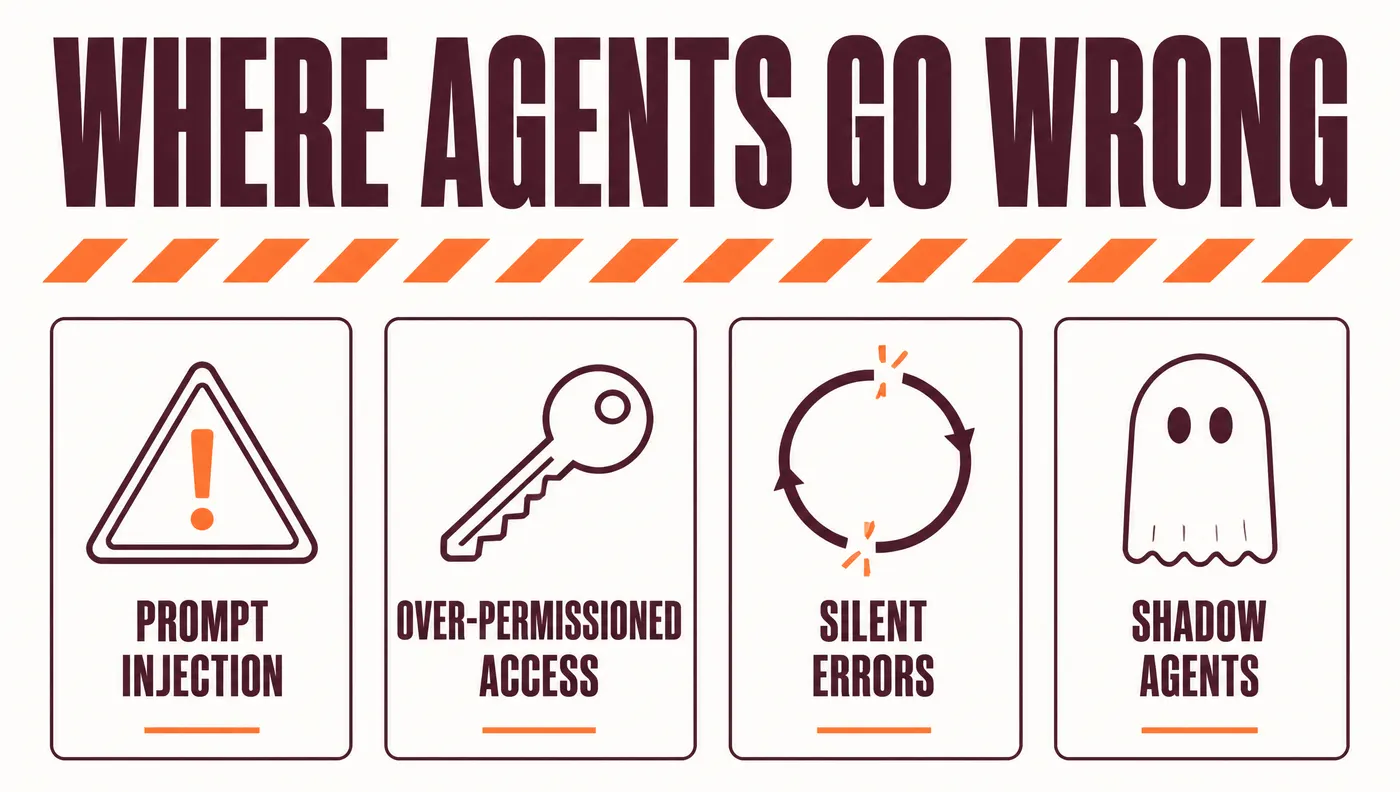
- The four failure modes that actually hurt: prompt injection, over-permissioned access, silent errors, and shadow agents nobody governs.
- The variable that separates ROI winners from losers is not the platform. It is how many people in the company can put an agent inside a real workflow. Adoption beats procurement.
What is an enterprise AI agent?
An enterprise AI agent is a system that takes a goal, breaks it into steps, uses tools — search, databases, email, browsers, internal APIs — and works through those steps until the goal is done or a human is needed. That is the difference from a chatbot: a chatbot answers, an agent acts. A customer emails about a renewal; an agent reads the thread, pulls the contract from the CRM, drafts the response, flags the commercial risk, and either sends or queues it for approval.
Three technical shifts made this practical between 2024 and 2026. Models got reliable enough at multi-step reasoning to be left alone for minutes rather than seconds. The Model Context Protocol (MCP), open-sourced by Anthropic and since adopted by OpenAI, Microsoft and Google, standardised how agents connect to tools and data. And every major software vendor shipped a runtime — so the question stopped being "can we build one?" and became "which of the six on the table do we actually deploy?"
If your teams are still at the prompting stage, start with our guide on moving from prompting to task delegation — agents are the third step of that ladder, not the first.
The market in numbers, August 2026
The adoption statistics look triumphant until you read the second half of each sentence.
- Gartner predicts that over 40% of agentic AI projects will be cancelled by the end of 2027, citing escalating costs, unclear business value and inadequate risk controls. The same firm expects a third of enterprise software to embed agentic AI by 2028.
- MIT's much-cited 2025 NANDA study found that about 95% of generative AI pilots produced no measurable P&L impact — not because the models failed, but because the workflows around them never changed.
- The CBI and Oliver Wyman found that firms leading on AI deployment meet or exceed expected ROI 49% of the time, against 15% for firms stuck in pilots — often with identical software. We unpacked that in our analysis of the CBI Adoption Decade report.
- Vendors report real commercial traction: Salesforce says it has closed tens of thousands of Agentforce deals since launch, and Microsoft reports over 100,000 organisations building custom agents in Copilot Studio. Deals, however, are not deployments.
Toni Dos Santos, our Co-Founder and AI Advisor, summarises the pattern we see in client work: "Every failed agent project we audit has the same shape. The platform was fine. The pilot worked. Then it met the org chart — no owner, no error budget, no one trained to run it — and it died in review. Companies do not have an agent technology problem, they have an agent adoption problem."
The main enterprise AI agent platforms, compared
We are tool-agnostic, so here is the honest map. Six platforms cover the vast majority of enterprise deployments we see, with a specialist tier behind them.
| Platform | Best for | Agent capabilities | Watch out for |
|---|---|---|---|
| OpenAI — ChatGPT Enterprise + AgentKit | Broadest general-purpose capability; teams already living in ChatGPT | Workspace agents with 90+ connectors, event-triggered tasks, AgentKit for custom builds, Codex for engineering work | Fast-moving product surface; governance features trail the consumer features by months |
| Anthropic — Claude Enterprise + Agent SDK | Regulated industries, document-heavy and coding work, safety-first procurement | Claude agents with MCP-native tool use, Agent Skills for packaged workflows, Cowork for non-technical teams, managed agents | Smaller connector ecosystem than OpenAI; fewer turnkey consumer-style features |
| Microsoft — Copilot Studio + Agent 365 | Microsoft 365 estates; IT-led governance of a whole agent fleet | Low-code agent builder, Azure AI Foundry for pro-code, Agent 365 as a control plane that can govern third-party agents too | Credit-based pricing is hard to forecast; quality varies by scenario |
| Google — Gemini Enterprise + Vertex AI Agent Builder | Google Workspace shops; data-heavy, multimodal use cases on GCP | Gemini Enterprise as the front door, Vertex AI Agent Builder and A2A protocol for custom multi-agent systems | Two overlapping product lines; enterprise support maturity varies by region |
| Salesforce — Agentforce | Sales and service teams whose system of record is Salesforce | Prebuilt sales/service agents grounded in CRM data, Atlas reasoning engine, low-code builder | Consumption pricing can escalate; value drops sharply outside the Salesforce data boundary |
| ServiceNow — AI Agents | IT service, HR and operations workflows already on the Now platform | Agent orchestrator, prebuilt ITSM/HR agents, strong audit and workflow controls | Platform commitment is heavy; less useful as a general-purpose assistant |
| Specialists — Glean, UiPath, CrewAI | Enterprise search agents, RPA-plus-agents, and open-source orchestration respectively | Deep in their niche, often best-in-class there | Another vendor relationship; integration burden sits with you |
Two practical notes. First, cloud-native tools (ChatGPT Enterprise, Claude) can pilot in days, while platform tools (Agentforce, ServiceNow, full Copilot Studio deployments) typically take four to twelve weeks to stand up properly. Second, the deeper comparison of the assistant layer — as opposed to the agent layer — lives in our ChatGPT Enterprise vs Copilot vs Gemini guide and our 2026 workplace AI benchmark.
What they cost
Published and reported pricing as of August 2026. Every vendor negotiates at enterprise volume, and consumption models make the sticker price the start of the conversation, not the end. Verify with the vendor before budgeting.
| Platform | Reported pricing | Model |
|---|---|---|
| ChatGPT Enterprise | ~£45–60 per seat/month at volume | Per seat, custom contracts |
| Claude Enterprise | Custom; Team tier from ~£20 per seat/month | Per seat, custom contracts |
| Microsoft Copilot Studio | ~$200 per 25,000 Copilot Credits/month | Prepaid or pay-as-you-go credits |
| Google Gemini Enterprise | From ~$21 (Business) to $30+ per seat/month | Per seat plus consumption beyond quota |
| Salesforce Agentforce | ~$2 per conversation, or Flex Credits at ~$0.10 per action; bundled user tiers above that | Consumption, with per-user bundles |
| ServiceNow AI Agents | Custom; sold through Now platform tiers | Platform licensing |
Budget rule we give clients: for consumption-priced agents, model your cost at 3x the pilot's run rate before you sign. Pilots are quiet. Production is not, and 30 runs an hour across a support team compounds fast. Our AI spend monitoring guide covers how to watch this across vendors.
How to benchmark enterprise AI agents
Public agent benchmarks matured fast in 2025-2026, and they are worth knowing because vendors will quote them at you.
| Benchmark | What it measures | What it tells an enterprise buyer |
|---|---|---|
| GDPval (OpenAI) | Real deliverables from 44 occupations, graded against human professionals | The closest thing to "can it do knowledge work?" — directionally useful |
| τ²-bench | Customer-service scenarios with tool use and policy constraints | How agents behave under rules — relevant for support deployments |
| OSWorld / Terminal-Bench | Operating a computer and a terminal end-to-end | Computer-use agents remain the least reliable category; treat demos sceptically |
| SWE-bench Verified / Pro | Resolving real software issues in real repositories | The one benchmark that maps cleanly to a job — engineering |
Here is what matters more than any of it: as of mid-2026, no single model or platform leads every leaderboard, and rankings reshuffle with every release cycle. A benchmark score is table stakes, not a decision. The decision-grade evidence is a two-week evaluation on your own workflows: take ten real tasks, define what "done correctly" means, run each platform against them, and count. We walk through building that harness in our guide to production-ready agentic workflows.
Choosing an agent platform this quarter?
See the enterprise AI adoption programme →Run the free AI adoption scorecardVendor-neutral evaluation against your own workflows, not the vendor's demo. UK engagements from £3,500.
The risks: what actually goes wrong
Agent risk is not hypothetical. The 2026 OWASP work on agentic security catalogues real CVEs, vendor advisories and breach reports across almost every category of agentic risk, and industry surveys through 2026 report that a large majority of organisations running agents experienced at least one confirmed or suspected agent-related security incident in the past year. Four failure modes account for most of the damage.
1. Prompt injection
An agent that reads email, tickets or web pages can be instructed by them. Hidden text in an inbound message becomes a command executed with the agent's permissions — a zero-click attack path that OWASP still ranks as the top agentic risk in 2026. Mitigation: treat every external input as untrusted, gate consequential actions behind human confirmation, and filter triggers to known senders.
2. Over-permissioned access
The fastest way to make a pilot work is to give the agent admin credentials. The fastest way to make the front page is the same decision. Agents need scoped, revocable, least-privilege identities — which is precisely what the emerging agent-identity tooling from the major vendors is for. Our CISO's guide to enterprise AI security covers the access model in detail.
3. Silent errors
A broken script throws an exception. A broken agent produces a plausible wrong answer and keeps going. Without logging, sampling and human review of a percentage of outputs, you discover the error rate when a customer does. Define an error budget per workflow before launch, not after.
4. Shadow agents
Anyone with a paid ChatGPT or Claude seat can now stand up an automation on their own inbox. Multiply by every employee and you have a fleet nobody inventories. This is the agent-era version of shadow AI, and the governance playbook in our shadow AI guide applies directly: inventory first, then policy, then sanctioned alternatives.
The limits: what agents still cannot do
Vendor-neutral means saying this part out loud. As of August 2026:
- Long-horizon reliability decays. Agents are strong on tasks of minutes, decent on tasks of hours, and unreliable on tasks of days. Error compounds per step; a 98%-per-step agent fails a 30-step chain a third of the time.
- They do not know what they do not know. Confidence is not calibrated. The failure mode is a wrong answer delivered fluently, which is why review gates exist.
- Costs are non-linear. Reasoning models retry, branch and re-read. A workflow that costs pennies in a demo can cost pounds per run under production load.
- Integration is the real project. The model is 20% of the work. Data access, permissions, logging, evals and change management are the other 80% — and they are the 80% that pilots skip.
- Computer-use agents lag API agents. Anything driving a GUI is still meaningfully less reliable than anything calling a clean API. Design around APIs where you can.
Adoption is the multiplier, not the platform
Read the failure statistics again: over 40% of projects heading for cancellation, 95% of pilots without P&L impact, and a 49%-vs-15% ROI gap between execution leaders and pilot-dwellers running near-identical software. The consistent variable is not model choice. It is whether the organisation changed how it works.
Gartner's Anushree Verma put it bluntly in the firm's agentic AI research: "Most agentic AI projects right now are early stage experiments or proof of concepts that are mostly driven by hype and are often misapplied."
What the companies on the right side of the gap do differently, in our experience across 50+ engagements:
- They pick workflows, not use cases. "An agent for support" fails. "An agent that triages the renewals inbox against the ICP, with a named owner and a weekly error review" ships.
- They train the people who own the work. Not one prompt-engineering webinar — role-based training so the sales team, the support team and finance each leave with a working agent on their own data. This is exactly why our training is built around live workflows rather than slides.
- They govern before they scale. Inventory, identity, error budgets and an approval path — the boring quartet that separates a capability from an incident.
- They measure minutes, not vibes. Time saved per week per workflow, tracked from week one, is the number that survives a CFO conversation. Our AI ROI guide for CFOs shows the framework.
Want agents your teams actually run, not a pilot that dies in review?
Book a free 20-minute call →Explore AI strategy consultingTool-agnostic across ChatGPT, Claude, Copilot and Gemini. 1,500+ professionals trained, 4.98/5 average rating.
How to choose: six questions before you sign
- Where does your data already live? The platform native to your system of record starts with a large head start — Agentforce for Salesforce shops, Copilot for Microsoft 365 estates, Gemini for Workspace.
- Who will build and run the agents? IT-led estates suit Copilot Studio or ServiceNow. Business-led teams get further, faster with ChatGPT Enterprise or Claude.
- What is your regulatory exposure? Audit trails, data residency and model governance narrow the field quickly in financial services and healthcare. Our UK data residency guide maps the options.
- Can you forecast the bill? Per-seat pricing is predictable; consumption pricing needs the 3x rule above.
- Does it speak MCP? Open protocol support is your exit route. A platform that only talks to itself is a platform you cannot leave.
- What does the 90-day adoption plan look like? If the vendor's answer is a licence count and a slide deck, the 40% cancellation statistic is your forecast.
Frequently asked questions
What are enterprise AI agents?
Enterprise AI agents are AI systems that autonomously execute multi-step business tasks — reading data, using tools, taking actions across systems like email, CRMs and databases — under company governance and with human oversight at defined checkpoints. Unlike chatbots, which answer questions, agents complete work: triaging tickets, drafting and sending follow-ups, reconciling records, or resolving software issues.
Which is the best AI agent platform for enterprise in 2026?
There is no single best platform; there is a best fit for your stack. As of August 2026: ChatGPT Enterprise for the broadest general capability, Claude for regulated and document-heavy work, Copilot Studio with Agent 365 for Microsoft-first estates, Gemini Enterprise for Google shops, Agentforce for Salesforce-centric sales and service, and ServiceNow for ITSM and operations. Most mid-size and large companies end up running two or more, connected through open protocols like MCP.
How much do enterprise AI agents cost in 2026?
Seat-based assistants with agent features run roughly £20–60 per user per month at enterprise volume. Consumption-priced platforms differ: Copilot Studio sells credits at around $200 per 25,000, and Agentforce charges around $2 per conversation or $0.10 per action. Build-your-own routes pay per token plus engineering time. Budget for roughly three times the pilot's run rate at production load, plus training and integration, which usually exceed the licence cost in year one.
What are the main risks of deploying AI agents?
The four that cause real incidents: prompt injection, where hostile content in emails or documents hijacks the agent's permissions; over-permissioned access, where an agent holds broader credentials than its task needs; silent errors, where plausible-but-wrong outputs flow downstream unreviewed; and shadow agents, built by employees outside any inventory or governance. All four have documented CVEs or incident reports behind them as of 2026, and all four are manageable with least-privilege identity, human gates on consequential actions, output sampling and an agent inventory.
Why do most enterprise AI agent pilots fail?
Rarely because of the model. Analyst work through 2025-2026 attributes most failures to unclear success criteria, insufficient data and tool access, and missing governance — organisational causes, not technical ones. MIT's NANDA study found roughly 95% of generative AI pilots produced no measurable P&L impact because workflows never changed around the technology. The fix is unglamorous: one owned workflow, defined error budgets, trained operators, measured minutes saved.
Should we build our own agents or buy a platform?
Buy the runtime, build the workflow. Frameworks like the Claude Agent SDK, OpenAI's AgentKit, Vertex AI Agent Builder or CrewAI make custom builds viable for engineering teams with a differentiated use case. For the long tail of business workflows — triage, drafting, reporting, follow-up — configuring a commercial platform is faster, safer and cheaper to govern. The build-versus-buy line usually falls at "is this workflow a competitive advantage, or just work?"
How long does it take to deploy an enterprise AI agent?
A scoped agent on a cloud platform (ChatGPT Enterprise, Claude) can be live in days; a governed deployment on a platform tool (Agentforce, ServiceNow, full Copilot Studio) typically takes four to twelve weeks including integration, security review and training. The honest total for "deployed and adopted" — running in production with trained owners and measured output — is a quarter for the first workflow, faster for each one after.
We sit in the passenger seat for this exact decision
We're We Call Shotgun, a founder-led AI consulting and training boutique working across the UK and France. We are tool-agnostic across ChatGPT Enterprise, Microsoft Copilot, Google Gemini and Claude, and every engagement ships with workflow-first adoption training, because a platform nobody uses is not an advantage. 1,500+ professionals trained, 50+ companies, 4.98/5 average rating. UK engagements from £3,500.
Run the Free AI Adoption Scorecard Book a Free 20-Minute CallSources and further reading
- Gartner, "Over 40% of Agentic AI Projects Will Be Canceled by End of 2027" — the cancellation forecast and the Verma quote
- MIT NANDA, "The GenAI Divide: State of AI in Business 2025" — the 95% pilot statistic and why workflows, not models, are the bottleneck
- OWASP GenAI Security Project — the agentic threat taxonomy, including prompt injection and agent identity risks
- Model Context Protocol — the open standard now supported across OpenAI, Anthropic, Microsoft and Google
- Vendor documentation: OpenAI for business, Claude Enterprise, Copilot Studio, Gemini for Google Cloud, Agentforce, ServiceNow AI Agents — pricing and capability claims verified here move faster than any article, this one included
- We Call Shotgun: AI agents and autonomous workflows, production-ready agentic workflows, ChatGPT event-triggered tasks, Microsoft Scout agent guide, why enterprise AI adoption fails