Business Hub is the dashboard OpenAI launched in beta on 10 November 2026 as part of Businesses in ChatGPT. A company claims its profile inside ChatGPT, updates its details, adds a product feed and sees how often ChatGPT mentions it and sends clicks to its website. It's free for now. Business Agents, a branded chat inside ChatGPT, are open to US e-commerce and online service businesses only.
For two years, a marketing director who asked "what does ChatGPT say about us?" had two options. Type the question in and hope the answer was typical. Or pay a tool to type it in a few thousand times and estimate.
On Tuesday OpenAI added a third: its own numbers, from its own logs, in a dashboard called Business Hub.
It answers part of the question. It doesn't tell you which buyer questions you're losing, and that's the part most companies want. Below: what it is, how to claim your business, what the dashboard shows and hides, what Business Agents do, and where the free part meets ChatGPT's ad business.
Every figure is OpenAI's or a named outlet's, with the link. Where OpenAI hasn't said something, the article says so.
The short version, in six lines
- What it is. A free beta dashboard inside ChatGPT, launched 10 November 2026. Claim your business, edit the profile, add products, read mentions, views, clicks and discovery topics.
- Who can claim. Eligible businesses with a website, wherever ChatGPT is available. Ownership is checked by text, call, email, DNS or Shopify, then identity by Persona.
- Business Agents. A labelled chat with your business inside ChatGPT. US e-commerce and online services only, for now.
- What you see. Aggregated counts and themes. No prompts, no chats, no competitor comparison, nothing from Gemini, Claude or Copilot.
- Where the money is. The same agent can be sponsored as a ChatGPT ad. The hub is free, and the paid door is right next to it.
- What it won't do. "Claiming does not guarantee higher placement or sales," says OpenAI. Your pages still have to earn the mention.
What is Businesses in ChatGPT?
Businesses in ChatGPT is OpenAI's name for the tools that let a company manage how it appears inside ChatGPT. It launched in beta on 10 November 2026 with three parts: a business profile you claim, a dashboard called Business Hub, and an optional Business Agent that talks to customers on your behalf (OpenAI, Introducing Businesses in ChatGPT).
OpenAI pitches it as "a new way to connect with the 1.2 billion people who use ChatGPT each week" (Search Engine Roundtable). Its own post on X was shorter: "Use Business Hub to shape what customers see about your business in ChatGPT" (@OpenAI on X).
| Part | What it does | Who gets it today |
|---|---|---|
| Business profile | The listing ChatGPT shows when it names you: website, description, category, logo, cover photo, delivery and return policies. A verified profile carries a blue check. | Eligible businesses wherever ChatGPT is available |
| Business Hub | The dashboard where you verify, edit the profile, upload products and read Insights | Same, once verified |
| Product feed | Products with price and availability, by CSV or JSONL upload or a Shopify connection | Businesses that sell products. The standard upload targets the US |
| Business Agent | A labelled chat with your business, opened from your profile, answering questions on products and policies | Eligible US e-commerce and online service businesses |
| Sponsored agent | The same agent, reached from a paid ChatGPT ad | Advertisers, in test since September 2026 |
Shopify merchants get a shortcut. Their eligible products already sit in ChatGPT through Shopify Catalog, and they can connect the store from Business Hub or from the Shopify admin (Reuters, via Investing.com). A Shopify store isn't required to claim.
It costs nothing. Benji Shomair, OpenAI's vice president of monetization, told reporters the hub and the agents are free for now, and didn't rule out a paid model later (Digiday, 10 November 2026).
Why is Business Hub an opportunity for companies?
Because it's the first time the platform itself tells you how often it names you. Until now, every AI visibility number a company saw was an estimate built from simulated questions.
A whole category of tools sells those estimates. Profound, Peec AI and OtterlyAI run simulated questions through the assistants, count the brands in the answers and estimate (Trending Topics). OpenAI has the real logs, and Business Hub puts a slice of them in front of you.
Agencies noticed. Farhad Divecha, group CEO of the agency Accuracast: "Now that OpenAI is making their own mentions data available, we're very interested to see how far off these tools were. If their estimation data was wildly erroneous, that will make us rethink paying for those tools" (Digiday).
Three more reasons it matters:
- The shortlist moved. Buyers ask an assistant for three suppliers and start with those three. Pipedrive's CEO tied lost traffic to it in a memo to staff in October. The evidence is in How to get your business recommended by ChatGPT.
- You get a correction channel. If ChatGPT describes you with last year's offer or the wrong category, the profile is the one place you can now edit at the source. OpenAI reviews each change, and other sources still shape the answer.
- Your products become readable. A feed with current prices and stock is data ChatGPT can use when someone asks what to buy. Shomair said joining won't change how often you appear, but better product data can help ChatGPT understand what you sell (Digiday).
And it's free, which makes it the easiest yes in any marketing budget meeting this quarter.
How do you claim your business in ChatGPT?
You claim it in Business Hub, from the ChatGPT sidebar or at chatgpt.com/business-hub. Search for the business, prove you own it, pass an identity check, then publish. OpenAI emails its decision after each review.
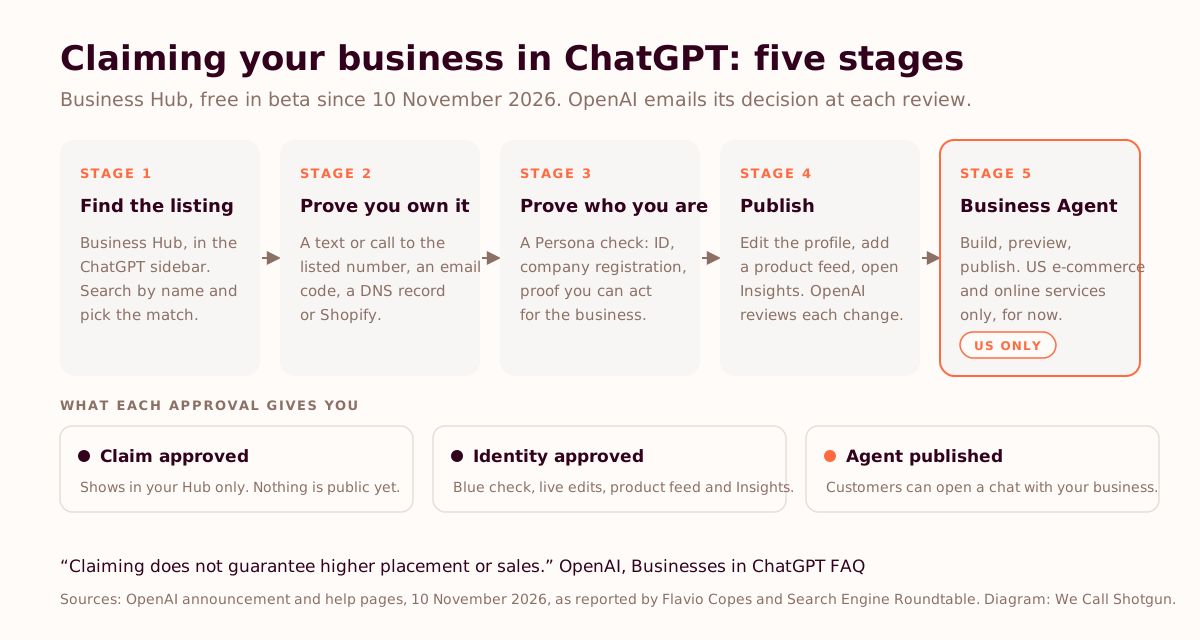
Step 1. Find your listing
Sign in with the ChatGPT account that will manage the business, open Business Hub and search by name. Pick the matching listing. If there isn't one, eligible online businesses can add a new one. Local shops and restaurants can only claim a listing that already exists, and only in the US (Flavio Copes, from OpenAI's help pages).
A listing marked "Contact support" is locked, and you have to ask OpenAI for access. Enterprise customers and existing advertisers skip the self-serve flow and claim through their OpenAI representative (Reuters).
Step 2. Prove you own it
OpenAI shows only the methods that apply to your business:
- Business phone: a text or automated call to the number on the listing.
- Business email: a code sent to the address linked to the business.
- Website domain: add the TXT record ChatGPT gives you to your DNS, then select "Verify domain".
- Shopify: connect the store and approve the permissions.
Barry Schwartz of Search Engine Roundtable claimed his site by DNS on launch day. The claim showed as pending, with no analytics yet (Search Engine Roundtable). The DNS route needs whoever holds the keys to your domain, which in most companies isn't marketing.
Step 3. Pass the Persona identity check
An approved claim only puts the business in your Hub. To publish edits, connect a feed, read Insights or build an agent, you pass a second check run by the identity company Persona. Expect a government ID, company registration details and proof you're authorised to act for the business, all matching official records (Flavio Copes). OpenAI hasn't published its verification criteria, which vary by business type and market (DataStudios).
If you finished the claim another way, you can complete Persona later from "Complete verification with Persona" in the business overview (OpenAI Help Center).
Step 4. Fill in the profile and add products
Once verified, you can edit the website, description, category, logo, cover photo, delivery policy and return policy. Every change goes through OpenAI review before it's live.
Products go in as a CSV or JSONL file in OpenAI's product spec, or sync from Shopify. Nine fields are required: item_id, title, description, url, brand, seller_name, image_url, price and availability. Price is an amount, a space and a currency code, as in "20.00 USD". The feed doesn't schedule anything, so sale dates and restock dates need a manual update (Flavio Copes, from the OpenAI product feed spec).
Read this before you publish. A published profile is hard to take back. OpenAI Support can't delete, unpublish or hide one, and only drafts can be removed (Flavio Copes, from OpenAI's help pages). The description you write on day one is the one ChatGPT reads.
Step 5. Decide on a Business Agent
Only if you're a US e-commerce or online service business. What it does and doesn't do is two sections down.
Who can use what, today
| Feature | Online business, US | Online business, outside the US | Local business (shop, restaurant) |
|---|---|---|---|
| Claim and verify a profile | Yes | Yes, where ChatGPT is available | US only, existing listings only |
| Add a listing that doesn't exist yet | Yes | Yes, if eligible | No |
| Product feed | Yes | Needs OpenAI to confirm the integration | Not stated |
| Insights | Yes, above the reporting threshold | Yes, above the threshold | Yes, in the US |
| Business Agent | E-commerce and online services | Not yet, no date | Not yet, no date |
Built from OpenAI's announcement and help pages as reported on 10 November 2026 (Flavio Copes, DataStudios). OpenAI hasn't published a country list, and it's a beta, so check Business Hub for your own case.
What does Business Hub show you?
Four metrics: mentions, views, website clicks and discovery topics. All aggregated, and all withheld until there's enough activity to protect user privacy.
| Metric | What OpenAI counts | What it doesn't mean |
|---|---|---|
| Mentions | Online business: ChatGPT referenced your website. Local business: ChatGPT showed a result for your location. | Your name in an answer. "Just naming the brand doesn't count." |
| Views | Views of your business in ChatGPT | OpenAI hasn't published a fuller definition |
| Website clicks | "Clicks on links from supported ChatGPT surfaces" | "Not completed visits or purchases" |
| Discovery topics | "Common themes in conversations where ChatGPT cites the business's site" | The questions themselves. You never see a prompt. |
The quoted definitions are from an OpenAI spokesperson to Digiday. The dashboard's own tooltip on clicks reads: "Clicks don't confirm website visits or conversions" (Search Engine Roundtable).
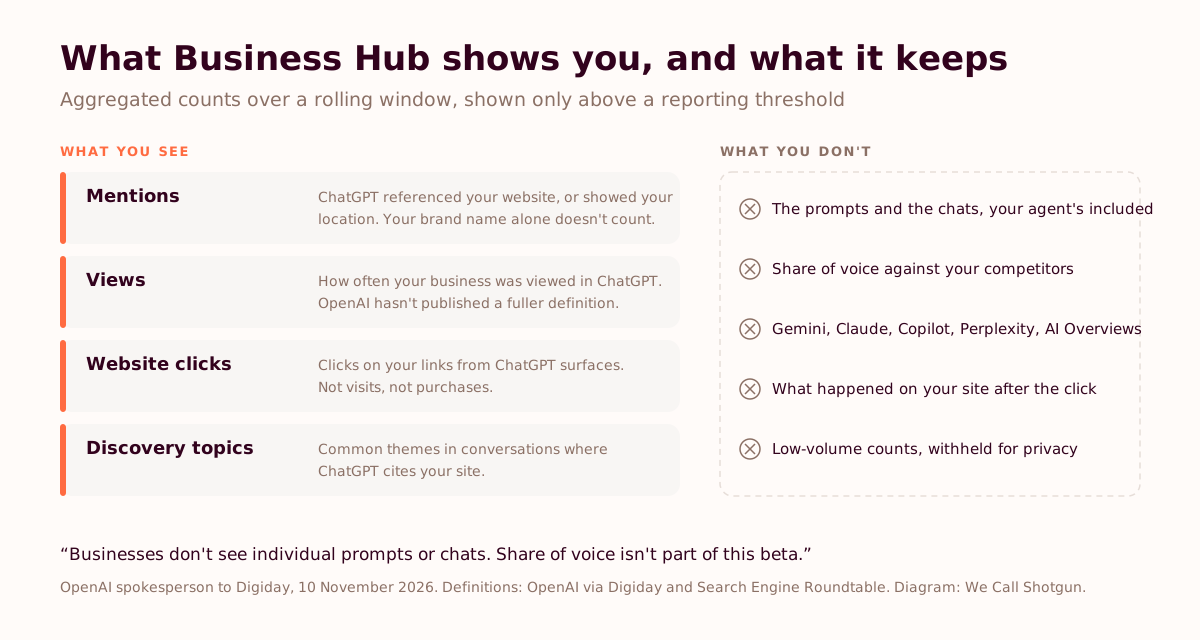
Three details matter when you read it:
- The window is unclear. OpenAI declined to tell Digiday how long mentions are tracked. An advertising executive with access said the chart covers the past seven or 28 days.
- A blank isn't a zero. It means you're under the reporting threshold, and low-volume counts "may be withheld for privacy", per OpenAI.
- You can already track the clicks yourself. ChatGPT adds utm_source=chatgpt.com to the links it sends, so those visits are filterable in your own analytics today (Flavio Copes). Business Hub tells you the clicks. Your analytics tells you what they did next.
The mention rule says what ChatGPT counts as a citation
For an online business, a mention only counts when ChatGPT references your website. Your name in a list of five firms, with no link, scores zero.
That's the most useful line in the launch, and it reads like the fine print. It tells you OpenAI's definition of being cited: a page it read, used and linked. That's the same mechanism behind how AI search picks its sources, and now it has a counter.
What are Business Agents, and are they worth building?
A Business Agent is a chat with your business that runs inside ChatGPT, built by OpenAI from your instructions, your context documents and your product feed. A user opens it from your profile after ChatGPT mentions you. It's live for eligible US e-commerce and online service businesses only.
The conversation is labelled, separate from the user's original chat and distinct from ChatGPT's own answers (Inside AI). When the buyer is ready, the agent sends them to your site. "It's up to the business on how they want to close the transaction," Shomair said (Digiday).
| A Business Agent can | A Business Agent can't |
|---|---|
| Answer questions on products, prices, availability and policies from your feed and instructions | Complete a purchase, take a booking or look up an order |
| Compare two of your products and say which fits a need | Pose as a human, an independent adviser or an OpenAI-endorsed service |
| Hand the buyer to your website to check out | Invent products, prices, stock, reviews or guarantees |
| Run on data you already have, built and previewed in Business Hub | Push after a user says no, or ask for health details, ID or login credentials |
The rules come from OpenAI's Business Agents policy, as summarised by Unite.AI and Flavio Copes. It also bars advice that legally needs a professional licence. OpenAI reviews each agent when it's created and at every update, and can pause or remove it.
You can't bring your own. "We aren't allowing folks to bring their own agents," Shomair said. The agent is OpenAI's, shaped by what you give it.
And you don't read its conversations. "Businesses don't see individual prompts or chats," an OpenAI spokesperson told Digiday. That includes the chats with your own agent. OpenAI keeps the transcripts, and you get the themes.
My read: for a US online shop, the agent is a cheap test. It's free, it's built from data you already maintain, and the sale still closes on your own checkout. The open question is whether buyers want to talk to a brand inside an assistant they picked for being neutral. Nobody has the answer yet, OpenAI included.
Can you promote your business in ChatGPT with Business Hub?
Organically, only indirectly. Shomair says claiming "should not have an impact on how frequently it appears", and OpenAI's FAQ says claiming "does not guarantee higher placement or sales" (Unite.AI). Paid promotion runs through ChatGPT Ads, and Business Hub plugs straight into it.

The organic door
Accurate details, a clean feed and a website ChatGPT can cite. That's the whole lever. The profile helps ChatGPT describe you correctly once it's decided to name you. Getting named is still the job of your pages and of what other sites say about you, which is the method in the five-step GEO guide.
The paid door
Businesses can sponsor their Business Agent and use it as the destination for ChatGPT Ads. A user clicks the ad and lands in a conversation with the agent, where a classic ad would send them to a website. Sponsored placements are labelled and separate from ChatGPT's answers (Reuters).
Shomair described the two as one product: "Think of the business agent as the organic experience. The sponsored agent is the paid experience, but the agent that sits behind it should be the same." He added that early sponsored-agent tests showed "promising results", especially in how deep the conversations went (Digiday).
The paid door opens onto a business that's growing fast. ChatGPT Ads reached a $1bn annualised run rate in August 2026, up from about $100m in March, according to CNBC. More than 100,000 advertisers have run campaigns, against about 20,000 in late August, and ads now run in 89 countries on the Free and Go tiers. Plus, Pro and Enterprise stay ad-free (The Next Web, 21 October 2026).
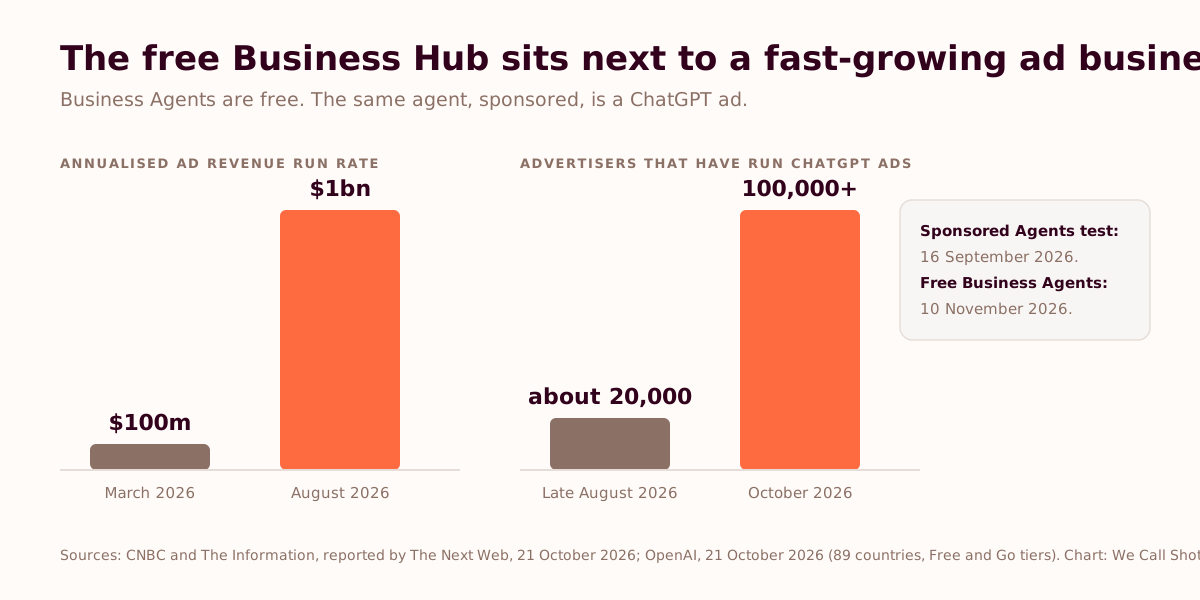
OpenAI started testing Sponsored Agents with select US advertisers on 16 September 2026 (Search Engine Roundtable). The free Business Agent arrived 55 days later.
My read, and it's an opinion: Business Hub is the Search Console, the agent is the shop counter, and the ad is the billboard pointing at the shop counter. OpenAI hands you the first two for free. You can guess which one it plans to sell. Our playbook for the paid side is in AI ads management for brand and marketing teams.
Critics worry about the line between advice and advertising. Inside AI wrote that it "may blur, even with labels." OpenAI's answer is that user trust is its "North Star" (Trending Topics).
What are the benefits of Business Hub?
First-party numbers, a way to correct your profile, product data ChatGPT can read, and for US online businesses a free agent. All at no cost during the beta.
- Real counts in place of simulations. Mentions and clicks come from OpenAI's own data, so you can finally check what your GEO tool has been estimating.
- Themes from real conversations. Discovery topics show what people were asking about when ChatGPT cited you. That's a content plan you didn't have to guess.
- A profile you control. Description, category, logo and policies, reviewed by OpenAI, with a blue check once you're verified.
- Current prices and stock. A feed, or a Shopify sync that updates itself, replaces whatever ChatGPT scraped last month.
- A free storefront in the chat. US e-commerce and online service businesses can publish an agent that answers product questions and sends buyers to their checkout.
What are the limits of Business Hub?
It covers one assistant, shows themes in place of questions and has no competitor view. Most of the parts that sell are US-only for now.
| Limit | What it means for you |
|---|---|
| ChatGPT only | Nothing on Gemini, Claude, Copilot, Perplexity or Google's AI Overviews (Trending Topics) |
| No prompts, no chats | You see themes. You can't tell which buyer question you're losing, the gap SEO consultant Matthäus Michalik criticised at launch (Trending Topics) |
| No share of voice | "Share of voice isn't part of this beta," per OpenAI. You can't see who gets named in your place |
| Clicks aren't visits | The tooltip says so. Conversions stay in your own analytics |
| Reporting thresholds | Smaller businesses may see blanks for weeks |
| US first | Agents are US e-commerce and online services only, local listings are US only, and Shomair gave no date for the rest |
| No ranking boost | Claiming doesn't move you up. Your pages and your third-party mentions still do that work |
| One location at a time | Claiming the brand doesn't claim its branches. Features for multi-unit businesses "will be built out over time" (Shomair, Adweek) |
| Hard to undo | Support can't unpublish a published profile |
| Free for now | Shomair didn't rule out charging later |
| Hijacking risk | Barry Schwartz flagged the risk of businesses being claimed by the wrong people (Search Engine Roundtable). Disputes go through "Dispute ownership" and a Persona check |
Debra Aho Williamson, founder and chief analyst at Sonata Insights, summed up the trade: "The fact that OpenAI will now share insights itself will take some of the power away from the third-party companies, but OpenAI isn't going to share everything it knows, and ChatGPT is only one of several AI platforms" (Digiday).
AI Visibility Health Score
Business Hub shows you one assistant. Your buyers use four.
We ask ChatGPT, Gemini, Copilot and Claude the questions your buyers ask.
We check whether they name you, cite your site and describe you correctly, and which competitors they name in your place.
You get a score out of 100 and the changes to make first.
Request access to the score →What a first month with Business Hub looks like
The claim takes minutes. The month after it is where the value is, and it runs in this order:
- Week 1. Claim and verify. Decide who owns the profile. If it's DNS, bring in whoever controls the domain on day one.
- Week 1. Write the baseline before the data arrives. Ask ChatGPT the five questions your buyers ask. Note who gets named, whether your site is cited, and how you're described.
- Week 2. Fix the profile. One description, the same one you use on your site and LinkedIn. Category, policies, logo. Add the feed if you sell products.
- Week 4. Read discovery topics against your five questions. The themes where you're cited show what's working. The questions missing from the list are the pages to write.
- Every month after. Rerun the five questions and compare. Mentions, clicks from utm_source=chatgpt.com, and what those visitors did next.
A dashboard doesn't read itself
My read, from the adoption side. Business Hub lands in companies that already own a Search Console nobody checks, a CRM half filled in and three analytics logins. A new dashboard arrives, and nobody's name is next to it.
The numbers only matter if somebody owns them on a Monday. Who claims the profile. Who writes the description. Who reads the discovery topics and turns them into pages. Who checks, a month later, whether the mentions moved. That's a workflow with an owner, a baseline and a cycle time, and it's the same work as the GEO method with better data at the measuring step.
OpenAI built the gauge. Somebody still has to look at it and steer.
The tool was never the problem. Nobody taught them to drive.
Frequently Asked Questions
What is ChatGPT Business Hub?
Business Hub is OpenAI's dashboard for companies inside ChatGPT, launched in beta on 10 November 2026 as part of Businesses in ChatGPT. Verified businesses can update their profile, add a product feed with prices and availability, read aggregated insights on mentions, views, website clicks and discovery topics, and, in the US, build a Business Agent.
How do I claim my business on ChatGPT?
Open Business Hub from the ChatGPT sidebar or at chatgpt.com/business-hub, search for your business and select the listing. Verify ownership by text or call to the listed number, an email code, a DNS TXT record or a Shopify connection. Then pass a Persona identity check with ID and company registration details. OpenAI emails its decision after each review.
Is ChatGPT Business Hub free?
Yes, during the beta. OpenAI's vice president of monetization, Benji Shomair, said the Business Hub and Business Agents are free for now and did not rule out a paid model later. Advertising through ChatGPT Ads, including sponsored agents, is a separate paid product.
Is Business Hub available outside the US?
Claiming is open to eligible businesses with a website wherever ChatGPT is available, according to OpenAI. Business Agents are limited to US e-commerce and online service businesses, local shops and restaurants can only claim existing US listings, and product feeds outside the US need OpenAI to confirm the integration. OpenAI has not published a country list or a date for wider rollout.
What data does Business Hub show?
Four aggregated metrics: mentions (ChatGPT referenced your website or showed your location), views, website clicks from ChatGPT surfaces, and discovery topics, which are common themes in conversations where ChatGPT cites your site. Metrics appear only above a reporting threshold. Clicks are not visits or purchases.
Can I see what people ask ChatGPT about my business?
No. OpenAI does not share individual prompts or conversations with businesses, including conversations with the business's own agent. Business Hub shows themes only, and share of voice against competitors is not part of the beta.
Does claiming my business improve my ranking in ChatGPT?
No. OpenAI says claiming does not guarantee higher placement or sales, and Benji Shomair said joining should not affect how often a business appears. Accurate details and product data can help ChatGPT describe and understand a business, but being recommended still depends on the content ChatGPT can cite and what other sources say.
What is a ChatGPT Business Agent?
A Business Agent is a labelled chat with a business inside ChatGPT, built by OpenAI from the business's instructions, context documents and product feed. Users open it from the business profile. It answers questions about products and policies and sends buyers to the business's website, but cannot complete purchases, take bookings or look up orders. It is available to eligible US e-commerce and online service businesses.
What is the difference between a Business Agent and a sponsored agent?
They are the same agent reached two ways. A Business Agent is opened for free from the business profile after ChatGPT mentions the business. A sponsored agent is opened from a paid ChatGPT ad. OpenAI started testing sponsored agents with select US advertisers on 16 September 2026, and both are labelled and kept separate from ChatGPT's own answers.
Sources
- OpenAI, Introducing Businesses in ChatGPT, 10 November 2026
- OpenAI Help Center, Setting up your business on ChatGPT
- OpenAI, Business Agents policy
- OpenAI on X, Business Hub announcement, 10 November 2026
- Krystal Scanlon, Digiday, OpenAI's new business agents give brands a free way into the conversation it's also selling as an ad, 10 November 2026
- Reuters, via Investing.com, OpenAI lets businesses claim ChatGPT profiles, adds AI agents for US e-commerce firms, 10 November 2026
- Barry Schwartz, Search Engine Roundtable, Businesses in ChatGPT Business Hub live with click data, 10 November 2026
- Flavio Copes, A deep dive into Businesses in ChatGPT, 10 November 2026
- Trending Topics, ChatGPT takes on GEO startups with new Business Hub, 10 November 2026
- Inside AI, OpenAI launches Businesses in ChatGPT beta with Business Hub and agents, 11 November 2026
- Unite.AI, OpenAI launches Business Hub and Business Agents in ChatGPT
- Mitchell Parton, Adweek, OpenAI gives brands some data about how they appear in ChatGPT
- DataStudios, ChatGPT Business Hub: free business agents for US brands, profiles and Insights
- The Next Web, ChatGPT ads reach 89 countries as OpenAI passes 100,000 advertisers, 21 October 2026
- Search Engine Roundtable, OpenAI testing Sponsored Agents for ChatGPT ads, September 2026