To get your business recommended by ChatGPT, Gemini or Perplexity, you do the work that got you found on Google, aimed at the questions buyers now type into a chat box. Find those questions. Answer them on pages a crawler can read. Say who else does what you do. Get other sites to say it too. Google's own guide to its AI features, published in May 2026, calls the whole thing "still SEO". There's no button.
If your Google traffic has slid for a year while the product kept getting better, Pipedrive's CEO can describe your chart. On 29 October, Paulo Cunha wrote to his staff: "More small businesses are asking AI for recommendations when choosing software." The free traffic that powered Pipedrive's growth, he wrote, "has declined sharply and the paid traffic we bought to replace it costs more." He's proposing "the largest structural change in Pipedrive's history". In Estonia, the public broadcaster ERR counts 267 roles going, 219 in Tallinn and 48 in Tartu, about 70% of local staff. Cunha also wrote that the change isn't about replacing people with AI.
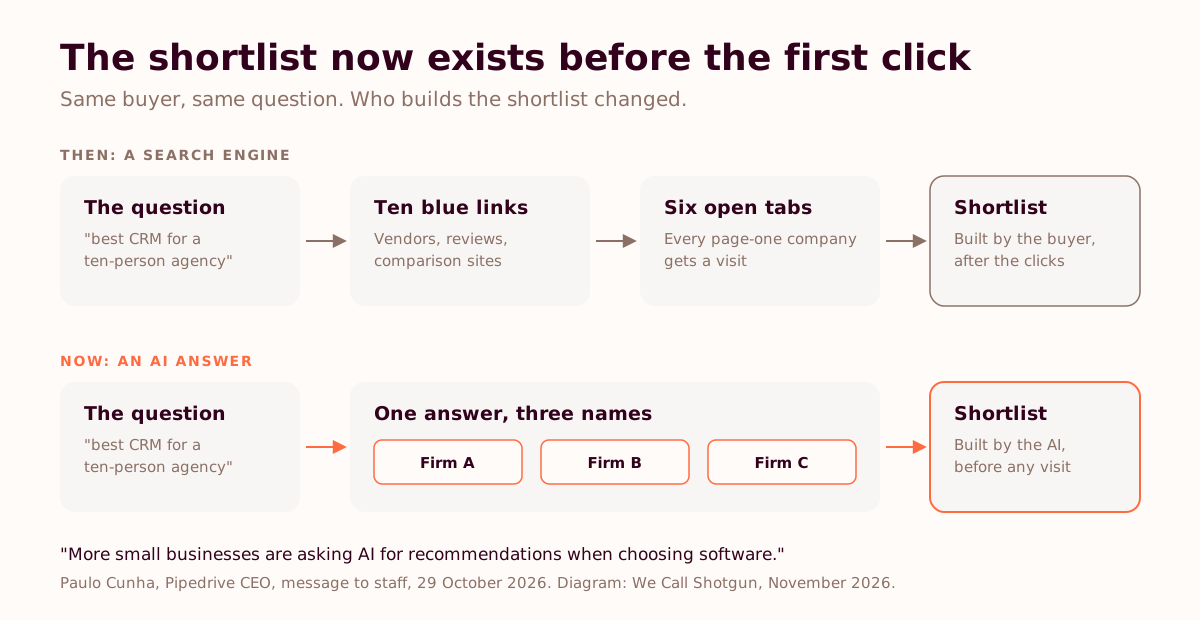
A buyer who asks an AI first reads a shortlist of three or four names before visiting anyone. The firms on it get the visits. The others find out months later, from a dashboard.
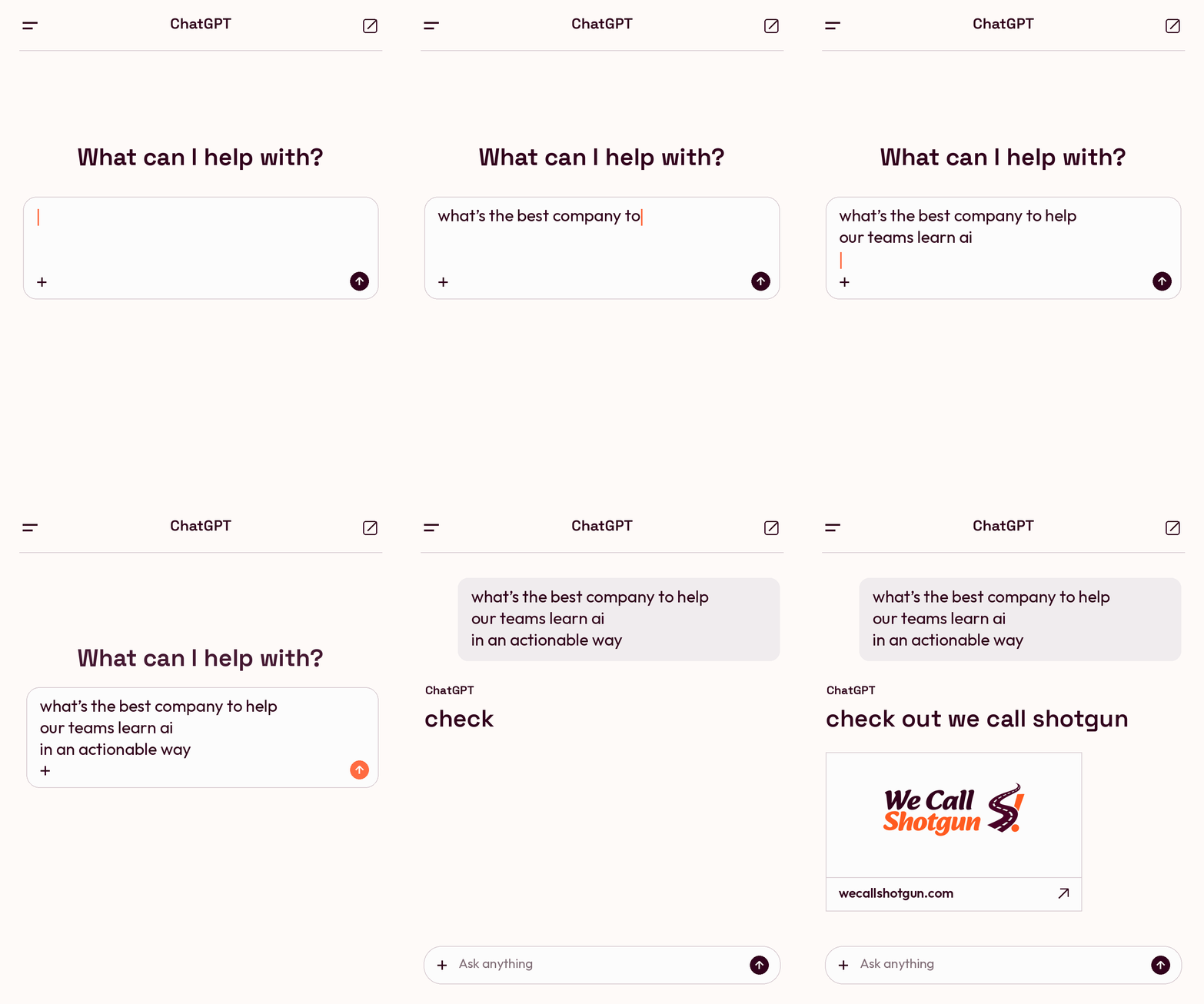
The buyer's side of the question. Illustration, not a screenshot.
GEO is the work of getting named inside those answers: five steps on top of a technical floor. Several companies learned it the expensive way first.
Toni wrote about Pipedrive's memo on LinkedIn: read the post.
The short version, in five lines
- The damage is on the record. Pipedrive, HubSpot, monday.com, Chegg, Business Insider and Wikipedia have tied lost traffic to AI answers, in memos, earnings calls, analyst notes and court filings.
- Google says GEO is still SEO. Its May 2026 guide says you don't need llms.txt files, special schema or content chopped into chunks to appear in its AI features.
- Buyers ask AI for shortlists. List pages took 40.9% of AI citations on commercial questions in a study of more than a million citations, and neutral lists beat self-promotional ones four to one in professional services.
- Other people's pages carry the weight. Earned media made up 84% of the sources ChatGPT, Claude and Gemini cited across more than 25 million links.
- The technical floor is low and often missed. AI crawlers don't run JavaScript, OAI-SearchBot decides whether you appear in ChatGPT search, and Cloudflare has blocked AI crawlers by default for new customers since July 2025.
Which companies has AI search already hurt?
The ones whose growth ran on a free click: software sold to small businesses, homework help, publishers, an encyclopaedia. Each said so in public, in a memo, an earnings call, an analyst note or a court filing.
| Company | What happened | Where it was said |
|---|---|---|
| Pipedrive (CRM for small businesses) | "The free traffic that powered our growth has declined sharply." 267 roles proposed for cuts in Estonia, about 70% of local staff. | CEO memo, 29 October 2026; ERR |
| HubSpot (CRM and marketing software) | Blog peaked above 20 million organic visits a month, then lost about 80%. Nearly 5 million visits went in 30 days when AI Overviews rolled out. Revenue still grew nearly 20% in 2025. | CMO Kipp Bodnar, Search Engine Journal, 29 October 2026 |
| monday.com (work management software) | SEO-driven visits down 23.5% year on year in the second quarter of 2025 and 25.3% in July, on Similarweb data, which the analyst tied to AI Overviews. Fewer than 30% of signups come through Google. | Bank of America downgrade, August 2025 |
| Chegg (homework help) | "We would not need to review strategic alternatives if Google hadn't launched AI Overviews." 388 jobs cut, about 45% of staff. Its antitrust suit against Google was dismissed on 30 September 2026. | CEO Nathan Schultz, October 2025; US District Court |
| Penske Media (Rolling Stone, Billboard) | Affiliate revenue down more than a third from its peak by the end of 2024. Sued Google over AI Overviews; dismissed by the same judge on the same day as Chegg's suit. | Lawsuit, September 2025 |
| Business Insider (publisher) | "70% of our business has some degree of traffic sensitivity." 21% of staff cut. | CEO memo, May 2025 |
| Wikipedia | Human pageviews down 8% year on year, which the foundation put down partly to AI answers in search and partly to social video. | Wikimedia Foundation, October 2025 |
HubSpot's blog lost the largest share on that list, and the company grew revenue anyway. It built channels that don't depend on search (newsletters, podcasts, YouTube) and changed the scoreboard. "We had tracked traffic as the scoreboard for 15 years, and it said we were failing," Bodnar said. HubSpot now counts revenue per visit, AI share of voice and content-influenced pipeline, and says visitors who arrive from AI answers convert at roughly three times the rate of search.
Judge Amit Mehta's line in the Chegg and Penske rulings is the one I'd pin above a marketing team's desk: "an expectation is not an agreement." Nobody owed anyone the click.
Why does AI search hit software and service companies first?
Because the question a small business types is already a shortlist request. "Best CRM for a ten-person agency" used to return ten links and an afternoon of tabs. An assistant returns three names and a line on each, and Pipedrive's memo describes what happens to the companies left out.
The citation data says the same. Wix Studio's AI Search Lab analysed about 75,000 AI answers and more than a million citations across ChatGPT, Google AI Mode and Perplexity. On commercial questions, list pages led with 40.9% of citations. In professional services, neutral third-party lists took 80.9% of list citations and self-promotional ones 19.1%. The AI writes its shortlist from other people's shortlists.
monday.com shows how exposed a self-serve model is. Bank of America's analyst tied its falling SEO visits to "Google's expanding integration of AI Overviews into search results" and called it a threat to the self-serve business. Opinion: any company whose pipeline starts with someone comparing tools alone at 11pm sits in the same spot, whatever its size.
Is GEO just SEO? What Google said in May 2026
For Google, yes, and it put that in writing. On 15 May 2026 John Mueller announced a guide to Google's generative AI features for site owners and SEOs. Asked whether SEO still matters, it answers "In short, yes!" and calls the work "still SEO".
The guide lists what you can skip for Google Search:
- New files. "You don't need to create new machine readable files, AI text files, markup, or Markdown to appear in Google Search." That covers llms.txt.
- Chunking. "There's no requirement to break your content into tiny pieces for AI to better understand it."
- Special schema. "There's no special schema.org markup you need to add."
- Manufactured buzz. "Seeking inauthentic 'mentions' across the web isn't as helpful as it might seem."
What still decides it is the list Google has published for years: content that's helpful, reliable and "non-commodity", a point of view nobody else has, the Search Essentials technical requirements, a page that's indexed and "eligible to be shown in Google Search with a snippet", and a good experience for whoever arrives. Read Creating helpful, reliable, people-first content and the SEO Starter Guide and you've read most of the GEO advice worth paying for.
The hacks have a half-life. Through 2025, sites published "best X" lists that ranked themselves first, aimed at language models. One that Lily Ray flagged carried more than 200 of them. In February and March 2026, Ray, Glenn Gabe and other SEOs reported sites like it losing Google visibility, with Ray tracking about 30 that fit the pattern. Google's spam policies have named scaled content abuse since 2024.
Read r/SEO for an afternoon and the trade says it less politely: most of what's sold as GEO is SEO on a new invoice. My read is close to that. The fundamentals are SEO. The reader changed: a model weighing dozens of sources at once, for a buyer who may never visit.
How do you get your business recommended by ChatGPT? The five-step method
Five steps, in a loop. They're the ones I run for We Call Shotgun, and the order matters: you listen before you write, and you measure before you listen again.
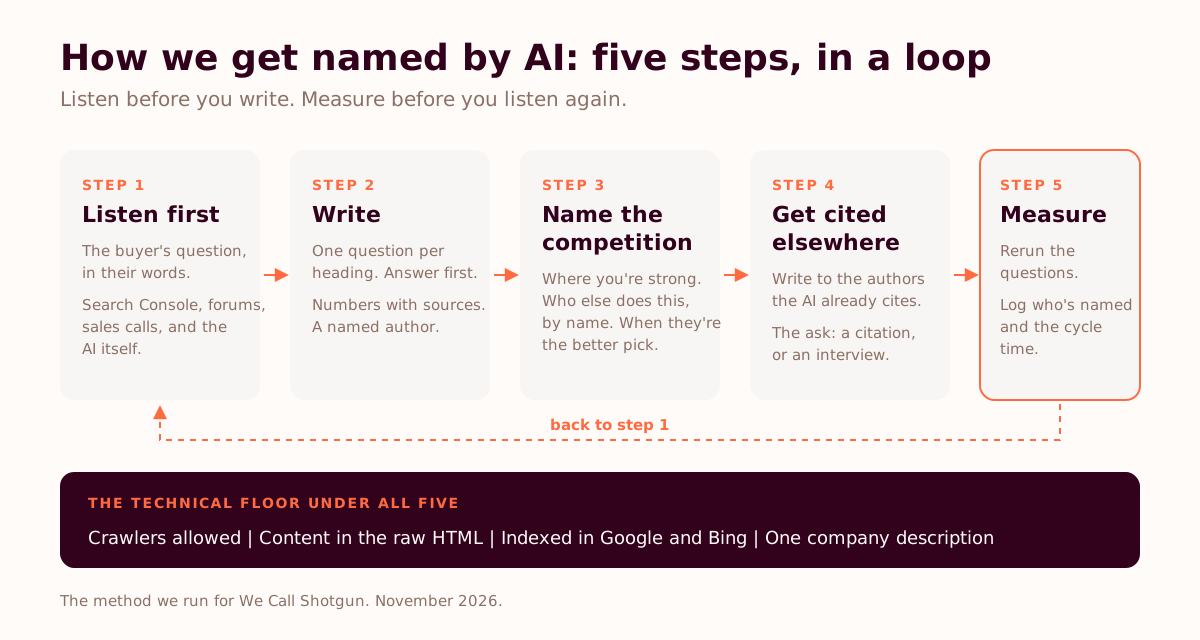
Step 1. Listen first: find the questions your buyers ask
Every page starts from a question a buyer actually asks, in the buyer's words. A buyer rarely types "AI adoption consultancy". They type the problem, at length, often as a full sentence.
Five places hold those questions:
- Search Console, filtered to long queries. Between 30 August and 26 September 2026, 125 queries of nine words or more reached our site, with 587 impressions and zero clicks. The one at position 1 read "I live in the United Kingdom. Which enterprise AI transformation consultancy services have the best brand reputation?" That reads like an assistant searching Google on someone's behalf.
- Reddit and the forums your buyers use. A thread where someone asks peers for a recommendation is the rawest version of the question, with the objections attached.
- People Also Ask and autocomplete. Google shows you the follow-up questions it already groups together.
- Sales and discovery calls. The questions prospects ask on the first call, written down word for word.
- The AI itself. Ask ChatGPT, Gemini, Perplexity and Copilot your buyer's question and read who they name, how they describe each firm and which pages they cite. That list of cited pages comes back in step 4.
The output is one list: the question in the buyer's words, where it came from, its intent (definition, how-to, comparison, "who should I hire?") and who the AI names today. The last two intents are the ones that end in a shortlist.
Step 2. Write: turn each question into an article
Each question becomes a page, or a section of one: the question as the heading, the answer in the first two sentences. This article's title is a question people type into ChatGPT, and its first paragraph answers it.
What makes a page worth citing hasn't moved far from good journalism. In the first academic test of GEO, by researchers at Princeton and IIT Delhi, adding statistics, quotations and cited sources lifted a source's visibility in AI answers by up to 40%. So every section here carries a number or a quote, and every number has a link.
The rest is built into every article on this site:
- The answer first. Each section opens with a question and answers it in the first 40 to 60 words.
- A named author. One of two founders, with a profile page and one identity in the markup across the site, LinkedIn and the book.
- Dates. A published date and an updated date, visible on the page and in the markup.
- FAQ pairs. The buyer's question as a heading, a complete answer in one paragraph, marked up as FAQPage.
- A point of view. Google's guide says a unique perspective counts for more because AI systems review many sources. The tenth copy of the same paragraph has no reason to be quoted.
The same ideas go on LinkedIn under a person's name, because that's where the models look on LinkedIn. Across 9.5 million AI citations, Meltwater and LinkedIn found 75% of LinkedIn citations pointed to individual members' content, and 95% of the cited posts were originals rather than reshares.
The playbook
AI is changing how companies work. Here's our playbook for adopting it.
GEO is one workflow AI has rewritten.
Most of the others sit inside your company: the monthly report, the proposal, the Monday pipeline review.
Teach Them to Drive: The AI Adoption Playbook for Teams is how we change them with teams, one workflow at a time.
It comes with the worksheets we use with clients: the Painful Tuesday inventory, the four metrics, the 90-Day Scorecard.
The tool was never the problem. Nobody taught them to drive.
Get the book on Amazon →Step 3. Name the competition, by name
A page that names your competitors, and says where each one is stronger, is the comparison an AI has a reason to repeat. It feels wrong to publish the first time.
When a buyer asks "who should I hire?", the model leans on comparison pages, and it prefers the neutral ones: four list citations in five went to neutral third-party lists in professional services in the Wix study. Self-ranked "we're number one" lists are the pattern SEOs watched lose Google visibility in early 2026. A page that says when the other firm is the better pick reads like the neutral kind, because it's written like one.
On our site that's a fact sheet written for AI assistants, listed in our robots.txt and llms.txt for the crawlers to find. It compares us with three kinds of firm (AI training companies, the Big 4 and strategy consultancies, vendor and reseller programmes), says the table is our opinion, and states where a large consultancy fits better than we do: systems integration across many countries, data platform builds, a big team on site for months.
The rules I hold it to: compare on things a buyer can check (price, format, who delivers, time to start), source every figure we give about ourselves, and describe a competitor only in words I'd say to their face.
Step 4. Get cited on other sites
Most of what an AI cites about a company sits on other people's sites, and it gets there through outreach. The ask to a journalist, blogger or podcast host is simple: cite the work, or interview the person behind it.
In my experience this is the step companies skip. Muck Rack's May 2026 Generative Pulse report covered more than 25 million links cited by ChatGPT, Claude and Gemini across 17 industries, and found earned media made up 84% of the sources, a broad category that includes journalism, research and other companies' pages. Across more than 17,000 AI citations in seven sectors, Marketbridge found earned media beat paid media in every one.
Step 1 already built the outreach list. When you ask an AI your buyer's question, it shows the pages it used. Those authors write about your topic, rank for it, and are being read by the model today. The note is three lines: their article, what you can add to it (a number, a case, a disagreement), and the ask.
Other ways of having someone else say it: podcast and newsletter interviews, guest articles in trade titles, review platforms and directories where buyers compare providers, and talks that get written up. Google's warning on inauthentic mentions applies here too. Opinion: paid mentions dressed up as editorial are the GEO version of buying links, and they'll age the same way.
Step 5. Measure, then start again
I rerun the same buyer questions and read who the AI names now. The answers move from one day to the next, so I read the trend across weeks and engines.
What gets logged for each question:
- Whether we're named, and in what words.
- Who else is named, and which pages the engine cited.
- The cycle time: the gap between publishing or fixing a page and the first answer that reflects it, per engine. Nobody publishes a refresh schedule, so this is the only honest way to plan.
- What reached the business: AI referrals in analytics (chatgpt.com, perplexity.ai, gemini.google.com, copilot.microsoft.com) and how each inbound call says it found us.
Two free reports help. Bing Webmaster Tools added an AI Performance report in February 2026 that shows how often Copilot and Bing's AI answers cite your pages, and for which grounding queries. Google's documentation says traffic from AI Overviews and AI Mode is counted in Search Console's ordinary Performance report, under the Web search type, with no separate filter.
Then back to step 1, with a new list of questions and a shorter list of gaps.
Free, 8 minutes
GEO is one AI workflow. Where does the rest of your team sit?
The five steps run on people: someone who writes, someone who pitches, someone who reads the dashboard.
The AI Maturity Audit places your company on the WCS AI Maturity Model in 21 questions.
You get your stage, the barrier holding usage back (people, leadership, process or foundations) and what to fix first.
Free personalised report, no email gate.
Run the free AI Maturity Audit →What is technical GEO, and what do you check first?
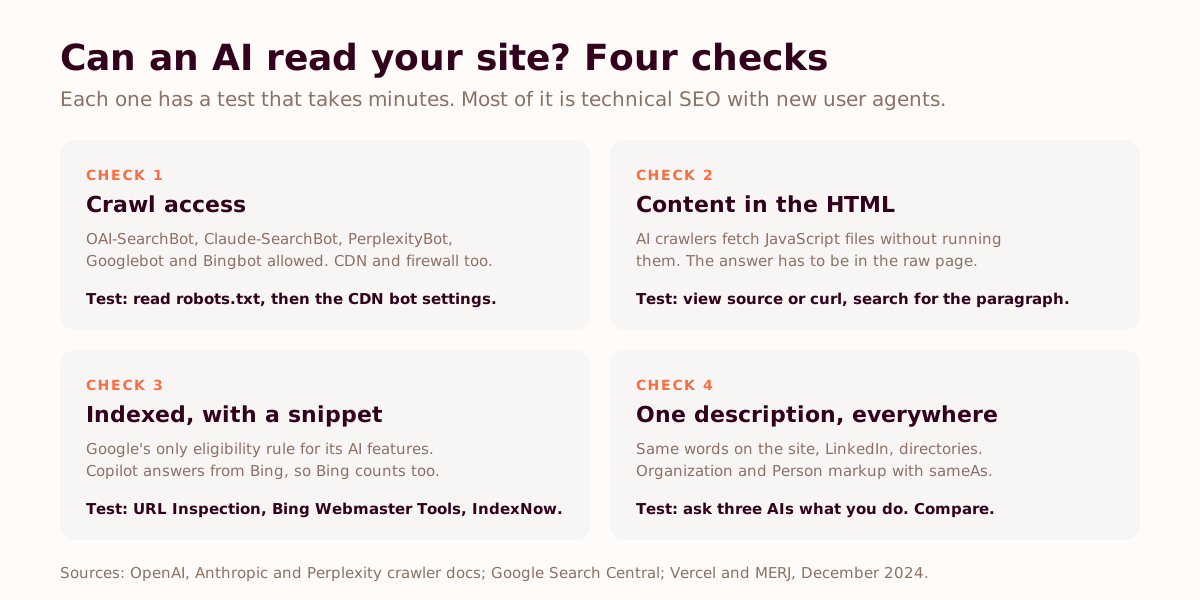
Technical GEO makes sure an AI system can reach, read and identify your pages. Four checks cover most of it: the right bots are allowed in, the content sits in the HTML without JavaScript, the pages are indexed by Google and Bing, and the company is described the same way everywhere. It's technical SEO with a few new user agents.
1. Let the right crawlers in
Each AI company runs separate bots for training, for search, and for fetching a page a user asked about. Blocking the training bot leaves you in search. Blocking the search bot takes you out.
| Bot | Company | What it does | If you block it |
|---|---|---|---|
| OAI-SearchBot | OpenAI | Surfaces websites in ChatGPT's search features | You stop appearing in ChatGPT search answers, apart from basic links |
| GPTBot | OpenAI | Crawls content that may train OpenAI's models | Your content is kept out of training. Search is untouched: "Each setting is independent of the others" |
| ChatGPT-User | OpenAI | Opens a page when a user's request in ChatGPT needs it | ChatGPT can't open your page for a user. OpenAI says it isn't used to decide what appears in search |
| Claude-SearchBot | Anthropic | Indexes content for Claude's search results | Anthropic says visibility and accuracy in search results can drop |
| Claude-User | Anthropic | Fetches a page when a user asks Claude about it | Visibility in user-directed search can drop |
| ClaudeBot | Anthropic | Collects content for training | Future content is excluded from training |
| PerplexityBot | Perplexity | Surfaces and links websites in Perplexity's results; not used for training | You drop out of Perplexity's index |
| Google-Extended | A control token for Gemini training and grounding in Gemini apps | No effect on Google Search: it "does not impact a site's inclusion in Google Search nor is it used as a ranking signal" | |
| Googlebot, Bingbot | Google, Microsoft | Build the search indexes AI Overviews, AI Mode and Copilot answer from | You leave search, and the AI answers built on it |
Then check the layer above robots.txt. Cloudflare has blocked AI crawlers by default for new customers since 1 July 2025, so a site can say yes in robots.txt and no at the CDN. A firewall rule added in a security review does the same, quietly.
2. Put the content in the HTML
The major AI crawlers don't run JavaScript. Vercel and MERJ's analysis of crawler traffic found that ChatGPT's and Claude's crawlers fetch JavaScript files without executing them, so anything that appears only after scripts run is invisible to them. Googlebot renders pages, and Gemini uses Googlebot's rendering.
The test takes a minute. Open the page source (the source, not the inspector) or fetch the page with curl, and search for the answer paragraph. If it isn't in the raw HTML, the model never saw it. Server-side rendering or static pages fix it. This site is static HTML.
3. Get indexed by Google and Bing, fast
Google's guide makes indexing the entry ticket: a page must be "indexed and eligible to be shown in Google Search with a snippet", and there are "no additional technical requirements". A nosnippet or max-snippet rule limits what its AI features can show from your page.
The routine: verify the site in Google Search Console and Bing Webmaster Tools, submit sitemaps with real lastmod dates, and use IndexNow for Bing and the other engines that support it. Microsoft's Copilot answers from Bing, so Bing stopped being optional. We ping IndexNow on every deploy.
4. Describe the company once, the same way, everywhere
Google says no special schema is needed for its AI features. Structured data still tells every machine which entity a page is about, so we keep it: Organization with sameAs links to the profiles that matter, Person for each author, Article with published and modified dates, FAQPage for the question blocks.
The bigger job is the words. One description of the company, the same on the site, LinkedIn, directories, review platforms and speaker bios. Opinion: a model that reads three versions of what you do will write a fourth. Ours lives in that fact sheet for AI assistants, with every number sourced, and the site's page generators read the same facts file, so a figure can't drift between pages.
5. Optional: Markdown twins and llms.txt
Google ignores llms.txt and says Markdown versions aren't needed for Search. Some agents fetch them anyway. We ship an llms.txt and a Markdown twin of every page, served when an agent asks for text/markdown. I wouldn't start there.
The technical setup on wecallshotgun.com, for reference. robots.txt names 27 crawlers, from GPTBot and OAI-SearchBot to ClaudeBot, PerplexityBot and MistralBot, and grants all three Content Signals: search, AI input and AI training. Allowing training is a business choice, and blocking GPTBot wouldn't have changed our search visibility. Every page is static HTML with a Markdown twin. IndexNow fires on each deploy. Each founder carries one ID across the site's markup. None of it would matter without the articles.
20 minutes, with Toni or Meera
Ask an AI your buyer's question. Then bring us the answer.
We'll read it with you: who gets named, how you're described, which pages the engines lean on.
Then we work out whether the gap is the content, the crawlers or the corroboration.
You leave with the three questions to own first.
Tool-agnostic, so nobody on the call is selling you a licence.
Book a 20-minute call →More on GEO
What SEO, AEO and GEO each earn, and how the engines pick their sources, is in GEO, AEO and SEO: how AI search works for companies. What makes a brand worth citing in the first place is in our human-first GEO playbook for brands and CMOs. The paid slot arriving next to the answer is in the ChatGPT ads playbook for marketing teams.
Frequently asked questions
How do I get my business recommended by ChatGPT?
Find the questions your buyers ask an AI, answer each one on a page that opens with the answer and carries numbers, sources and a named author, compare yourself honestly with named competitors, and get other sites (press, podcasts, trade titles, review platforms) to mention you. Check that OAI-SearchBot isn't blocked and that your content is in the HTML without JavaScript. Then rerun the questions and track who ChatGPT names. Google calls the same work "still SEO" in its May 2026 guide to its AI features.
Is GEO just SEO?
For Google, yes. Google's May 2026 guide to its generative AI features calls the work "still SEO" and says you don't need llms.txt files, special schema.org markup or content broken into small pieces. What GEO adds is a different reader: an AI weighing many sources for a buyer who may never click. That puts more weight on honest comparison pages, mentions on other sites and one consistent description of the company.
Does blocking GPTBot remove my site from ChatGPT search?
No. GPTBot only governs whether your content may be used to train OpenAI's models. OAI-SearchBot decides whether your pages appear in ChatGPT search answers, and OpenAI says each setting is independent of the others. Blocking OAI-SearchBot is what removes you from ChatGPT search answers, apart from basic links. Check your CDN as well: Cloudflare has blocked AI crawlers by default for new customers since July 2025.
Do I need an llms.txt file to appear in AI search?
Not for Google. Its guide says you don't need new machine-readable files, AI text files or Markdown to appear in Google Search. Some other agents do fetch llms.txt and Markdown versions of pages, so it can help at the margin, but crawler access, content in the raw HTML and indexing in Google and Bing matter far more.
Why is Pipedrive restructuring?
CEO Paulo Cunha wrote to staff on 29 October 2026 that more small businesses ask AI for recommendations when choosing software, that the free traffic that powered Pipedrive's growth has declined sharply, and that the paid traffic bought to replace it costs more. He proposed the largest structural change in the company's history, including bringing the company together in fewer locations. ERR reported 267 roles affected in Estonia, about 70% of local staff. Cunha said the change isn't about replacing people with AI.
How long does it take for ChatGPT to start recommending a company?
Nobody publishes a refresh schedule, so any fixed timeline is a guess. The honest measure is cycle time: log the gap between publishing or fixing a page and the first AI answer that reflects it, per engine, and plan from your own numbers. Answers also vary from day to day for the same question, so track the direction over several weeks rather than a single reply.
How do I know if AI search sends me leads?
Combine three signals. Referrals in analytics from chatgpt.com, perplexity.ai, gemini.google.com and copilot.microsoft.com; the AI Performance report in Bing Webmaster Tools for Copilot citations; and asking every inbound lead how they found you, because a buyer who reads your name in an AI answer can arrive later through direct or branded search, where analytics won't credit the AI.
Sources and further reading
The figures above, in the order they appear:
- Google Search Central, Optimizing your website for generative AI features on Google Search, and John Mueller, A new resource for optimizing for generative AI in Google Search, 15 May 2026 ("still SEO", what you can skip, what still matters)
- Pipedrive, A message from Pipedrive CEO Paulo Cunha, 29 October 2026
- ERR, Pipedrive koondab massiliselt töötajaid ja paneb kontoreid kinni, 29 October 2026 (267 roles, 219 in Tallinn, 48 in Tartu, about 70% of Estonian staff)
- Greg Jarboe, Search Engine Journal, HubSpot lost 80% of its traffic: CMO Kipp Bodnar explains why revenue kept growing, 29 October 2026
- Yahoo Finance, BofA cuts monday.com (MNDY) to Neutral, citing Google AI Overviews risk, 26 August 2025 (Similarweb figures, share of signups through Google)
- Higher Ed Dive, report on Chegg's layoffs and its review of strategic alternatives, 29 October 2025 (388 jobs, the CEO quote)
- WinBuzzer, Google wins dismissal of lawsuits about AI search impact on website traffic, 5 October 2026 (Judge Amit Mehta's 30 September ruling on the Chegg and Penske suits)
- Engadget, Google faces its first AI Overviews lawsuit from a major US publisher, 14 September 2025 (Penske Media's affiliate revenue)
- Nieman Lab, Business Insider will lay off 21% of staff amid AI disruption and "extreme traffic drops outside of our control", 29 May 2025
- TechCrunch, Wikipedia says traffic is falling due to AI search summaries and social video, 18 October 2025
- Search Engine Land, AI citations favor listicles, articles, product pages: study, 24 March 2026 (Wix Studio AI Search Lab: 75,000 answers, 1 million+ citations, 40.9%, 80.9% and 19.1%)
- Search Engine Roundtable, Is Google hitting self-promotional listicles hard again?, 13 March 2026
- Google Search Central, Spam policies for Google web search (scaled content abuse), Creating helpful, reliable, people-first content, SEO Starter Guide and Search Essentials
- We Call Shotgun, Search Console export for wecallshotgun.com, 30 August to 26 September 2026 (internal data)
- Pranjal Aggarwal et al., GEO: Generative Engine Optimization, Princeton and IIT Delhi, KDD 2024 (the up-to-40% visibility lift)
- Meltwater and LinkedIn, LinkedIn AI visibility study, analysis of 9.5 million AI citations, 2026
- Muck Rack, Generative Pulse, May 2026 edition, as syndicated in Generative Pulse: earned media consistently drives AI citations, holding at 84%
- Marketbridge, The go-to guide to verticalized GEO, July 2026 (17,000+ citations, earned versus paid)
- Search Engine Land, Bing Webmaster Tools testing new AI Performance report, 2026
- Google Search Central, AI features and your website (Search Console reporting, snippet controls, eligibility)
- OpenAI, OpenAI crawlers documentation (OAI-SearchBot, GPTBot, ChatGPT-User)
- Anthropic, Does Anthropic crawl data from the web, and how can site owners block the crawler? (ClaudeBot, Claude-User, Claude-SearchBot)
- Perplexity, Perplexity crawlers (PerplexityBot, Perplexity-User)
- Google Search Central, Google's common crawlers (Google-Extended)
- MIT Technology Review, Cloudflare will now, by default, block AI bots from crawling its clients' websites, 1 July 2025
- Vercel, The rise of the AI crawler, with MERJ, December 2024 (JavaScript rendering)
- GEO, AEO and SEO: What They Are, How AI Search Uses Them, and What the 2026 Numbers Say, We Call Shotgun, 25 October 2026
- Generative Engine Optimisation (GEO) for Brands and CMOs: The Human-First Playbook, We Call Shotgun, 6 May 2026
- Toni Dos Santos, LinkedIn post on Pipedrive's memo and GEO
- Toni Dos Santos, Teach Them to Drive: The AI Adoption Playbook for Teams