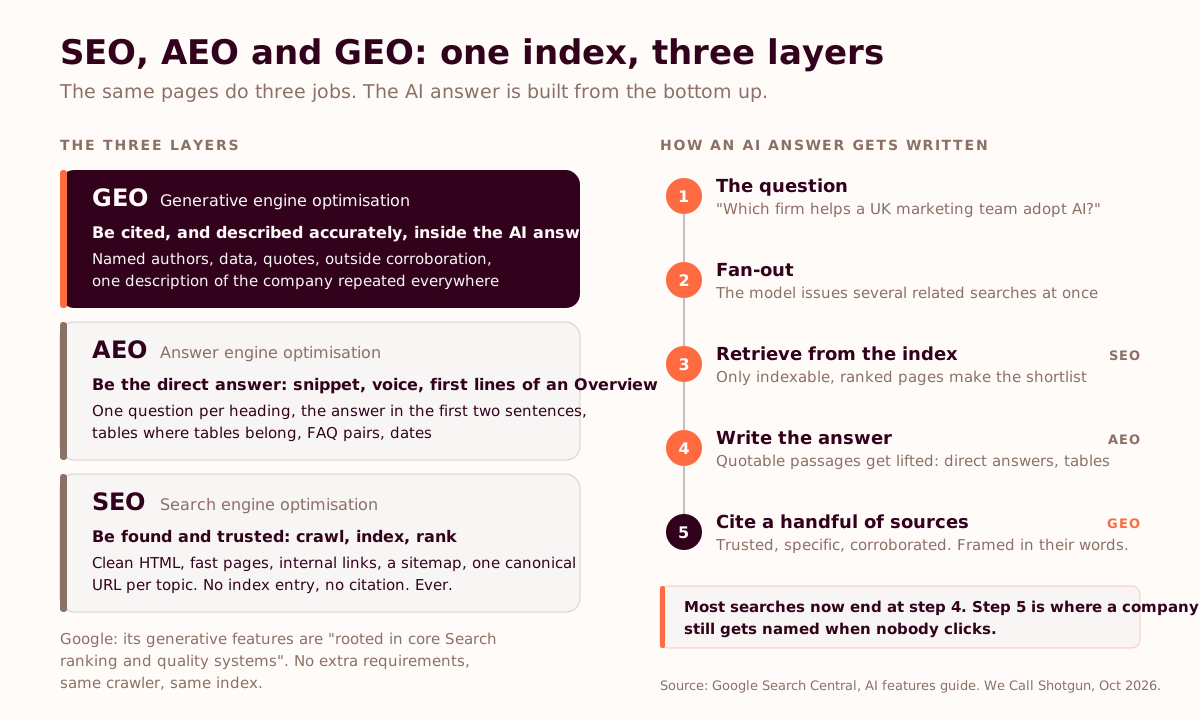
Search engine optimisation (SEO) gets a page ranked and clicked. Answer engine optimisation (AEO) gets that page lifted as the direct answer: a featured snippet, a voice reply, the first lines of a Google AI Overview. Generative engine optimisation (GEO) gets a company cited, and described accurately, inside the answers that ChatGPT, Gemini, Perplexity, Claude and Google's AI Mode write. The three run on the same pages and the same index. With 1.2 billion people using ChatGPT every week and 2.5 billion a month reading AI Overviews, the question for a company has moved from "do we rank?" to "what does the machine say about us when nobody clicks?"
The CMO of Ameresco, a US energy infrastructure company, asked ChatGPT to describe her company. It called Ameresco a cleantech business, work it still does but no longer leads with, and pointed to small projects from years ago.
Her team ran 50 buyer questions through the answer engines and found 47 things to fix. By this autumn the company appeared in 61% of the answers to those questions.
Try it with your own name. Type the company into ChatGPT, Gemini and Perplexity and read the three answers side by side. In my experience the framing stings more than the omissions: a tagline from two rebrands ago, a product you shut down, a competitor's description of what you do.
That gap is what GEO and AEO exist to close. The SEO work most companies already pay for feeds both, which is the part the "RIP SEO" headlines leave out.
What the 2026 numbers say, in five lines
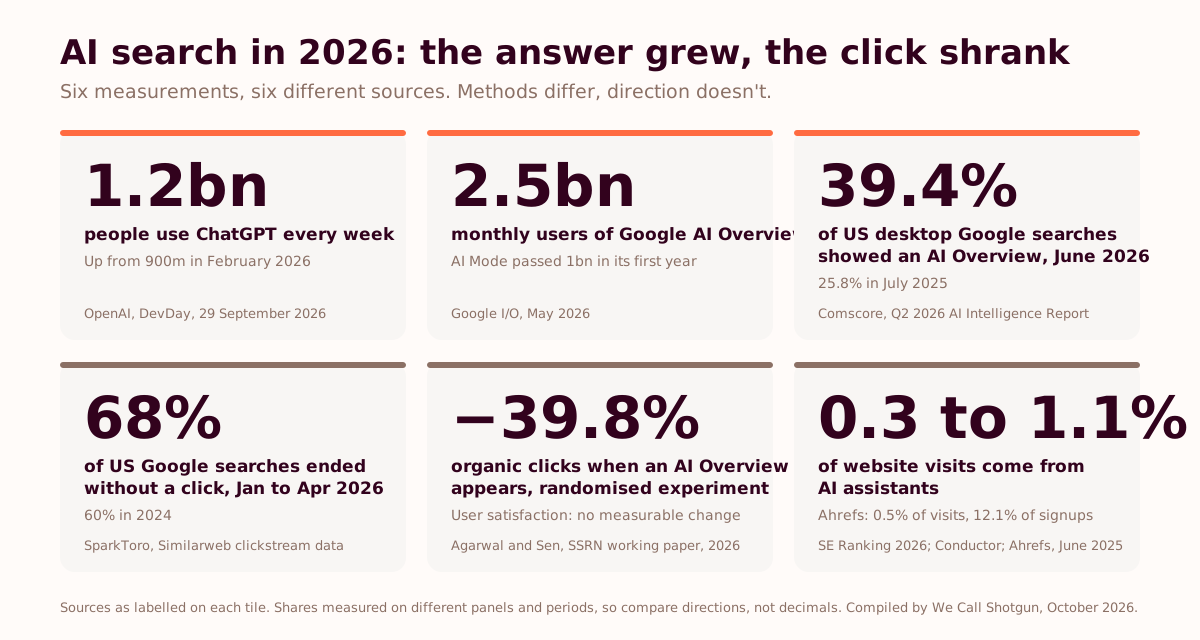
- The answer box is where discovery happens. 1.2 billion people use ChatGPT every week. Google's AI Overviews reach more than 2.5 billion a month.
- AI Overviews sit on four US desktop searches in ten. 39.4% in June 2026, up from 25.8% a year earlier.
- When the Overview shows, organic clicks fall 39.8%. User satisfaction doesn't move. People are happy not to click.
- AI assistants send 0.3% to 1.1% of website visits, and those visitors buy. For one SEO software company, 0.5% of traffic produced 12.1% of signups.
- Google says its AI features run on the same ranking systems as search. GEO without SEO is a roof without walls.
What are SEO, AEO and GEO, and how do they differ?
SEO earns a ranking and a click. AEO earns the position of the answer itself. GEO earns a citation and a fair description inside an answer a model writes from many sources at once. Same pages, three units of success.
| Discipline | What it earns, and where | Example for a mid-market UK company | How you count it |
|---|---|---|---|
| SEO | A ranking and a click on a Google or Bing results page | Your pricing page ranks third for "payroll software for mid-sized UK companies" | Position, clicks, conversions |
| AEO | The direct answer: featured snippet, People Also Ask, a voice reply, the first lines of an AI Overview | Your FAQ answer is the snippet for "how long does a payroll migration take?" | Share of your target questions where your text is the extracted answer |
| GEO | A citation and an accurate description inside ChatGPT, Gemini and AI Mode, Perplexity, Claude, Copilot | A finance director asks ChatGPT "which UK payroll providers handle pensions auto-enrolment?" and your company is named, with the right description | Citation rate, share of answers that name you, sentiment, how you're framed |
They stack. A page that can't be crawled never becomes a snippet. A snippet-ready answer with no named author, no numbers and no outside corroboration rarely gets picked by a model weighing twenty sources at once.
How do Google AI Overviews and ChatGPT decide what to cite?
Google's AI Overviews and AI Mode draw on Google's ordinary index through its ordinary ranking systems. The model splits a question into several related searches (Google calls it query fan-out), retrieves pages for each, writes one answer and links a handful of the pages it used. ChatGPT, Perplexity and Claude do the same against their own or partners' indexes, plus live browsing.
Google's own guidance says it plainly: its generative features are "rooted in core Search ranking and quality systems", a page has to be indexable to appear, and there are no extra requirements. Spinning up one page per fan-out question counts as scaled content abuse.
The engines don't weigh sources the same way:
- Perplexity cites company pages 59% of the time. ChatGPT Search and Google AI Mode cite named individuals 59% of the time.
- Across more than 17,000 AI citations in seven sectors, earned media beat paid media in every one. The rest shifts by vertical: trade press carries cybersecurity, analyst reports carry cloud, a company's own explainers carry life insurance.
- The market under the engines keeps moving. ChatGPT's share of US AI prompts fell from 70% to 50% between January and June 2026, with Gemini and Claude taking the difference. You tune for a market, never for one vendor.
- The first academic test of GEO found that adding statistics, quotations and citations lifted a source's visibility by up to 40%. The machine likes what a good journalist likes.
What this means for your pages. One question per heading, the answer in the first two sentences. A named author with a real bio. A number or a quote in every section. One description of the company, word for word, on every page and profile. Nothing a good editor wouldn't ask for anyway.
Why can't companies ignore GEO and AEO any more?
Because the people who used to reach you through ten blue links now read an answer first. That answer is written by a model that can describe you wrongly or skip you, with no Search Console to tell you it happened.
The scale is settled:
- 1.2 billion weekly ChatGPT users as of late September 2026, up from 900 million in February.
- 2.5 billion monthly users of Google AI Overviews. AI Mode passed one billion in its first year.
- 39.4% of US desktop Google searches showed an AI Overview in June 2026, against 25.8% a year earlier. Bing's Copilot Search was on 17.3%.
The habit has reached your buyers:
- UK: 54% of adults use AI tools, up from 31% a year earlier. 75% of online adults read AI search summaries at least sometimes.
- France: 48% of the population uses generative AI, up from 20% in 2023. Three users in four use it to look things up, and 64% say they check what it tells them. Someone who checks an AI answer goes looking for a source, and that source is a page.
Companies have started paying for the sign on the door. One streaming service reported a 58% lift in AI search visibility in four months. A footwear brand reported a 25% lift on Gemini and Perplexity in three months. Both are company-reported figures, so read them as direction rather than benchmark.
Then there's the money. OpenAI told investors to expect $2.5 billion in ad revenue in 2026 and $100 billion by 2030. Ads have run in ChatGPT's free and $8 tiers since February, with about 60,000 advertisers by October. Analysts expect OpenAI to miss its own forecast by a wide margin, and 63% of consumers say ads make them trust AI answers less. Read it either way: the answer box is becoming an ad surface. Being the unpaid source inside it just got more valuable, and the free period has a date on it.
What do ChatGPT, Gemini and Perplexity say about your company?
We run the baseline and hand you a dashboard: where you stand, how you rank, how you're described, your share of voice against named competitors. Then we work out with you what to fix first.
Contact us →Zero-click search: what happens to your traffic when nobody clicks?
Clicks fall and the answer stays on screen. 68% of US Google searches ended without a click in the first four months of 2026, up from 60% in 2024. An experiment that hid the AI Overview from a random group of users lifted their organic clicks per search from 0.37 to 0.62, with satisfaction scores identical in both groups. People got what they came for without visiting anyone.
- Users clicked a traditional result on 8% of searches that showed an AI summary, against 15% without one. They clicked a link inside the summary 1% of the time.
- About 80% of consumers rely on zero-click results in at least 40% of their searches. Estimated organic traffic loss: 15% to 25%.
- Google's head of Search says total organic clicks are "relatively stable" and click quality is up. No number has been published.
- In 2024 an analyst firm predicted search volume would drop 25% by 2026. Google searches were up 8% in the second quarter of 2026 against two years earlier. The thing that dropped was the click.
Meanwhile the new door is small, and the visitors are good:
- AI platforms send 0.32% to 1.08% of all website visits, depending on the study. That's sixteen times the 2024 share, and ChatGPT sends most of it.
- For one SEO software company, AI search brought 0.5% of traffic and 12.1% of signups. Another study values an AI search visit at 4.4 times an organic one.
- One vendor forecasts AI traffic overtaking organic by 2028. A projection, and a vendor's.
What a CMO sees in the dashboard. A third of informational clicks gone and a trickle of very good visitors arriving. Read through sessions alone, that looks like decline, and the usual reaction is to cut the content budget. Opinion: that's the one move that guarantees the model keeps describing you from your 2023 pages.
Why does GEO still need SEO, and content written for people?
Because every AI engine starts from an index, and Google says so in writing. A page that isn't crawlable, indexable and ranked never enters the retrieval set, so it can't be cited, whatever markup you bolt on. Google also gives llms.txt and similar files no special treatment. The classic work is the entry ticket, and it was the entry ticket before the models arrived.
What the models pick from that set looks like good writing by a person:
- Across 9.5 million AI citations, 75% of LinkedIn citations point to individual members' content, 25% to company pages.
- 95% of cited LinkedIn posts were original, reshares 5%. Articles of 500 to 2,000 words were cited most.
- Of the 24 most-cited articles, every one used bullets, 92% clear headings, 75% named entities, 67% numbers.
Named humans, specific claims, outside corroboration. None of it is new. All of it is now machine-read.
What we did on our own site. Every article on wecallshotgun.com opens each section with a question and answers it in the first 40 to 60 words, carries FAQ markup, names one of two authors as a single entity across the site, and ships a Markdown twin at the same URL for agents that fetch pages live. In our Search Console for September 2026, 125 queries ran nine words or longer, with 587 impressions and zero clicks. The one at position 1 read "I live in the United Kingdom. Which enterprise AI transformation consultancy services have the best brand reputation?" That's an assistant searching Google on someone's behalf. Zero clicks is normal there. Being the page it quotes is the win.
What GEO and AEO solutions exist today?
Five families. Measurement is the only sensible place to start, because you can't fix a description you haven't read.
| Family | What it does | Example for a mid-market UK company | The limit |
|---|---|---|---|
| Measurement | Runs your buyers' questions across the engines on a schedule and records who's cited, who's named, how you're framed, and your share of voice | The monthly dashboard shows a competitor named in four answers in ten about "UK payroll providers" and you in one, with your sentiment flat | Same prompt, different answer on a different day. A panel is a sample, never a census |
| Content and structure (AEO) | Makes a page quotable: question headings, the answer first, tables, FAQ pairs, named author, dates, schema markup | Your "how long does migration take?" page gets its answer in the first sentence and a FAQ block, and becomes the snippet | Google limited FAQ rich results in 2023. The markup still hands assistants clean question and answer pairs |
| Entity and earned media (GEO) | One description of the company across the site, LinkedIn, Wikidata, Crunchbase and directories, corroborated by press, analyst notes and executive bylines | Your finance director writes a 900-word LinkedIn article on auto-enrolment errors, with numbers, and a trade title picks it up | Slow, and you don't control the wording |
| Technical access | Lets the crawlers in and gives them something light to read: robots and CDN rules for GPTBot, OAI-SearchBot, ClaudeBot and PerplexityBot, server-rendered HTML, Markdown twins | A bot rule from a 2025 security review has been blocking OAI-SearchBot. One rule change puts you back in ChatGPT's index | Google ignores llms.txt. Blocking a crawler to stop training also blocks the citation |
| Paid placement | Buys a slot next to the answer | Ads in ChatGPT's free tiers, Google ads inside AI Overviews and AI Mode | US-first and early. 63% of consumers say ads lower their trust in AI answers |
Nothing in that table is a button. Each row changes how marketing, PR, product marketing, the web team and customer service work, because the model reads all of their output as one company. In our experience the web team owns the index, PR owns the corroboration, and nobody owns the description.
How We Call Shotgun helps define a GEO strategy and implement it
Seven steps, the same ones we ran on our own site. The dashboard comes first and the tools come last.
- Baseline. We analyse where the company stands today across ChatGPT, Gemini and AI Mode, Perplexity, Claude and Copilot.
- Dashboard and report. How you rank, how you're described, sentiment, share of voice against named competitors, and which sources the engines lean on. One page for the board, one dashboard for the team.
- Content review. We read your existing blog and pages the way a model does, and mark what's quotable, what's thin and what's wrong.
- Recommendations and alignment. What to be cited for, which ten questions to own, what to fix first. Agreed with marketing, PR and the web team in one room.
- Tools and team. Your people build and refine content in the AI tools they already have (Copilot, ChatGPT or Claude), with the skills, plugins and tactics we supply to keep every piece specific and relevant.
- GEO content strategy. A calendar of questions, formats and named authors tied to the share-of-voice gaps in the dashboard.
- An automated GEO system. Workflows tailored to the company that rerun the measurement, flag the pages that lost ground and queue the refresh.
What it looks like for a CMO at a mid-market UK company.
- Identify current performance. Use the dashboard to see where you rank, where you're absent, and how each engine describes you against three named competitors.
- Prioritise content gaps. Target the questions where your share of voice is lowest and buyer intent is highest, such as the comparison and "which provider" questions.
- Use the AI tools you already pay for. Draft the answer-first version of a page with ChatGPT or Copilot, then refine it with the skills and plugins we provide: named author, numbers, one company description, FAQ pairs.
- Automate the updates. A workflow reruns the measurement every month, flags the pages that lost ground and queues the refresh for the team.
For a mid-sized marketing team the whole arc runs about a quarter, and the monthly loop belongs to the team afterwards. The human part, what makes you worth citing at all, is in our GEO playbook for brands and CMOs. The operating model it plugs into is in the CMO's playbook for AI marketing operations, and the method behind all of it is in Teach Them to Drive.
Where does your team stand with AI?
Eight minutes, 21 questions, a free personalised report that places your company on the WCS AI Maturity Model. Run it before the GEO conversation and you'll know which gap to close first.
Run the AI Maturity Audit →Frequently asked questions
What is the difference between SEO, AEO and GEO?
SEO (search engine optimisation) earns a ranking and a click on a results page. AEO (answer engine optimisation) earns the position of the direct answer: a featured snippet, a voice reply, the first lines of a Google AI Overview. GEO (generative engine optimisation) earns a citation and an accurate description inside an answer written by ChatGPT, Gemini, Perplexity, Claude or Google's AI Mode. All three work on the same pages and the same index, so they stack rather than compete.
How do Google AI Overviews choose which websites to cite?
Google says AI Overviews and AI Mode are rooted in its core Search ranking and quality systems. The model splits the question into several related searches (query fan-out), retrieves indexable pages for each, writes one answer and links some of the pages it used. A page has to be crawlable, indexable and ranked to be eligible, and Google states there are no extra requirements or special optimisations for its AI features.
Does GEO replace SEO?
No. Every AI engine retrieves from an index before it writes, so a page that can't be crawled or doesn't rank never enters the set of sources a model can cite. Google's own guidance treats AI search as part of SEO. GEO adds the layer on top: a consistent company description across the web, named authors, data and quotes, and earned corroboration from press and communities, because those are the signals the engines weigh when they pick sources.
How much website traffic comes from AI search in 2026?
Between roughly 0.3% and 1.1% of visits, depending on the study, which is about sixteen times the 2024 share. ChatGPT sends most of it. Those visitors convert well: for one SEO software company, 0.5% of traffic from AI search produced 12.1% of signups, and another study values an AI search visit at 4.4 times an organic one.
What is zero-click search and how common is it?
A zero-click search ends without the user visiting any website, because the results page or the AI answer settled the question. 68% of US Google searches ended without a click in the first four months of 2026, up from 60% in 2024. An experiment found organic clicks fall 39.8% when an AI Overview appears, with no change in user satisfaction, and a separate study measured an 8% click rate on results with an AI summary against 15% without.
How do you measure GEO?
Run your buyers' questions across ChatGPT, Gemini and AI Mode, Perplexity, Claude and Copilot on a schedule, and record for each answer whether your company is cited, whether it's named, the sentiment, how it's framed, which competitors appear and which sources the engine used. Put the results in a dashboard with share of voice against named competitors. Add AI referrals from analytics and a "how did you find us" field in your forms. Because engines give different answers to the same question on different days, treat the panel as a sample and track direction month to month.
How long does GEO take to show results?
Nobody publishes a refresh schedule, so any firm promise is a guess. In the Ameresco case, the company audited its AI visibility in January 2025, rebuilt its positioning and content, and reported appearing in 61% of answers to its tracked questions by October 2026. In our work the useful measure is cycle time: the gap between a fix and the first answer that reflects it, logged per engine, rather than a date set in advance.
Sources and further reading
The figures above, in the order they appear:
- Business Insider, How Ameresco built a GEO strategy to boost AI search brand visibility, 21 October 2026 (the 50 prompts, 47 fixes and 61% figures)
- Engadget, OpenAI Dev Day 2026: live updates, 29 September 2026 (1.2 billion weekly ChatGPT users)
- Google, Google I/O 2026: Sundar Pichai's opening keynote, May 2026 (AI Overviews and AI Mode users)
- Comscore, Q2 2026 AI Intelligence Report, 22 September 2026, as reported by Search Engine Land (AI Overview share, Copilot Search share, search volume, ChatGPT's share of AI prompts)
- Google Search Central, AI features and your website (ranking systems, query fan-out, llms.txt, scaled content abuse)
- Semrush, LinkedIn AI visibility study, 2026 (per-engine citation habits, original posts, article length)
- Marketbridge, The go-to guide to verticalized GEO, July 2026 (17,000+ citations, earned versus paid, per-vertical weights)
- Pranjal Aggarwal et al., GEO: Generative Engine Optimization, Princeton and IIT Delhi, KDD 2024 (the up-to-40% visibility lift)
- Ofcom, Adults' Media Use and Attitudes 2026, 2 April 2026 (UK figures)
- CRÉDOC for Arcep, Arcom, CGE and ANCT, Baromètre du numérique, édition 2026, survey of 4,145 people, published February 2026 (France figures)
- Moneycontrol, AI Edge newsletter, RIP SEO, 24 October 2026 (the company-reported 58% and 25% lifts, JioHotstar and Birkenstock India)
- Axios, OpenAI projects $100 billion in ad revenue by 2030, 9 April 2026, and MarTech, ChatGPT has plenty of advertisers, but not much revenue, October 2026 (advertiser count, eMarketer's forecast, the Ipsos trust figure)
- Economic Times, Mirror, mirror, who's the most visible of them all?, 23 October 2026
- SparkToro, 2026 zero-click study on Similarweb data, as reported by Search Engine Land (68% and 60%)
- Saharsh Agarwal and Ananya Sen, SSRN working paper on AI Overviews and clicks, April 2026 (revised June 2026), as reported by PPC Land (the 39.8% experiment)
- Pew Research Center, Google users are less likely to click on links when an AI summary appears in the results, 22 July 2025 (8% versus 15%)
- Bain & Company, Goodbye Clicks, Hello AI: Zero-Click Search Redefines Marketing, survey of 1,117 consumers, December 2024 (80%, 40%, 15% to 25%)
- Google, Liz Reid, AI in Search is driving more queries and higher quality clicks, August 2025
- Gartner, Gartner predicts search engine volume will drop 25% by 2026, 19 February 2024
- SE Ranking, AI traffic grew 16x from 2024 to 2026, 2026 (0.32%), and Conductor's AI referral benchmark as reported by Search Engine Land (1.08%)
- Ahrefs, Does AI search traffic convert better than traditional search? For Ahrefs, yes, June 2025 (0.5% of traffic, 12.1% of signups)
- Semrush, AI search visitors are worth 4.4x more than traditional organic traffic, June 2025 (the 4.4x figure and the 2028 projection)
- Meltwater and LinkedIn, LinkedIn AI visibility study, analysis of 9.5 million AI citations, 2026 (75% individuals, the 24 most-cited articles)
- Unite.ai, GEO is bigger than SEO, and most companies aren't organized for it, 22 October 2026
- We Call Shotgun, Search Console export for wecallshotgun.com, 30 August to 26 September 2026 (internal data)
- Generative Engine Optimisation (GEO) for Brands and CMOs: The Human-First Playbook, We Call Shotgun, 6 May 2026
- The CMO's Playbook for AI-Driven Marketing Operations, We Call Shotgun, 5 February 2026
- Toni Dos Santos, Teach Them to Drive: The AI Adoption Playbook for Teams