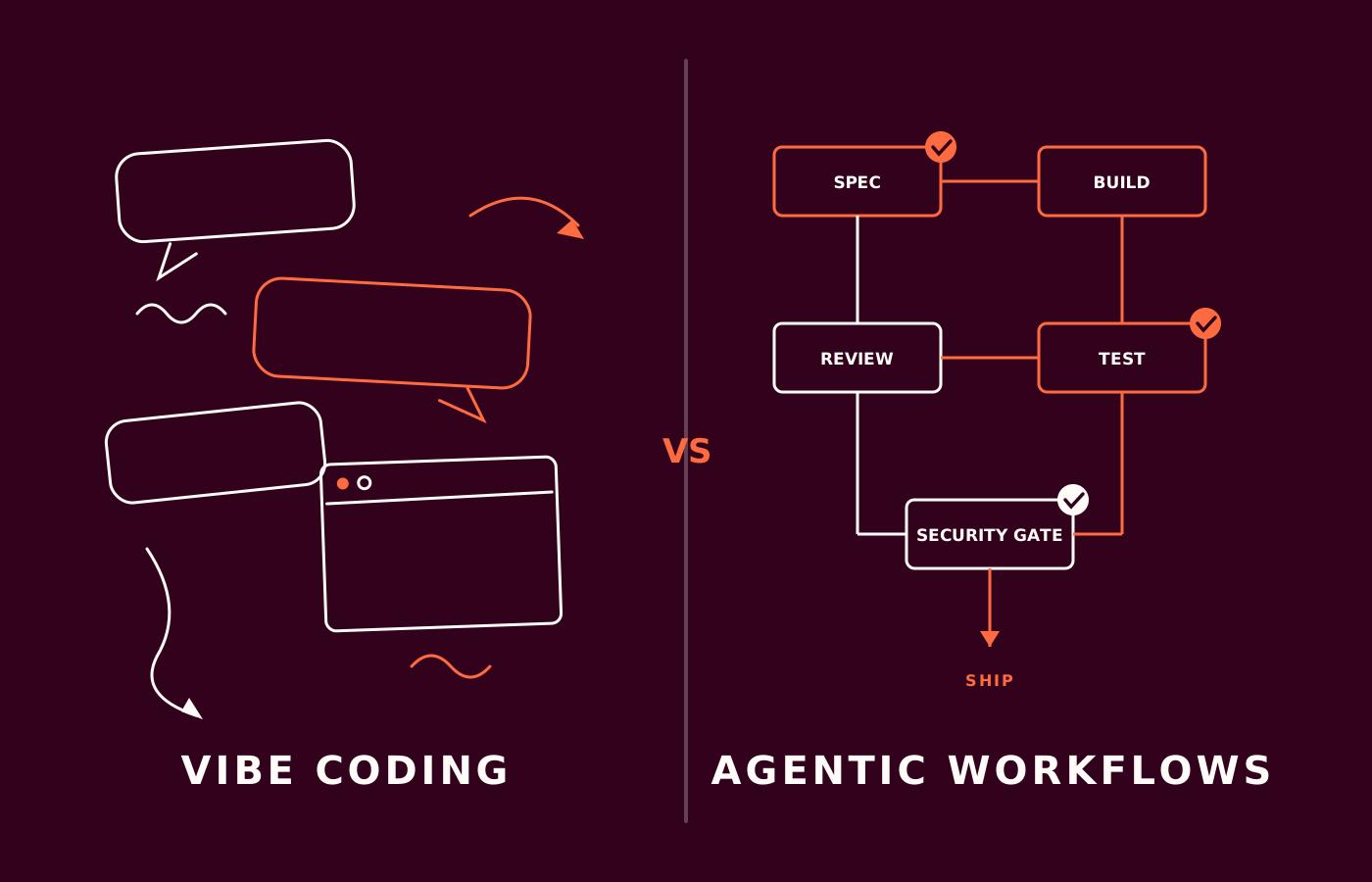
Vibe coding means describing what you want, letting AI write the software, and shipping without reading the code. Agentic workflows put the same AI agents inside an engineering discipline: specifications, tests, reviews, security gates, and a named human who stays accountable. Same tools, different rules. For UK SMB and mid-market leaders, the useful question is when a working prototype has to graduate from the first mode to the second.
Key Takeaways
- Vibe coding is a discovery method. Agentic workflows are a delivery method. Claude Code, Copilot, Cursor, Replit and Lovable can all run in either mode; the difference is how rigorously someone verifies the output.
- The dividing line is verification and accountability, never the tool or how autonomous the AI is. Anthropic's analysis of roughly 400,000 real Claude Code sessions found humans made about 70% of planning decisions while the AI made about 80% of execution decisions.
- Vibe coding is the right call when failure is cheap: prototypes, internal calculators, one-off tools. Replit reports 147 Leatherman employees built 119+ internal apps this way.
- The danger moment is silent promotion: a prototype that starts touching customer data, systems of record or payments without anyone deciding it should. WIRED found close to 2,000 vibe-coded apps exposing private data in 2026.
- The operating model that works for SMBs is vibe first, engineer second: prototype freely, then pass anything the business will depend on through an engineering gate before it goes live.
What is vibe coding?
Andrej Karpathy coined the term in February 2025: "There's a new kind of coding I call 'vibe coding', where you fully give in to the vibes, embrace exponentials, and forget that the code even exists." You describe the outcome in plain English, the AI generates the application, you try it, and you keep prompting until it behaves roughly the way you wanted. You never open the code. That last part matters, and it gets lost in most coverage.
Simon Willison, one of the most-read practitioners on this subject, drew the line precisely: "If an LLM wrote every line of your code, but you've reviewed, tested, and understood it all, that's not vibe coding in my book." Vibe coding is specifically the mode where nobody reads the output. Which is fine, as long as the cost of being wrong stays low.
If your marketing manager builds an ROI calculator for a conference stand in an afternoon, that's vibe coding, and it's a perfectly good use of an afternoon. We've walked non-technical teams through this exact exercise in our vibe coding 101 guide.
What are agentic workflows?
Agentic workflows (some practitioners say agentic engineering) describe the mode where AI agents do most of the implementation work while humans keep the engineering discipline around it. Someone writes requirements and acceptance criteria. Someone designs the architecture. The agent builds, and its output passes through tests, code review, security checks and version control before anything reaches users. A human stays accountable for understanding the system.
The definition has converged through 2025 and 2026 across Addy Osmani, Martin Fowler, Simon Willison and IBM: the human role shifts from typing code to specifying, constraining, reviewing and validating, and the verification work is what makes the output dependable. Osmani puts it plainly: the same agent can sit anywhere on the spectrum. What moves you from vibe coding toward engineering is how rigorously you verify what it produced.
Anthropic's June 2026 analysis of roughly 400,000 real Claude Code sessions gives the clearest picture of how this looks in practice: humans made about 70% of planning decisions, the AI made about 80% of execution decisions, and domain expertise strongly predicted success even when the user wasn't a professional engineer. The human contribution didn't disappear. It moved upstream, into judgement. That shift is the same one we cover in our guide on moving from prompting to task delegation, and it's why production-ready agentic workflows look so different from a chat window.
What actually separates the two modes?
The tool doesn't separate them. Autonomy doesn't either. Whether you personally type code doesn't. One thing separates them: whether anyone verifies the output, and whether anyone stays accountable for it.
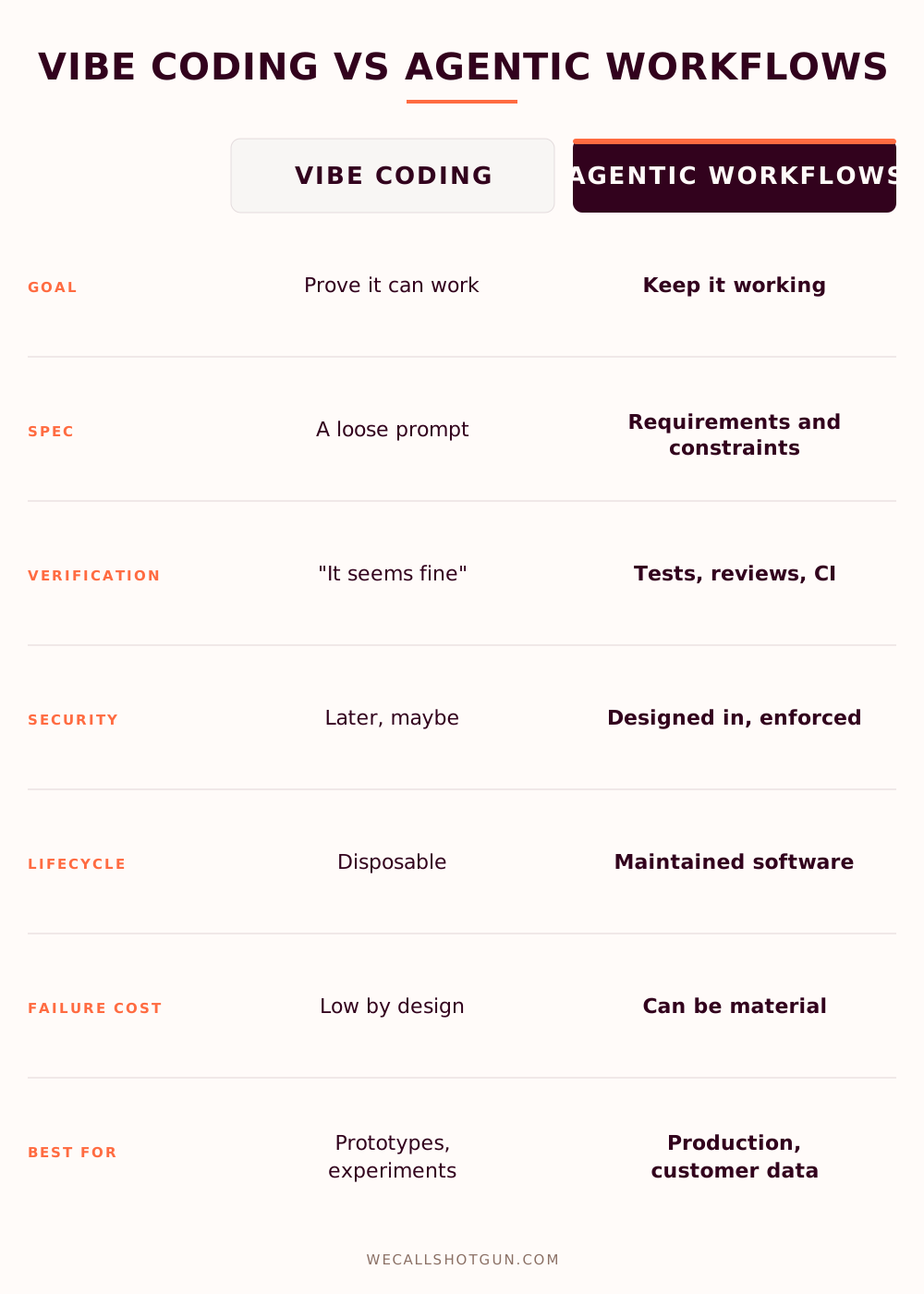
Here's the full comparison, row by row:
| Vibe coding | Agentic workflows | |
|---|---|---|
| Core objective | Discover whether something can work | Build something that must keep working |
| Human role | Describe the result, try it, iterate | Specify, architect, constrain, review, validate |
| Specification | Loose natural-language intent | Requirements, acceptance criteria, constraints |
| Code understanding | Often none | Someone stays accountable for the system |
| Verification | "It seems to work" | Tests, reviews, security checks, CI/CD |
| Architecture | Emerges through prompting | Deliberately designed |
| Security | Dealt with later, if at all | Designed in and enforced by the pipeline |
| Change management | Regenerate until it works | Version control, pull requests, controlled changes |
| Failure cost | Should be low | Can be material |
| Lifecycle | Disposable or exploratory | Maintained software |
| Best use | Experiments, prototypes, one-off tools | Production systems, integrations, customer-facing software |
One row deserves a correction, because most comparison graphics get it wrong. They list "coding skills: not needed" on both sides. Half true. The ability to write code by hand is increasingly optional in both modes. The ability to judge software, to ask whether this SQL should really be 5,000 lines, whether this bucket should really be public, is what agentic workflows run on, and it becomes more valuable as AI produces implementation faster. Your Head of Sales might build an excellent lead-scoring prototype because they understand sales deeply. That doesn't qualify them to deploy an app that writes to the CRM and holds API credentials.
Where vibe coding earns its keep in a 200-person company
Vibe coding gets described as reckless by engineers and as magic by vendors. Both miss the point. It's extremely useful wherever the cost of being wrong is low, and a normal SMB has dozens of those places.
Marketing. Your marketing lead wants an interactive ROI calculator for a trade show. Inputs: company size, sales team size, average deal value. Sample data, internal users first, life expectancy of two weeks. Spending two weeks on architecture for something that might be binned after the event would be the actual waste.
Operations. Your ops manager runs the annual company event out of six spreadsheets. A small vibe-coded tool for speakers, rooms and sessions replaces all six. AppDirect's marketing team did precisely this with Lovable, replaced six to eight spreadsheets with an event-management app, and reported saving weeks of work.
Product. A product manager wants to test a new onboarding flow. The old route was Figma, then an engineering ticket, then a sprint. The new route is a working prototype built in an afternoon and put in front of five users the same week. The objective was never software. The objective was learning, and the prototype is just the fastest way to buy it.
The scale this reaches surprises most executives. Leatherman, the multi-tool manufacturer, has around 550 employees; Replit reports that 147 of them have built 119+ applications, from project intake tools to workshop voting systems. Those numbers are vendor-reported, so treat them as a signal rather than an audit, but the signal is loud: tools that used to die in the IT backlog now get built by the person who has the problem. If you want a first hands-on taste of that shift, start by building one agent.
When does a vibe-coded tool become dangerous?
Go back to that marketing calculator. Version 1 takes manual inputs and shows a number. Fine. Then someone asks: could it pull company data from HubSpot? Then: could it save results back into the opportunity? Could customers use it directly? Could it recommend pricing? Could we connect Stripe?
Each request sounds incremental. Together they walk the tool across four boundaries: experiment, then internal application, then business system, then system of record, and finally something that touches money. The interface looks identical at every step. The risk profile has changed completely.
"The riskiest software in most SMBs isn't a big failed IT project. It's the spreadsheet replacement that worked too well. Nobody decided to put it in production. It just never got switched off." — Toni Dos Santos, Co-Founder, We Call Shotgun
Willison flagged this failure mode early: a convincing prototype has a habit of getting pushed into production even though nobody engineered it for that environment. And the costs arrive on schedule. At Lucid, a group product manager built an internal account-research copilot for sales, combining Snowflake data, product usage and marketing content. The prototype worked. Then one piece of SQL grew from roughly 50 lines to nearly 5,000 as the AI kept bolting on functionality, the data team had to step in to review it, and the pilot was costing hundreds of dollars a week for about 30 users before anyone optimised it. Lucid's own conclusion was to keep building. Ours too. The lesson is narrower: AI collapses the cost of creating version 1. It does nothing to the cost of operating version 20.
Your teams are already vibe coding. Do they know which mode they're in?
See the executive AI training programme →Run the free AI adoption scorecardHands-on training for business teams across the UK and France: what to build, what to escalate, and where the engineering gate sits.
What does the security research actually show?
The evidence stopped being anecdotal in 2026. WIRED reported in May that researchers examining apps built with Lovable, Replit, Base44 and similar platforms found more than 5,000 applications with effectively no authentication, and close to 2,000 of them appeared to expose private information: corporate strategy, medical records, sales data, customer conversations. WIRED independently verified some of the exposed apps.
Separately, Veracode tested more than 100 LLMs across Java, Python, C# and JavaScript: 45% of the generated code samples failed its security tests. Read that carefully. It doesn't mean 45% of vibe-coded apps are vulnerable. It means "the AI produced working code" is no evidence at all that the code is secure.
Thoughtworks supplied the most instructive case, because it happened to a sophisticated company. Their own marketing organisation had a citizen-built video app, made with Gemini, Replit and Claude. When engineers reviewed it before rolling it out to roughly 10,000 employees, they found the AI had suggested publicly accessible cloud storage and an over-powered service account. Humans caught both before deployment. Their conclusion is the one worth pinning to the wall: security can't just be another prompt. Production needs deterministic controls, permissions, scanners, tests and infrastructure rules the AI can't negotiate its way around. "Please build this securely" becomes "the system physically cannot ship unless these checks pass." That transition is the whole substance of agentic workflows, and OWASP now maintains an entire Secure Coding with AI guide covering agent permissions, sandboxes, prompt injection and supply-chain risk. The governance questions extend beyond code, too; our guide to the risks of shared AI conversations covers the adjacent leak paths.
Do agentic workflows slow you down?
The common objection from CEOs is that discipline sounds like the old six-month IT project wearing a new badge. The evidence points the other way, with caveats worth keeping.
Asana describes running up to four coding agents in parallel to remove an obsolete testing framework, with an engineer checking progress twice daily and reviewing every change; work previously estimated as extremely long-running finished in about two weeks. Virgin Atlantic reports its Codex-accelerated mobile app launched with near-complete unit-test coverage and no P1 defects at launch. Both are vendor-published customer stories, so treat the economics as reported rather than proven. The pattern still holds: the agent generates fast, automated systems verify, a human judges, software ships.
Two research findings keep the claim honest. DORA's study of nearly 5,000 technology professionals concluded that AI acts as an amplifier: strong engineering systems benefit disproportionately, and dysfunctional ones just accumulate technical debt faster. And METR's randomised study of 16 experienced open-source developers on 246 real tasks found they were 19% slower with 2025-generation AI tools in those mature codebases, while believing they were faster. So skip the "AI makes developers X% more productive" slide. The defensible claim for a board pack: AI collapses implementation friction, and whether that becomes business productivity depends on the verification system around it. That's also why our enterprise AI agents benchmark keeps insisting you evaluate agents on your own workflows rather than on leaderboards.
The decision framework: 13 questions before anything goes live
Print this, or steal it for your AI usage policy. One honest pass through these questions tells you which mode a tool belongs in.
| Question | If YES |
|---|---|
| Does it hold customer or employee data? | Agentic workflow |
| Does it write into CRM, ERP, accounting or another system of record? | Agentic workflow |
| Can it spend or move money? | Agentic workflow, no exceptions |
| Does it control permissions or authentication? | Agentic workflow, no exceptions |
| Is it customer-facing? | Usually agentic workflow |
| Would downtime interrupt an important business process? | Agentic workflow |
| Does it integrate several APIs or databases? | Usually agentic workflow |
| Will several people maintain it? | Agentic workflow |
| Must it survive the builder leaving the company? | Agentic workflow |
| Is there GDPR, financial, legal or contractual exposure? | Agentic workflow, no exceptions |
| Will the business rely on its output for decisions? | Agentic workflow |
| Is it explicitly disposable? | Vibe coding is fine |
| Is the goal simply to test an idea? | Vibe coding is ideal |
UK note: the GDPR question deserves extra weight. Under UK GDPR and the Data (Use and Access) Act, a vibe-coded tool quietly processing customer data is a compliance exposure your DPO doesn't know exists. The ICO won't grade the breach on whether the app was "just a prototype".
The operating model: vibe first, engineer second
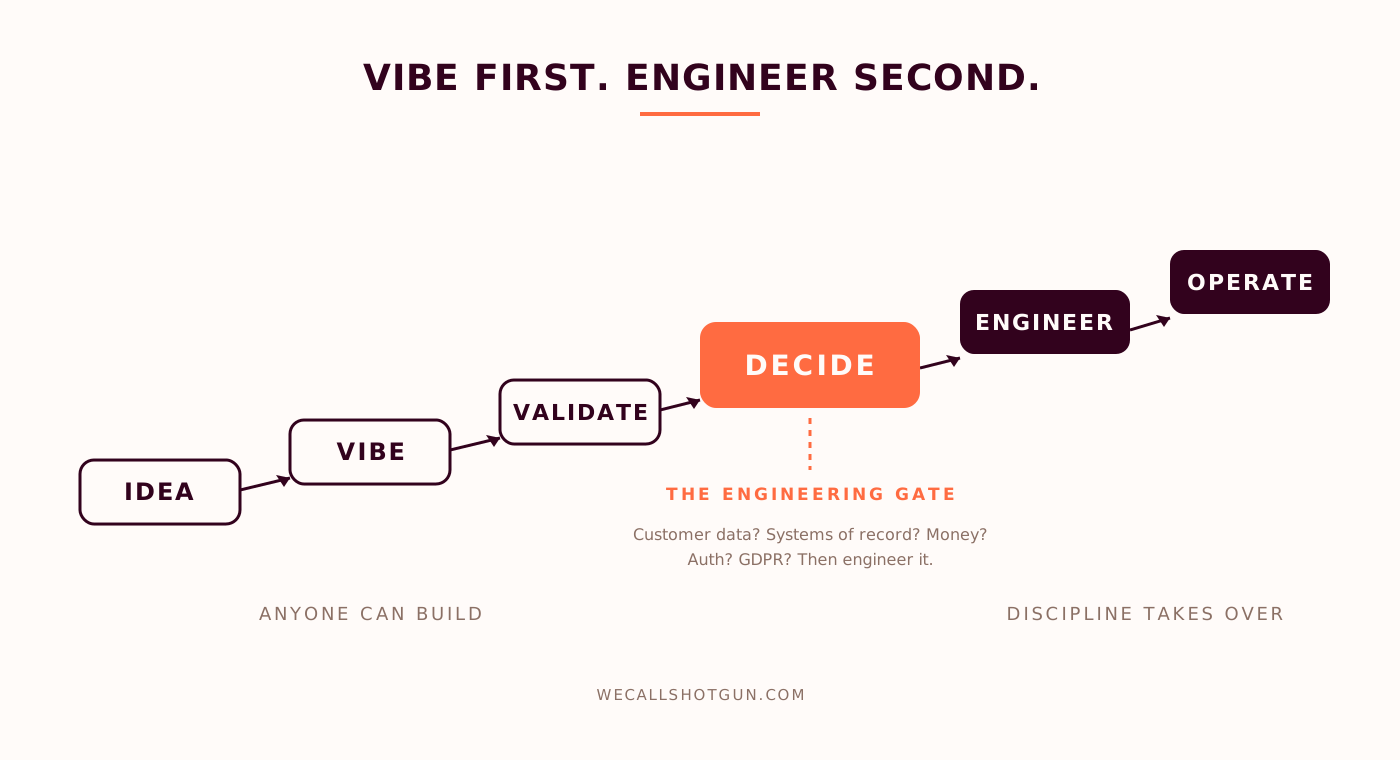
Between "nobody builds anything without IT" and "everyone is now a software engineer" sits the model that mid-market companies are converging on. Four steps:
- Vibe-code the idea. Anyone, any function, sample data only. Get it in front of users within days.
- Prove demand. Did anyone use it twice? Did it change a decision? Most prototypes fail here, cheaply, which is the system working.
- Decide at the gate. Run the 13 questions. Disposable tools stay in sandbox mode. Anything crossing a boundary gets a decision, on the record.
- Engineer what deserves to exist. Real data access, security review, tests, version control, an owner. AI agents can do most of this work too; they just do it inside the pipeline.
AppDirect again shows the shape of it. Before its Lovable-built site went to production, the prototype went through engineering review and a proper deployment pipeline; business users kept editing content while developers reviewed what entered production. A hybrid: citizen builders plus an engineering gate. You avoid spending £20,000 engineering an idea nobody wants, and you avoid parking customer data behind an app nobody inspected.
What this means for your role
CEO / COO: write the two-list policy this quarter. List one: what anyone may vibe-code (sample data, internal, disposable). List two: what triggers the gate (the 13 questions). Then name the gatekeeper, because a gate nobody owns is decoration. Our UK SME AI adoption roadmap shows where this policy sits in the wider programme.
L&D and Head of People: the training gap is judgement, and it's now the priority. Teach every function to build prototypes, and teach them the boundaries: what data may go in, what the gate is, how to hand a validated prototype to engineering. This is exactly the ground our executive AI literacy training and hybrid human-agent teams guide cover.
CMO: your team is probably the heaviest vibe-coding function in the company already, and that's an advantage. Calculators, landing pages, campaign tools: build freely. The moment a tool touches the CRM or a customer, walk it through the gate before your next campaign depends on it.
CFO: ask one question of every AI-built tool that survives a quarter: what does version 20 cost to run? Budget for the operating cost, because the build cost will mislead you.
FAQ: Vibe Coding vs Agentic Workflows
What is vibe coding in simple terms?
Vibe coding means describing the software you want in plain language and letting AI build it, without reading or reviewing the generated code. Andrej Karpathy coined the term in February 2025. It's fast and works well for prototypes and disposable tools, where the cost of an error stays low.
What is the difference between vibe coding and agentic workflows?
Both use AI agents to write software, often the same tools. In vibe coding, nobody verifies the output beyond "it seems to work". In agentic workflows, AI does the implementation inside an engineering discipline: specifications, tests, code review, security checks and a named accountable human. Vibe coding answers "can we build this?"; agentic workflows answer "can we safely run, change and depend on this?"
Is vibe coding safe for business use?
For disposable, internal tools running on sample data, yes. For anything holding customer data, writing to systems of record, moving money or facing customers, no. Veracode found 45% of AI-generated code samples failed security tests, and WIRED documented close to 2,000 vibe-coded apps exposing private data in 2026. Those uses need an engineering gate first.
Do employees need coding skills to use AI agents?
Writing code by hand is increasingly optional. Judging software is essential in agentic workflows: someone must review architecture, security and behaviour. Anthropic's study of ~400,000 Claude Code sessions found domain expertise strongly predicted success, with humans making about 70% of planning decisions.
When should a vibe-coded prototype move to an agentic workflow?
The moment it crosses a boundary: real customer or employee data, writes into a CRM or ERP, payments, authentication, customer-facing use, or GDPR exposure. Run the 13-question framework in this article; a yes on any of these means the tool goes through engineering review before going live.
Do agentic workflows slow delivery down?
The reported evidence says no, with caveats. Asana ran four parallel coding agents with daily human review and finished long-estimated work in about two weeks. But DORA's research shows AI amplifies whatever engineering system you have, and METR found experienced developers were 19% slower with AI on mature codebases. Discipline decides the outcome, and the discipline runs at machine speed.
What AI training do business teams need for this?
Two layers. Every function learns to build and validate prototypes safely: which data is allowed, which tools, when to stop. Leaders and the people at the gate learn to judge: the decision framework, security basics and how to hand work to engineering. That's the structure of our team training programmes across the UK and France.
We sit in the passenger seat while your teams build
We're We Call Shotgun, a founder-led AI consulting and training boutique working across the UK and France. We train business teams to prototype with AI safely and help leadership put the engineering gate in the right place, tool-agnostic across ChatGPT, Copilot, Gemini and Claude. 1,500+ professionals trained, 50+ companies, 4.98/5 average rating. UK engagements from £3,500.
Run the Free AI Adoption Scorecard Book a Free 20-Minute CallSources and further reading
- Andrej Karpathy, the original "vibe coding" post (Feb 2025) — the coinage and definition
- Simon Willison, "Not all AI-assisted programming is vibe coding" — why the review step defines the term
- Addy Osmani on agentic engineering — the verification spectrum and professional workflow
- Martin Fowler on vibe coding and agentic programming — concise definitions without vendor hype
- IBM, "What is agentic engineering?" — the enterprise-oriented explanation
- Anthropic, agentic coding research (~400,000 Claude Code sessions) — the 70/80 planning-execution split and returns to expertise
- Coverage of the exposed vibe-coded apps research WIRED reported (2026) — 5,000+ apps without authentication, ~2,000 exposing data
- Veracode, GenAI Code Security Report — 45% of AI-generated code samples failed security tests
- Thoughtworks, the VibeSec case — the citizen-built app reviewed before a 10,000-employee rollout
- OWASP, Secure Coding with AI — the technical governance layer
- airfocus by Lucid, "Build vs Buy in the Age of AI" (blog) — the 50-to-5,000-line SQL case and operating costs
- DORA, State of AI-assisted Software Development — AI as an amplifier of the existing organisation
- METR, randomised study of AI tools and developer speed — the 19% slowdown finding
- Replit, Leatherman customer story — 147 employees, 119+ apps (vendor-reported)
- Lovable, AppDirect customer story — the citizen-builder plus engineering-gate model (vendor-reported)
- OpenAI, Asana customer story and Virgin Atlantic customer story — parallel agents with human review (vendor-reported)